
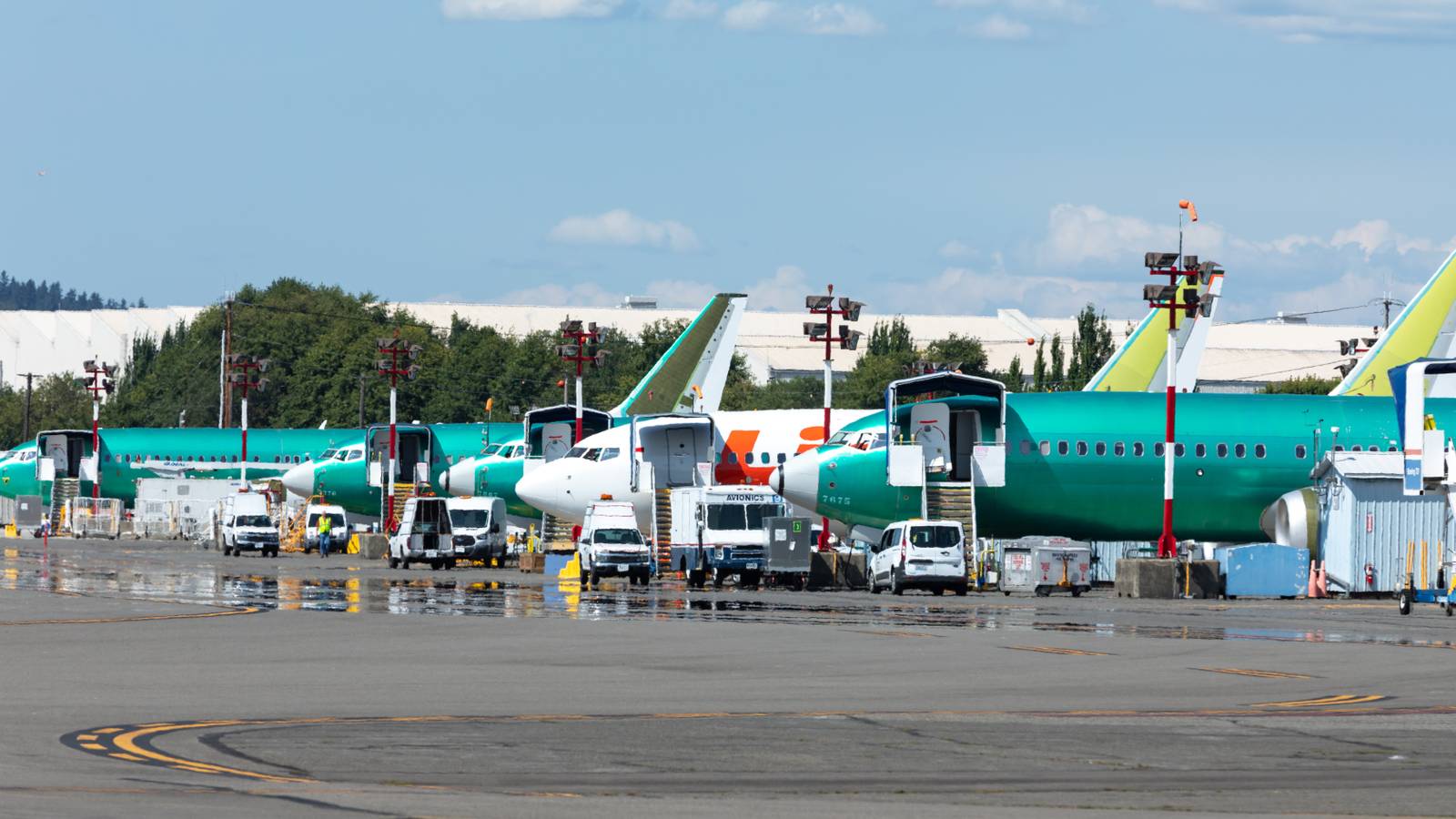
Published Nov 21, 2026, 4:14 PM EST Jack comes to Simple Flying with a lifelong interest in all things aviation. He holds a degree in Aerospace Engineering from Georgia Tech, and is a certified private and remote pilot. Beyond these experiences, Jack previously worked for a corporate flight department where he gained first-hand experience in the world of business aviation. Currently, Jack works in the professional services industry and continues to build his flight hours outside of work. Boeing declined on Thursday to tell one of its largest unions whether further layoffs will follow a round planned for next month, even as the company struggles to lift Boeing 737 MAX output from 42 jets a month to 47, a rate it had expected to reach this past summer. The company announced earlier in November that it would cut 5% of the roughly 50,000 employees in its commercial airplanes division, and it now expects to reach 47 jets a month in early 2027, according to reporting by Reuters. Bryan Corliss, a spokesperson for the Society of Professional Engineering Employees in Aerospace (SPEEA), said the union asked whether December 9 was the only date for layoff notices and was told Boeing did not know. Managers told union officials that employment at every commercial airplane site is under review, that the cuts will be targeted at work statements that are ending or can be ended rather than applied across the board, and that no voluntary layoffs or buyouts will be offered. A Wing Shortfall At The Root Of The Slowdown Credit: Thiago B Trevisan | Shutterstock The 737 MAX is Boeing’s best-selling jet, and the company had planned to reach the 47-a-month rate by summer 2026. The bottleneck behind the delay is the wing line, where Chief Executive Kelly Ortberg told analysts in late October that Boeing was not yet stably producing wings in the volume needed for 47 jets a month, while acknowledging that some process improvements intended to speed the flow had not delivered the expected savings. Boeing will miss its 2026 production and delivery targets, and Chief Financial Officer Jay Malave said the company will fall short of its goal of delivering 500 737s this year, though the company has not said by how much. A shortage of wings also limits the usefulness of added assembly staff, since workers downstream cannot build jets without them, which helps explain why strong demand and layoffs can coexist. The longer-term schedule has moved accordingly, since Boeing is targeting 52 jets a month in the second half of 2027 and Ortberg said the company must first demonstrate sustained performance at 47, with no significant increase in output expected before then. How The Cuts Were Announced And Sized Credit: Coby Wayne | Shutterstock Stephanie Pope, chief executive of Boeing Commercial Airplanes, told employees in a November 9 memo that the division would reduce headcount by roughly 5% through attrition and involuntary layoffs, with notifications starting in December. She said adjusting production schedules and lowering output leaves the unit in an overstaffed position, and that Boeing needed to reset its ramp pace to give factories and suppliers more time to stabilize. Pope also noted that Boeing has made significant investments in talent, training, and infrastructure over the past two years, a point that frames the reduction as a recalibration rather than a retreat. Boeing has not published a headcount target, and it has declined to name affected locations, divisions, or programs. Applying 5% to the 50,494 people the division employed in December 2025 implies about 2,500 positions, a figure reported by observers rather than confirmed by the company. The reset also affects suppliers, whose own schedules were built around a faster ramp, although the sources reviewed do not quantify any changes to supplier orders. Labor Relations And The Road Ahead Credit: Coby Wayne | Shutterstock The timing is sensitive for the labor relationship, because SPEEA, which represents engineers and technical employees at Boeing, ratified a new four-year contract in early October, roughly five weeks before the layoff announcement. The agreement includes a guaranteed ten percent raise on ratification, annual increases of 4% , and a possible additional 2% tied to performance. Boeing managers told the union that the layoffs are not retaliation for that agreement. The backdrop is unusual for a manufacturer with strong demand, since a record backlog of $745 billion was reported alongside the cuts. That pairing suggests the constraint is throughput, not orders, and it frames what to watch next: whether the December 9 notices are the last, whether wing output holds at 47 in early 2027, and whether the step to 52 arrives on schedule in the second half of that year. Boeing’s fourth-quarter results should offer the next formal update on that timeline.
Boeing Weighs More Layoffs As 737 MAX Output Boost Slows
Full Article
Original Source
Read the full article at Simpleflying →KhanList aggregates and links to publicly available news content. We do not host full articles from third-party sources. Always verify important information with original sources.