
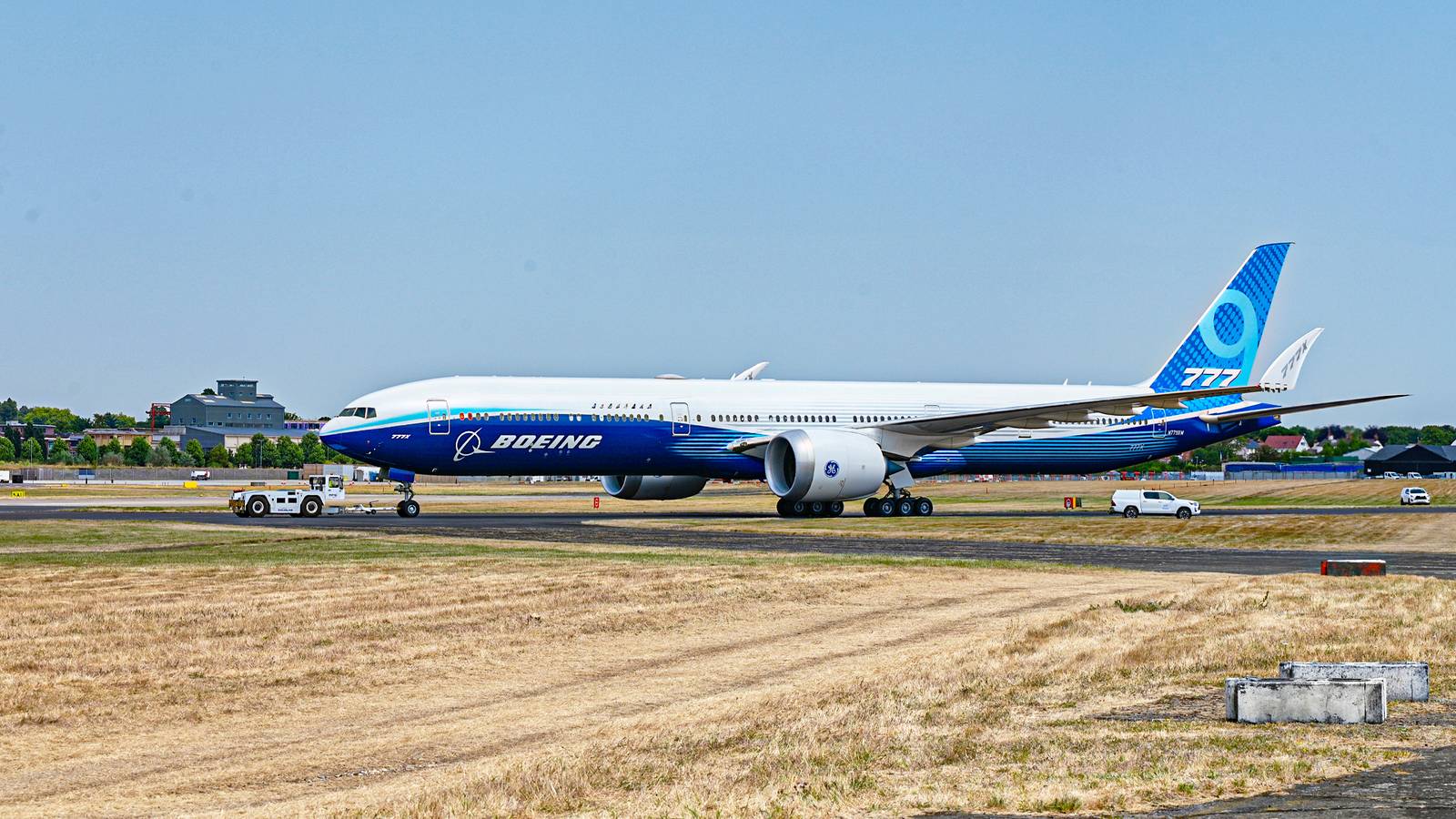
Published Nov 19, 2026, 7:00 AM EST Daniel comes to Simple Flying with a business focused approach to the aviation world. Daniel enjoys analyzing strategy and how companies move against each other to gain a step ahead in the skies. Besides strategy, Daniel also has a passion for aircraft design and the history of aviation. Based in New York One of the Boeing 777X's most famous new features is its folding wingtips. They're roughly 11 feet (3.5 meters) wide each and are designed to be folded up whilst on the ground, allowing the aircraft to use the same airport facilities as older 777 models. They extend before takeoff and remain fully extended until after landing. Interestingly, it's the pilots' responsibility to extend the wingtips before takeoff, but the wingtips retract automatically after landing as the aircraft decelerates on the runway. The 777X is a massive upgrade of the legacy 777 airframe, featuring a fuselage stretch, a redesigned interior, new engines, and a new carbon composite wing. It's significantly larger than the wing on the older 777 models, meaning that it produces more lift than before. This cuts down on fuel burn and allows the aircraft to have much improved performance on long-haul services. It's one of the most important changes for the 777X, and the wingtips help ensure operational flexibility for the aircraft's customers. How The 777X's Wingtips Are Operated Credit: Aerospace Trek | Shutterstock The last 11 feet (3.5 meters) of the wings on the 777X can fold upwards, decreasing the 777X's wingspan from 235 feet five inches (71.76 meters) to 212 feet nine inches (64.84 meters). The wingtips themselves are carbon-composite and use a hydraulically driven hinge system to move between positions. The transition takes roughly 20 seconds, and once in place, electric locking pins hold the wingtips in place, preventing them from moving into the other position on their own. The pilots control the mechanism via a simple knob on the overhead panel, while the position of the wingtips is displayed on the aircraft's EICAS screens. The pilots' pre-departure checklist actions now include switching the wingtips into their unfolded position, with the EICAS icon also displaying whether the wingtips are moving. If the crew members attempt to take off with the wingtips folded, the aircraft's master warning horn will sound, alerting them to the error. Curiously, while the pilots manually move the wingtips before takeoff, they do not do so after landing. Rather, after decelerating below 50 knots, the aircraft automatically folds the wingtips while the overhead switch pops into place. While it's the crew's responsibility to verify afterwards that the wingtips are folded, it's not an action they're meant to regularly perform after landing. In normal circumstances, manually retracting the wingtips after landing is not an action that crews will be expected to perform. The Pre-Departure And After-Landing Flows Credit: Ian Dewar Photography I Shutterstock The main appeal of the folding wingtips is to allow the 777X to use the same gates and taxiways as prior 777 models. The plane's full wingspan pushes it into ICAO Code F standards, whereas older 777s were Code E aircraft. With the wingtips folded, the 777X has the same wingspan as older 777s on the ground, which means that the wingtips are only meant to be extended shortly before takeoff. Therefore, it's part of the pre-departure checklist that pilots run right before lining up on the runway. Because of how much extra span the wingtips add when fully extended, they can pose a collision hazard to other aircraft taxiing around the airport and near the runway. Therefore, the pilots are responsible for ensuring that they have appropriate clearance from other aircraft before they extend these massive wingtips. The crew are the ones watching the aircraft's surroundings and can judge when they have enough space to extend the tips without striking another aircraft. Upon landing, the wingtips are no longer necessary, and the crew would ideally fold them as soon as possible. However, the flight deck during the rollout can be a chaotic environment, as crews simultaneously need to safely decelerate the aircraft, maneuver it off the runway, and reconfigure the plane while performing checklist items. As such, the wingtips fold automatically after landing, as this reduces pilot workload. During this phase, it's not necessary for the pilots to judge when it's appropriate to retract the wingtips. Why The 777X's Wingspan Is So Big Credit: billlinphotos I Shutterstock The folding wingtips are a significant innovation. It's the first time that such technology has been applied to a commercial airliner, and it represents a major achievement to design such a system that can function safely and reliably. However, designing folding wingtips is also expensive, while the system itself adds weight, costs, and complexity. It's necessary to allow 777X operators to use the same ground facilities as other widebody types because the 777X's wingspan is otherwise much greater than the 777, 787, or A350. The wing is all-new for the 777X, with Boeing having spent an estimated $2 billion on just this part of the program. While the outgoing 777-300ER was a hugely successful aircraft, its wing was relatively undersized for the weights that the aircraft routinely flew at on its typical long-haul missions. To compete against the A350-1000, which delivered significantly better performance and economics at roughly the same size as the 777-300ER, the 777X would need a new wing. The wing itself is the widest that Boeing has ever built, as its span is even greater than that of the 747-8 (although the 747-8's wing is larger by area). It was necessary to give the 777X more lift during the initial cruise when fully loaded, allowing it to fly higher and burn less fuel. The aircraft also requires less thrust during takeoffs, allowing the 777X's General Electric GE9Xs to use less thrust. This decreases fuel burn and improves the engine's long-term durability. If the wing were any smaller, then the aircraft would be compromised. The Overall Design Changes For The 777X Credit: Georgi Bidenko I Shutterstock The biggest changes to the 777X are the new wing and the fuselage stretch. The wing is necessary to improve the aircraft's cruise performance on long-haul flights, which is how it will mainly be used. Meanwhile, the 777X still retains the original's heavy metal fuselage, which weighs significantly more than the carbon-composite fuselage on the A350. By stretching the fuselage, the 777X can seat significantly more passengers than the outgoing model, while the weight gain is relatively minor. Underneath the wings on the 777X are two General Electric GE9X turbofans. These are the largest jet engines ever built, and they also hold the record for the most amount of thrust ever produced from a jet engine. They feature a heavier use of advanced materials than any other engine before, making use of materials like ceramic matrix composites (CMCs) to deliver industry-leading thermal efficiency. This significantly cuts down on fuel burn, and the engine is a major leap forward even compared to a powerplant like the 787's GEnx. Current Generation Engines Aircraft Entry Into Service General Electric GEnx Boeing 787 Dreamliner (GEnx-1B) Boeing 747-8 (GEnx-2B) 2011 (747-8) 2012 (787) Rolls-Royce Trent 1000 Boeing 787 Dreamliner (Trent 1000) Airbus A330neo (Trent 7000) 2011 (787) 2018 (A330neo) Rolls-Royce Trent XWB Airbus A350 2015 Pratt & Whitney PW1000G Airbus A320neo (PW1100G) Airbus A220 (PW1500G) Embraer E2 (PW1900G) 2016 (A320neo/A220) 2018 (E2) CFM LEAP Airbus A320neo (LEAP-1A) Boeing 737 MAX (LEAP-1B) Comac C919 (LEAP-1C) 2016 (A320neo) 2017 (737 MAX) 2023 (C919) General Electric GE9X Boeing 777X 2027 (projected) The aircraft features a new cabin and updated flight deck to more closely resemble the cockpit on the 787. Rather notably, Boeing has physically designed new windows that are larger and higher than those on prior models, while also incorporating a dimming function. The aircraft is also meant to have a lower cabin pressure comparable to that of the 787, which is a remarkable target considering that the 777 still has a metal fuselage. While it's a derivative of an existing type, the 777X is an extremely thorough overhaul. The 777X In The Market Credit: Georgi Bidenko I Shutterstock There are three variants of the 777X: the 777-8, the 777-9, and the 777-8F. However, the 777-8 has attracted very few orders, and development is on pause as a result. The 777-8F is being developed and has been reasonably popular for its market, with just over 100 orders in total. This is almost exactly the same amount as the competing A350F. Meanwhile, the 777-9's closest competitor is the A350-1000, and against the Airbus, the 777-9 has actually fared very well. The A350-1000 has received 373 orders, whereas Boeing has received just under 550 orders for the 777-9. Admittedly, 325 of these have come from just two customers (Emirates and Qatar Airways), but it's still a solid showing. The 777-9 is well-suited for airlines needing a large amount of floor space, as well as those that need to move heavy payloads across 15 to 16-hour routes. As it stands, however, the A350-1000 can fly farther and can carry more payload near the edge of the 777-9's payload-range envelope. What has kept sales of both types slow is that many 777-300ERs worldwide are young. This is the aircraft that the A350-1000 and 777-9 are meant to replace, but there hasn't been much of a need for most examples to be retired yet. However, the 777-9 is better suited for carriers that want to upsize, as well as A380 and 747 operators. The A350-1000, meanwhile, is still highly effective as a 777-300ER replacement, although it has less floor space and seats fewer passengers.
Boeing 777X Pilots Have To Manually Extend The Wingtips Before Takeoff But Not Fold Up After Landing
Full Article
Original Source
Read the full article at Simpleflying →KhanList aggregates and links to publicly available news content. We do not host full articles from third-party sources. Always verify important information with original sources.