
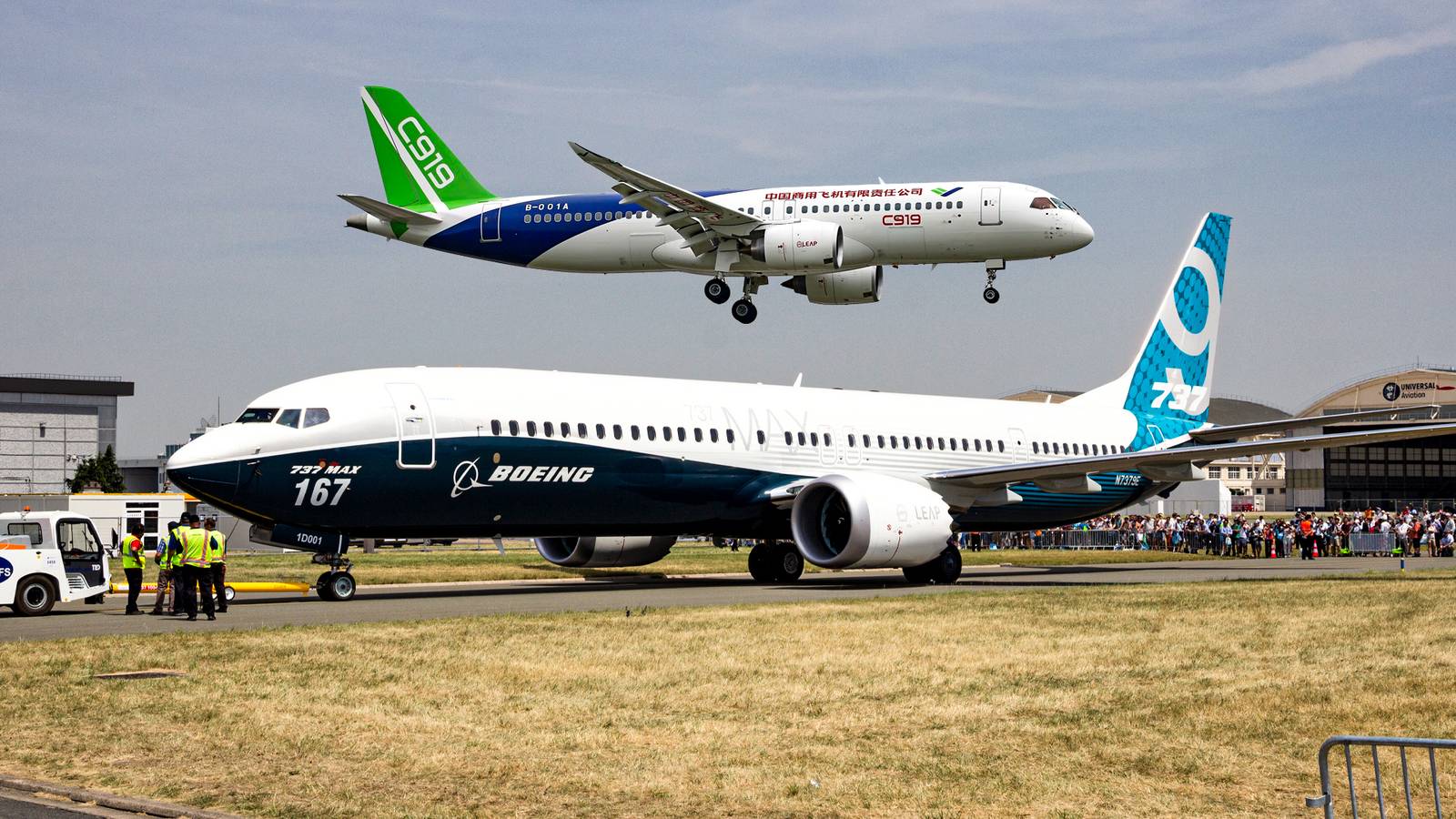
Published Oct 17, 2026, 8:00 AM EDT Louis is a military historian and the staff writer for History of War magazine, a leading military history monthly. He also has an interest in private and commercial aviation. The Boeing 737 MAX and Comac C919 should be direct rivals. They are both future-facing narrowbody airliners that have become a figurehead for the US and China, respectively. Both jets even use the same engine family: the CFM International LEAP (-1B for the 737 MAX and -1C for the C919). Yet, these homegrown jets stack up poorly against each other. The C919 is sold only to Chinese airlines, while the 737 MAX flies worldwide. It has also suffered worse production issues than the 737 MAX, partially due to 2025's suspension of LEAP-1C engine export licenses. On the other hand, the C919 has had no fatal accidents or hull losses in service, while the 737 MAX has suffered some of the worst air crashes in recent history. Comparing The Capabilities There are immediate similarities between these two aircraft. These include comparable maximum takeoff weight between the smallest 737 MAX variant and the C919, as well as similar height and wingspan. Meanwhile, the C919 has a significant length and capacity advantage over the MAX 7, while it is close to the 737 MAX 8. The C919's main deficiency compared with the 737 MAX is its range, which is about 900 nautical miles (1,700 km) shorter than the MAX's lowest-range variant (737 MAX 10). This lower range makes sense, given that the C919 is mostly restricted to domestic flights within China. The table below compares the specifications for the COMAC C919-100 with the Boeing 737 MAX 7, as these two jets are closest in terms of maximum takeoff weight: Characteristic C919-100 737 MAX 7 Seating 164 (China Eastern) 135 to 160 (standard two-class) Length 127 feet, 8 inches (38.9 meters) 116 feet, 8 inches (35.6 meters) Height 39 feet, 3 inches (11.95 meters) 40 feet, 4 inches (12.3 meters) Wingspan 117 feet, 6 inches (35.8 meters) 117 feet, 10 inches (35.9 meters) Range 2,235 nautical miles (4,139 kilometers) 3,800 nautical miles (7,040 kilometers) Maximum takeoff weight 166,000 lb (75,100 kg) 177,000 lb (80,280 kg) Although they have similar silhouettes, the C919 is clearly less advanced. One sign of this is its heavy reliance on traditional metal alloys. Nearly 80% of the aircraft uses steel and duralumin. Only 12% of the aircraft's weight is accounted for by composite materials. 74% of the weight is from aluminum-lithium alloys. Meanwhile, the 737 MAX uses composites in structures like its winglets and tail cone. The C919 Continues To Suffer Production Challenges The 737 MAX and C919 are at different points in their production journeys, with COMAC yet to find the rhythm needed for a high-volume narrowbody aircraft. Leeham News reports on a forecast from IBA, an aviation consultancy, that is damning for the long-term success of the C919. The consultancy puts the 2026 production rate at just 26 aircraft, with unimpressive accelerations coming. IBA expects 59 deliveries by 2028 and 93 by 2030. Should this delivery rate be achieved, the in-service C919 fleet is set to grow from 31 jets at the start of 2026 to 159 in 2028 and 322 in 2030. The opposite is the case for the 737 MAX. Reuters reported that the US manufacturer delivered 57 of these jets in September, with plans to increase speed further. Boeing said it had achieved a total of 2,399 deliveries for the MAX from August 23 this year. The table below shows the number of C919s in operation for each of its Chinese customers. It includes both leased and owned aircraft, and uses data from Planespotters.net: Airline Number delivered Date of first delivery Air China 12 August 29, 2024 China Eastern Airlines 17 December 8, 2022 China Southern Airlines 13 August 27, 2024 COMAC 7 May 5, 2017 COMAC Express 1 May 25, 2025 This speed is necessary because Boeing has attracted a massive number of orders for its modern narrowbody aircraft. Boeing puts its current backlog at 4,537 737 MAX jets, after adjusting the overall unfilled order sheet by -365 planes. Export Restrictions Have Contributed To The Production Problems The C919 production issues are not solely COMAC's fault. On May 29, Simple Flying's Tatenda Karuwa reported that the US suspended exports of some critical technologies to China. An example includes the LEAP-1C engines that power C919 jets. This was a substantial setback, coming two years after the C919 entered commercial service, too late for alternative engine options to be explored. At the time, only 18 C919s were in service, and reports said the backlog of orders from domestic airlines had reached 1,000 aircraft. A spokesperson for the Chinese Embassy said: "China firmly opposes the US's overstretching the concept of national security, abusing export controls, and maliciously blocking and suppressing China.” YetReuters reported that the export ban was lifted on July 4, 2025. Given the relatively short period this ban stood, COMAC's manufacturing infrastructure has not recovered well. The C919 Has Only Just Crossed International Borders The C919 reached a major milestone in August by completing its first international flight. An Air China C919 flew from Beijing to Ulaanbaatar. Western commentators have downplayed the significance of this flight, since no other modern airliner would make such a splash just for crossing a border. The Guardian reported that Scott Kennedy, a senior adviser at the Centre for Strategic and International Studies, said: “This is essentially a public relations move. Ulaanbaatar was likely chosen because of how close it is to Beijing. It doesn’t change the fact that the plane was years overdue, is composed of western components, and is less efficient than its Boeing and Airbus cousins.” On the other hand, the 737 MAX has risen to become an international workhorse, even taking on transcontinental missions. For example, United Airlines already flies its 737 MAX on transatlantic flights. Destinations include Santiago–Rosalía de Castro Airport (SCQ) (seven hours and 55 minutes), Cristiano Ronaldo International Airport (FNC) (seven hours and 45 minutes), and Glasgow Airport (GLA) (seven hours and 40 minutes). The 737 MAX Crisis The 737 MAX has one substantial failing when compared with the C919. Its Chinese rival has not suffered the MAX's hull losses and groundings. This crisis was several years ago, but it continues to cast a shadow over the narrowbody family. As Simple Flying wrote last October, "The 737 MAX program can no longer be classified as a total failure, but its recovery remains fragile," a statement that remains relevant today. Henrico Dolfing’s case study estimates total direct losses at $19 billion to $20 billion. The crashes, groundings, and compensation to airlines will forever be one of history's most expensive aviation crises. It also challenged the long-standing assumption that Boeing could be trusted to provide safe aircraft for global aviation. Problems with the 737 MAX after the October 2018 and March 2019 tragedies have further slowed its ability to recover. In December 2024, the FAA delivered a report on the 737 MAX 9. It reflected on the January 2024 door-plug incident that grounded aircraft, and on worrying quality-control issues. "We will continue our aggressive oversight of the company and ensure it fixes its systemic production-quality issues," the FAAwrote. The C919 and 737 MAX Comparison Is Geopolitical Rather Than Industry-Relevant Boeing clearly has no reason to be concerned by the C919. Its main competitors come from other Western manufacturers, particularly Airbus with jets like the A321neo and A321XLR. The dynamic at play is more geopolitical, with both COMAC and Boeing taking on significance that has transcended the aviation industry. The C919's political significance is obvious, given that it is owned by the Chinese state. It gives the authoritarian giant a way to challenge the dominance of Western manufacturers like Boeing and Airbus in the aviation sector. COMAC wants to gain a foothold in the Asia-Pacific region, the world's fastest-growing part of the industry, as the Chinese government battles to pull nations in this area into its sphere of influence. Asia-Pacific is also an area of huge potential for COMAC, with the region's airlines struggling with delivery delays from Airbus and Boeing. "We have been waiting for this for a long time. COMAC is a welcome introduction. We need more suppliers in the Asia Pacific especially," said Subhas Menon, director general of the Association for Asia Pacific Airlines (AAPA), the BBC reports. Boeing and the 737 MAX are independent enterprises, but they are still closely tied to the US. It is a mutually beneficial relationship. Boeing is one of the US's top exporters by dollar value, so its health directly impacts the nation's jobs and its manufacturing sector, while government support can help Boeing grow its order book. This was seen in May 2025, when Qatar Airways signed a $96 billion deal for up to 210 Boeing widebody jets during President Donald Trump's Middle East tour, Boston Warwick notes.
Boeing 737 MAX Vs. COMAC C919: How These Homegrown Airliners Stack Up In 2026
Full Article
Original Source
Read the full article at Simpleflying →KhanList aggregates and links to publicly available news content. We do not host full articles from third-party sources. Always verify important information with original sources.