
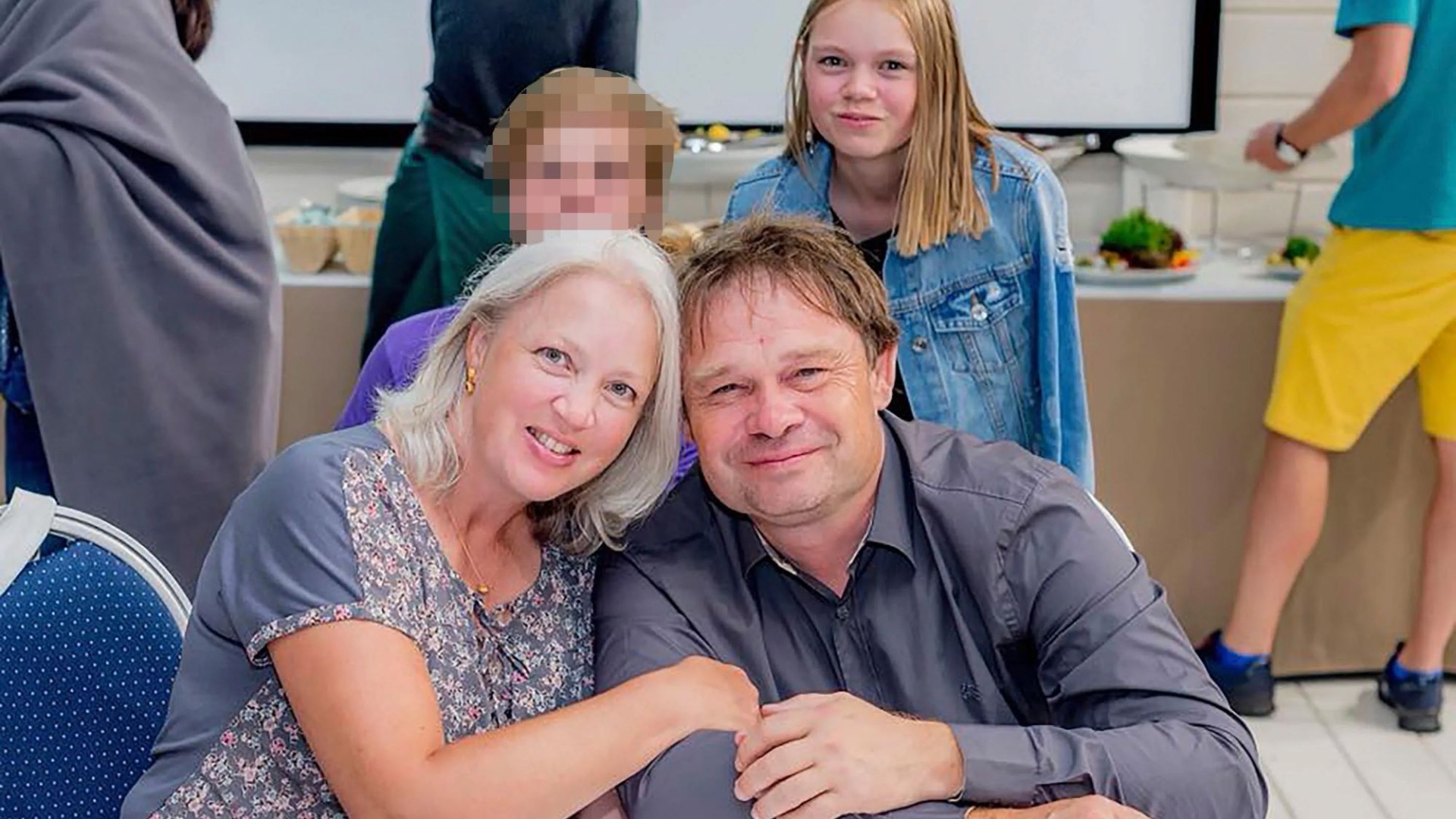
AS the grim and grinding war in Ukraine continues, the bloodshed is spilling over across Europe – with Russian agents dispatching gangland contract killers to hunt down enemies in even the most unassuming locations. One chilling new battleground for these extrajudicial killings is a popular British holiday hotspot – where the body count is escalating at a frightening rate. The Costa Brava is becoming a battleground for extrajudicial killings Credit: Getty Russian gas tycoon Sergey Protosenya, his wife Natalya, 53, and their teen daughter Maria were found dead in their Spanish mansion in Lloret de Mar Credit: East2west News Spanish officers investigate the garage where the body of Russian pilot Maxim Kuzminov was found shot dead Credit: Reuters A burned car allegedly used by the perpetrators of the murder of the Russian pilot Maxim Kuzminov Credit: Reuters Maxim Kuzminov was a national hero. Not to Russia, the land of his birth, but to Ukraine, the land he was paid to bring to its knees. A pilot-navigator in the Russian 319th Separate Helicopter Regiment, Kuzminov first saw action in October of 2022. He was sent to operate his Mil Mi-8 chopper in the brutal battle theatre unfolding around Mariupol on Ukraine’s Black Sea coast. Unlike millions of Russians, Kuzminov used his downtime in the early stages of Moscow’s invasion to do some reading on the issue. Scouring YouTube and other sites, he wanted to better understand Putin’s reasoning for the so-called “Special Military Operation” that he was being sent to prop up. He quickly found himself developing a burning sense of injustice at the invasion. Recruited by Ukrainian Intelligence agents, the pilot carried out a high-profile defection on August 9, 2023. Flying his helicopter into Ukrainian-controlled airspace, he delivered both the airframe and a host of sensitive military data to Kyiv. Maxim Kuzminov was shot dead in Alicante Credit: Wikipedia Spanish cops inside the garage where Russian pilot Maxim Kuzminov was found Credit: Reuters Upon landing, Ukrainian officials found both of Kuzminov’s Russian crewmates shot dead. The Ukrainian government celebrated Kuzminov’s defection, paying him half a million dollars and giving him a new identity, as well as arranging the escape of his family from Russia, hoping his bravery would inspire other Russians to cross the zero line and pin their colours to Kyiv’s mast. Moscow, however, could not let this act of treachery go unpunished. Kuzminov’s Ukrainian handlers had warned him not to leave the country, explicitly cautioning that Kremlin hit squads would be sent to track him down. However, flushed with both newfound wealth and a tragically misplaced sense of freedom, the young Russian pilot bought an apartment in the town of Villajoyosa near Alicante in Spain, and began living la buena vida. In February of 2024, shortly before the second anniversary of the war he so despised, in the parking garage below his beachfront high-rise, two men emerged from the shadows and shot him dead with silenced pistols. Spanish authorities say Kuzminov’s bullet-riddled corpse was also run over by his assassins as they made their escape in a vehicle. The press later reported that it may have been an intercepted telephone call inviting an ex-girlfriend to Spain that sealed the airman’s fate. Spanish Civil Guard officers outside the garage where Russian pilot Maxim Kuzminov was found dead in Alicante Credit: Reuters Maxim Kuzminov (right) discussing his defection to Ukraine Credit: Wikipedia Using typically bloodthirsty invective, Sergey Naryshkin, the head of Russia’s SVR foreign intelligence service, commented: “This traitor and criminal became a moral corpse at the very moment he planned his dirty and terrible crime.” The shooting laid bare how the Kremlin’s deadly tentacles spread over Europe – even reaching a normally serene tourist resort loved by British visitors. There was no question of who had ordered the hit. The only question was who had pulled the trigger. Dr Kamil Zwolski, the Jean Monnet Professor of European Security at the University of Southampton and a leading expert on Russian state security policy, tells The Sun: “Europe has been very slow to open its eyes and actually look closely and acknowledge what Russian organised crime groups have been doing on European territory. “This has gradually been changing, and there have now been high-profile investigations like the ones in Spain.” Within months of Kuzminov’s killing, the Spanish theatre of state-sanctioned assassinations began to rapidly morph into a wholly new and unpredictable beast. In May 2025, Andriy Portnov, a former Ukrainian official, was shot dead outside the American School in Pozuelo de Alarcón, an affluent suburb of Madrid, after dropping off his children. Portnov was approached by as many as three suspects before suffering multiple gunshot wounds to the back and one fatal round to the head, after which at least two assailants were reported to have made their escape in a waiting BMW. Andriy Portnov, a former Ukrainian official, was shot dead in an affluent suburb of Madrid after dropping off his children Credit: Shutterstock Police at the scene outside the American School of Madrid where Portnov was killed Credit: EPA Spanish authorities say their investigation is ongoing. Portnov, a Ukrainian lawyer and former senior aide in the administration of pro-Russian president, Viktor Yanukovych, had served as deputy head of the presidential administration among other powerful positions. He was a controversial figure in Ukraine, over the years facing accusations of corruption, bribery, and levelling death threats at journalists and critics alike. As a skilled law professor, he was able to defend himself successfully. Vocally pro-Kremlin, he was also subjected to foreign sanctions on numerous occasions and had faced a charge of High Treason in Ukraine over his involvement in the illegal annexation of Crimea by Russia. With what has been described as a “minefield” of possible perpetrators, some commentators suggest Russia is to blame, others Ukraine, while yet more point to powerful criminal elements as possible suspects. His public execution, in broad daylight and outside a school, did not suggest that this was the work of elite government assassins. Every sliver of evidence, scarce as it was, pointed to mobsters. Sergey Protosenya, a Russian gas tycoon, was found hanged alongside his wife and daughter who died of axe wounds in 2022 Credit: East2West Protosenya’s mansion in Lloret de Mar as police work at the scene Credit: East2West Professor Zwolski continues: “I think it’s unsurprising that much of this happens in Spain, because those organised crime groups have been well established in Spain, especially the south coast – Majorca, Malaga.” If the gangland-adjacent suspicions of Spanish intelligence agencies were correct, law enforcement urgently needed to connect the dots and the killings. “So, here we see this kind of new modus operandi, where this outsourcing is taking place, which, of course, gives Russia a convenient kind of deniability,” Professor Zwolski says. “But also, we have to say that Russian official capacities, or the official capacities of the Russian state have been limited, because those people, those Russian diplomats, embassy operatives, they are being looked at much more closely since the war in Ukraine. “So, [hiring gangland figures] allows Russia to continue doing the work, only through different means.” But events in Spain were about to get markedly stranger when, in June of 2025, Ihor Hrushevskyi, formerly a senior figure in Ukraine’s Department for Combating Organised Crime and later in the National Police, was found dead in a swimming pool. This occurred at the same Spanish complex in Villajoyosa, Alicante, where Maxim Kuzminov was assassinated 18 months before. Hrushevskyi, 61-years-old at the time, was found face-down in the swimming pool of the Cala Alta housing complex, where he had apparently also recently purchased an apartment. Ihor Hrushevskyi, a former senior figure in Ukraine’s Department for Combating Organised Crime, was found dead in a swimming pool in Alicante Credit: Getty Andriy Portnov, a former Ukrainian official, was killed in an affluent suburb of Madrid Credit: Alamy After discovering his body, fellow residents attempted CPR while they waited for an ambulance. No obvious signs of assault were found on Hrushevskyi’s body, although blood was reportedly flowing from one of his ears. His short-lived neighbours were naturally highly suspicious of the Ukrainian’s death in the same location as the murder of Maksim Kuzminov, Russia’s runaway pilot. Spanish authorities continue to treat the death as both unexplained and suspicious, adding that their investigations are continuing. The Ministry of Foreign Affairs of Ukraine have stated that, according to the Consulate General in Barcelona, the death was caused by drowning. This was despite the pool being only around 1.5 metres deep, marking the authorities’ drowning theory as deeply suspect for many. Despite the plethora of red flags and jarring coincidences, no one seems able to posit a remotely plausible explanation for Hrushevskyi’s presence at the apartment block, much less his apparent decision to buy a property in the same block that had witnessed the execution of Kuzminov the year before. But assassinations linked to Russia were not new to Spain. Further back, the Iberian Peninsula had not escaped the glut of grisly Moscow-linked and energy-related killings that spilled over into Europe in 2022. Dozens of suspicious deaths were recorded, with many of the casualties being oligarchs and executives in the oil and gas industries, and many of those occurring in Russia being spuriously labelled as suicides by Moscow. Spain’s share of the murderous tide sweeping the continent was the discovery of a gruesome scene in Lloret de Mar at the home of Sergey Protosenya, a businessman and former Deputy Chairman of PAO Novatek, Russia’s largest natural gas producer. Police found Protosenya hanging in his garden, while his wife and one of his children were found dead in their beds from what detectives believe were blows from an axe and stab wounds from a knife. Both of the weapons were found near Protosenya’s body, however police later said that there were no fingerprints on either and that no traces of blood were found on Protosenya’s body, despite having allegedly carried out two frenzied attacks. Protosenya’s son Fedor has also stated that he believes his father could never have carried out such a crime, and that he was murdered. Many are asking why Moscow seems to have turned to gangland figures when it has a multitude of highly qualified covert teams with extensive military experience and real-world tradecraft under their belts. The answer seems to be that the new, digital era of big data, biometrics, and near-total surveillance has done Russia’s topflight black ops teams more harm than good. At the same time, their capacity to utilise “official cover” roles at embassies and consulates worldwide has been drastically eroded. “Europe has previously been very slow to wake up to the role of so-called Russian diplomats, legally deployed in European countries,” Dr Zwolski says. “That has been changing since 2022 with those expulsions. I think the number was over 600 Russian so-called diplomats have been expelled from Europe since at least 2016, 2017.” Russia now needed a wholesale pivot to a new way of doing business, and it seemed that Moscow had a readymade solution to their problem. With the war in Ukraine bringing increased scrutiny and a litany of murders and terrorist attacks throughout Europe directly linked to Moscow via increasingly recognisable agents, Putin’s commanders needed new tactics when it came to neutralising individuals that it deemed a threat to national security. “What Russia had to do is orchestrate a different kind of approach, a different strategy,” Dr Zwolski explains. “So it seems that they have started recruiting, almost kind of outsourcing those kinds of tasks to individual freelance assassins, local criminal groups. “[There is] this phrase, ‘layered outsourcing’, where we have Russian-based criminal groups outsourcing to local criminal groups on the ground in countries like Spain to do the dirty work. “I think this kind of evolution and adaptation is interesting, because that’s something that we haven’t seen, because Russia did have capacity to do those things, but now it’s more kind of outsourced, networked, a kind of by proxy approach.” Meanwhile, many European intelligence agencies have laid the blame for the continent’s explosion in assassinations at the feet of a single Russian black ops team – Unit 29155, also known as ‘Ember Bear’. A covert squad within the GRU, Russia’s Military Intelligence division, Unit 29155’s mission briefs include everything one might expect from Moscow’s most vaunted kinetic espionage unit; sabotage, hybrid warfare, foreign destabilisation operations, covert infiltration, and, naturally, assassinations. But in recent years, Unit 29155’s mask has begun to slip, their operatives now well-known and featuring on wanted posters the world over. Prior to being implicated in Spain’s state-sanctioned assassinations problem, Ember Bear had a rich and storied history of alleged involvement in notorious black ops missions throughout Europe. Professor Zwolski explains: “We can distinguish broad operational modes. “So, one is this kind of elite state unit like 29155 doing this kind of work. “The example here would be Sergei and Yulia Skripal, the Salisbury poisonings, which were linked back to this unit, but also 2014 ammunition warehouse explosions in the Czech Republic. “After concluding the investigation, Petra Pavel, the Czech president, confirmed that the event was, in fact, a Russian attack on Czech soil, and there were two GRU officials involved.” As The Sun has reported on, while many countries suffered an influx of organised crime groups as the Soviet Union crumbled in the early nineties, Spain has historically had a problem with Russian gangsters. Many of those who left the Motherland to escape the descent into open warfare on the streets of Moscow and St Petersburg immediately began engaging in bribery, extortion, money laundering, contract murders, and trafficking of all shades. This period saw the Russian authorities enter a pact with organised crime groups under the watchful eye of the ambitious Deputy Mayor of St Petersburg, one Vladimir Putin. As Putin negotiated an end to the running gun battles, car bombings, and drive-by shootings between rival factions, gang leaders began to not only work closely with the government, but also saw bosses put aside rivalries for the sake of profit and leverage, evolving into an altogether more dangerous, collaborative force. “In the case of Spain, Russia has been extremely well organised in terms of organised crime and assassinations.” Dr Zwolski says. “These gangs have long and confirmed links to Moscow. “One is more kind of St. Petersburg, and the other one is Moscow based, and there is evidence of them being protected but also being used by Russian authorities.” While London mainly dealt with Oligarchs spreading about their ill-gotten gains, Spain’s expat communities were bolstered by senior, experienced gangsters, a clique very willing to use violence, corruption, and extortion to bend the Costas to their will. Far more used to dealing with elderly British bank robbers and North African hash smugglers, Spanish law enforcement has suddenly been confronted by hardened, well-funded, well-connected gangsters with no fear of authorities and no respect for the status quo. More than that, the newly cosy relationship these gangsters have brokered with Moscow means that the Russian state now has a paramilitary force of trained killers at their beck and call – a literal army at their command in all four corners of Europe and beyond. Professor Zwolski concludes: “One thing we have to perhaps clarify is that those links between Russian organised crime groups and the Russian state, they go back to the Soviet Union times. “I mean, President Putin himself is a former KGB agent. Those contacts go way, way back. “So what Russia is doing now is activating them in new ways and evolving that relationship. “It’s part of a broader approach – and I would say philosophy – of how the state works. Russians are socialised to value strength, decisiveness, and effectiveness. “Russians want a state that can do things and accomplish things. “When Russia invaded Ukraine, one of the things Putin said at the very beginning of the invasion was that the West better not interfere, alluding to the use of nuclear weapons, that they cannot be taken off the table. “And that signalling has been a consistent message coming from the Kremlin. “It’s all part of that kind of broader messaging where Russia signals to its own audience, to its own people, that it is decisive, it is resolute, and it is capable of projecting strength. “But also, it is signalling to Western Europe, hoping to intimidate.” He shrugs with a slight smile. “Because it has been working to some extent, right?”
Bodies are piling up in a Brit holiday hotspot – & they all point to one sinister theory… Putin’s assassins are prowling
Full Article
Original Source
Read the full article at Thesun →KhanList aggregates and links to publicly available news content. We do not host full articles from third-party sources. Always verify important information with original sources.