
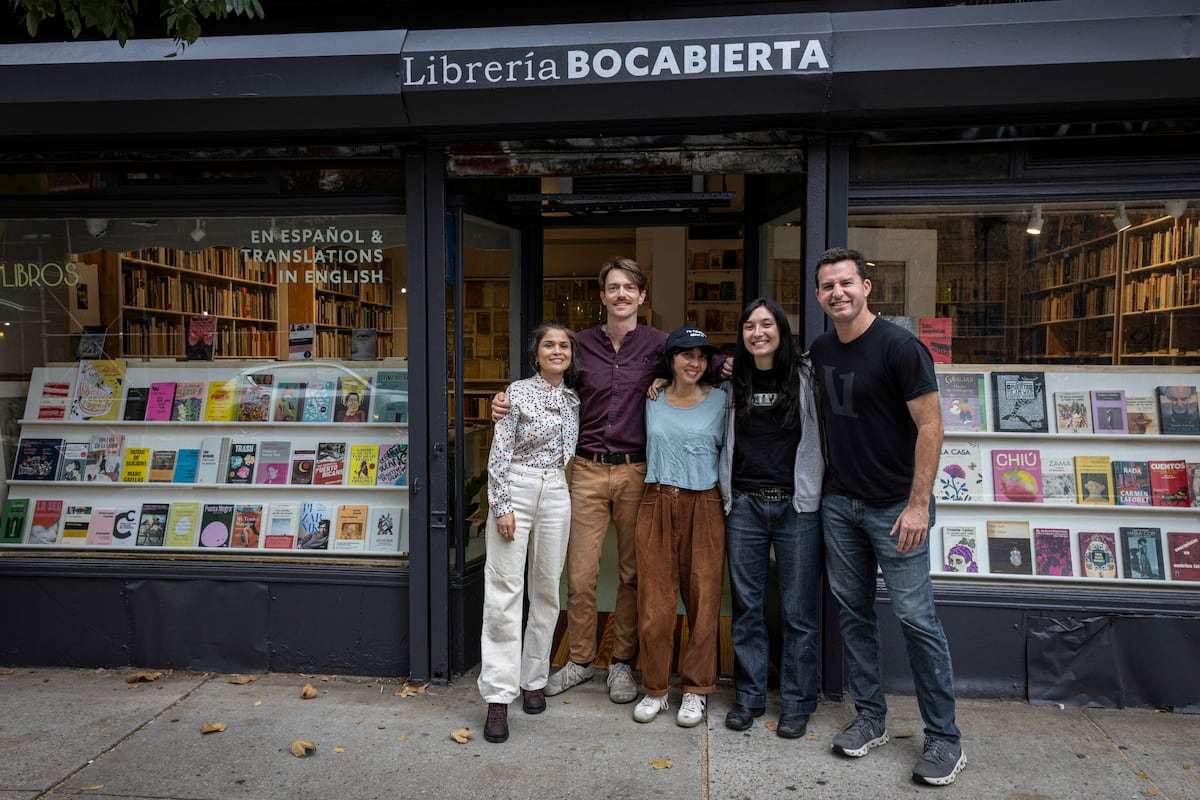
The sidewalk in front of a new bookstore called Bocabierta was packed on Saturday with people waiting their turn to go inside for the opening party. Rows of new and used books covered the display windows of the establishment. A yellow sign shone from the corner: LIBROS (BOOKS). Writers, editors, academics, poets, and other lovers of words filled the place, and the only language one could hear was Spanish.The scene could well have taken place in Buenos Aires, Mexico City, Barcelona or Madrid. However, the literary gathering instead took place in Manhattan’s East Village, where this space dedicated exclusively to literature and non-fiction in Spanish has just opened.In the 1970s, 14th Street, which forms the backbone of historic downtown Manhattan, once had up to five Spanish-language bookstores. The rise in rental costs and competition from large chains like Barnes & Noble and Amazon closed them one by one. Those that survive today have become multilingual bookstores or community centers for readers from Hispanic communities.The opening of Bocabierta confirms a new energy in the city that has revived interest in Latin American literature and has given wings to new generations of authors to write literature from the United States, and even then, to do so in Spanish.“There is an existing ecosystem right now where writers, institutions, and these bookstores converge,” says Jeffrey Lawrence, co-owner of Bocabierta, which officially opened its doors on November 21. He and his partners, Nelly Cuellar and Corey Eastwood, are veterans of the literary world. Eastwood has been a bookseller for more than two decades, Cuellar is a designer, and Lawrence is a writer and professor of Latin American literature at Rutgers University. “There can’t be a resurgence of Spanish-language literature if we don’t have independent spaces. And for me, the key there is these bookstores,” says Lawrence.Bocabierta has opened in a neighborhood already full of iconic bookstores — Book Club Bar, Village Works, Mast Books, and Pillow-Cat Books, among others — but all in English. The bet is that interest in Spanish-language literature is growing in this city and that even among the Anglo public there is an appetite for Hispanic-American culture. The book selection includes new, used, and rare books in Spanish, as well as editions that are hard to find in the United States.Additionally, the store, with an all-Spanish offering, joins a handful of independent bookstores — Word Up in Washington Heights, Barco de Papel in Queens, and Mil Mundos Books in Brooklyn — that, scattered across different parts of the city, sell books within their bilingual or multilingual catalogs to the 1.8 million Spanish speakers in the Big Apple.“It seems to me that we are at a moment when a certain idea of the Hispanic, the Latino, is trying to move beyond the stereotype related to identities and the subordinate place of culture,” says Ezequiel Zaidenwerg, an Argentine poet and director of the Hispanic Society’s poetry center. “Maybe I’m being optimistic, but I like to think that the conditions are right for something similar to what the Harlem Reinassance was a century ago, something like a Hispanic Reinassance.” For Zaidenwerg, it is important not to define Latin American literature only from the optics of resistance, because it reduces it to a reaction: it must be seen throughout its history, spanning centuries, countries, and even languages (Latin America does not only speak Spanish). Something similar was sought by the artists of the Harlem Renaissance in the 1920s: faced with a caricatured gaze on their people, they developed a new repertoire of art and their own stories.Today, about 44.9 million people speak Spanish at home in the United States, more than double the number in 1990. With that comes an economic and political power that is hard to ignore. Latino voters have been key in recent elections, both in the 2024 presidential election that brought Donald Trump to power and in the recent midterm elections that led to a Democratic blue wave.According to an analysis by the University of California, Los Angeles (UCLA), if Latinos in the United States were a country, they would be the fourth largest economy in the world. Furthermore, as new Hispanic generations are born in the United States, a sense of belonging has grown that was not previously present, where they are allowed to celebrate the culture they are part of.Although the phenomenon is not unique to New York City—a few years ago, the academic Naida Saavedra coined the term New Latino Boom—this city brings together a series of factors that make a movement like this possible: institutions willing to celebrate the language and its culture; universities where talent is nurtured; independent publishers; and a community eager to connect and create in its own language. This makes the city a place where culture, the arts, and literature are respected and revered. While the federal government cut funding last year, the city took the opposite path: in 2026, the Department of Cultural Affairs was allocated the largest budget in its history and doubled grants for artists and small organizations.In the last 15 years, at least six independent publishers have opened in New York that publish Latin American writers, including Sudaquia, Chatos Inhumanos, Sundial House, and Five Points Publishing. They build bridges with the rest of Latin America and allow writers to publish from the U.S., without depending on Mexico, Argentina or Spain. Interest has also reached the English-speaking world: independent publishers like New Directions and Ugly Duckling Press have brought some of the region’s most important voices to the English-speaking reader.In New York, a meeting point for these literary communities is the New York City International Book Fair (FILNYC), which is now in its eighth edition. Last year, it brought together more than 4,300 people. This year, from October 21 to 25, it offered 160 free activities, including talks, workshops and book presentations, double the number in 2025. The fair, an initiative of the Institute of Mexican Studies at CUNY (City University of New York), addresses the need for cultural spaces that bring Hispanics together to celebrate their culture. Its growth demonstrates the great interest this type of event generates in the city and the rest of the Spanish-speaking world. But for José Higuera López, director of the CUNY Mexican Studies Institute, the fair’s success does not lie in how big it is, but in who it can reach, especially since the project is part of the event offerings for students of CUNY, the city’s public university, where one in four students is of Latin heritage. “For me, it is very important that these young people discover that Spanish is not only a language they inherited from their family, it is a language they can use to write, publish, and do research,” says Higuera.None of this would be possible without the drive of the writers themselves and without universities willing to bet on them. In 2007, Argentine writer Sylvia Molloy founded what would be NYU’s first master’s degree in creative writing in Spanish. This type of program, with an Anglo tradition, arrived in Latin America later, but NYU’s has been key in giving writers the creative training, space, and time to develop their projects.Writers of the stature of Fernanda Trías, Jazmina Barrera, Federico Falco, Zaidenwerg himself, and Guillermo Severiche, among others, have passed through its classrooms. Other city programs, such as the Casa Hispánica of Columbia University and the Spanish-language programs of CUNY, also contribute to the ecosystem with readings, courses, and meetings. And the city’s private institutions have joined forces to celebrate Hispanic American culture and literature. Moreover, a consortium of institutions including the Cervantes Institute, the Queen Sofía Institute and the Hispanic Society, among others, is taking advantage of the moment to work hand in hand and celebrate the centenary of the literary movement known as the Generation of 1927. The centenary resonates with the city’s energy; the group that renewed literature in Spanish finds an echo in today’s New York literary scene.The creative practices of New York’s new writers are sustained hand in hand with independent projects that bring these literary communities together and give them space to germinate and collaborate with new ideas. En Construcción, for example, a project by Guillermo, brings writers together for readings of their projects that have not yet been published. Como un lugar, co-founded by Zeidenwerg, it is a collective space for poetry and performance. LetraMuerta is a cultural and archive center that began as a publishing house in Venezuela, and Colectiva Macarayas is a literary and community group in Spanish. Building collectives, series, and other literary events around this language creates a support network and refocuses the act of writing, usually seen as solitary and individual, toward the community.According to Paula Ortiz, owner of Barco de Papel, after the Covid pandemic, there was a renewed interest in meeting in person, returning to analog, and building community. In 2016, The New York Times referred to Barco de Papel as one of the city’s last Spanish-language bookstores. Today, the outlook feels like a reverse. That’s why Ortiz doesn’t see the opening of new Spanish-language bookstores, like Bocabierta, as competition. Instead, she sees them as part of the same mission. She also adds that, as long as the community is alive, this ecosystem will be too.“I would say that about any Spanish-language bookstore. We exist thanks to the community,” Ortiz says. “The approach is not just about buying a book; bookstores also need people to come, to get to know them, and to make them their own.”Sign up for our weekly newsletter to get more English-language news coverage from EL PAÍS USA Edition
Bocabierta Bookstore, the new epicenter of the Spanish-language literary boom in New York
Full Article
Original Source
Read the full article at English →KhanList aggregates and links to publicly available news content. We do not host full articles from third-party sources. Always verify important information with original sources.