
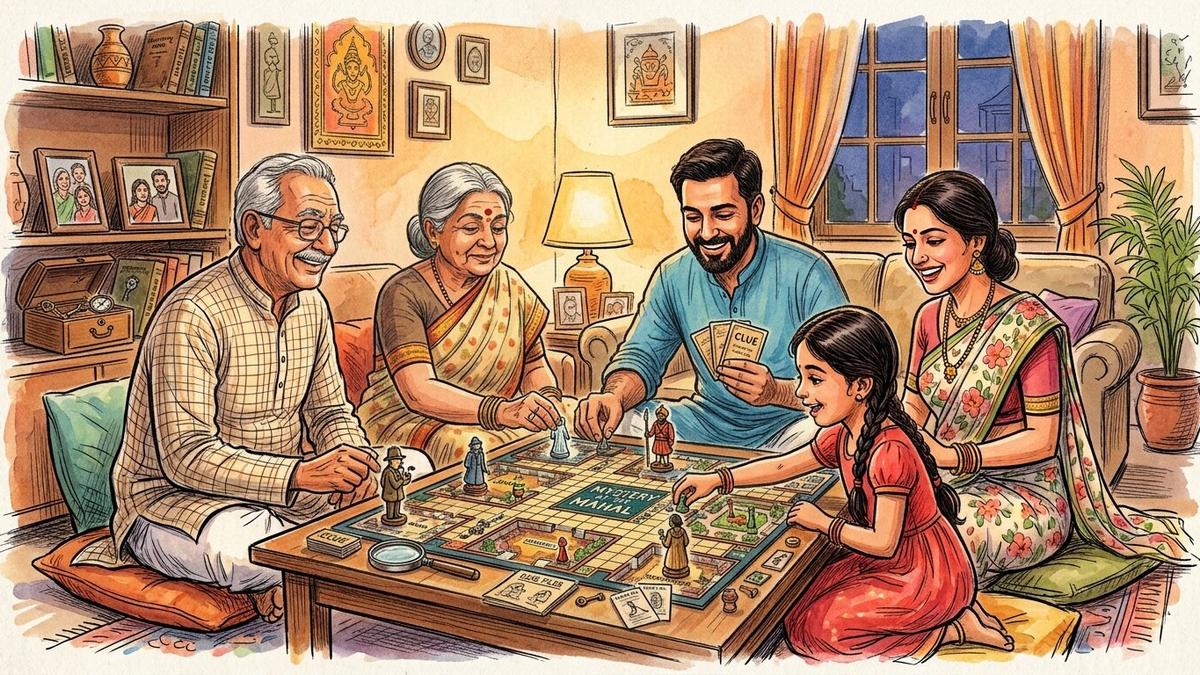
AI generated image | Photo Credit: GEMINI Hues and CuesIn a world of colours, the key to victory is paying attention to the slightest shade contrasts! What are the odds that you can get another person to guess the colour you are thinking of out of 480 options? Well, this game will put that to the test! With this game, you and your family can have a fun afternoon of colourful banter! Using only your words, which will be the clues for other players, your task will involve slowly nudging them towards the colour on the board that reflects the one chosen on your card!Components:A game board, 100 colour cards, 30 player pieces, and one scoring frameGameplay: The game board is open, and each player is given three playing pieces, each of the same colour. The great thing about this game is that the fun banter may start even before anyone makes a move with any of the components! Because the player wearing the most colourful outfit is selected as the first cue-giver, or the person whose colour choice the other players must guess! Each player will place one of their pieces at the border of the game board, and the cue-giver will pick the top card from the face-down pack and not show it to anyone. The card will have four colour choices, each labelled not with a name, but with a letter and a number. These letters and numbers will be reflected on the board as rows and columns. For example, G1 could be a shade of light orange. The cue-giver, once they choose their colour from the four on the card, will ask the other players to turn away while they locate it on the board. Then, he or she must give a single-word clue for the players to guess where their chosen colour is. At this first attempt, the players will take their game pieces and place them on the square of the board that would display the hue they believe is closest to the clue. If the cue giver wants, they can give a second, two-word clue, following which the players can take their second game piece to place in a different square. This is where the scoring frame comes in! It is fixed in the shape of a 3 x 3 square, which the cue-giver will place in a manner that will put their chosen colour at the centre. The points are given based on which game pieces lie in the other eight squares within the frame! Hues and Cues | Photo Credit: WIKIMEDIA COMMONS TsuroIn the world of Tsuro, you will make the decision regarding the creation of your own path. But be warned: if you make a wrong choice, there is no going back or changing it. It will either lead you into the trap of your opponent or toss you off the road entirely! Tsuro is a fun tile-placing game you can play with your family. On a board graced by the presence of the phoenix, every tile you place will create a path that will either send you off the cliff or keep you in the game! This is a game where you can find out just how sneaky some of your family members can get!Components:The game board, eight plastic pawns, 35 path tiles, and one Dragon TileGameplay: Each player is given three path tiles, each containing different twisting lines (paths) within them. The game board (which has a picture of a phoenix) will have a 6 x 6 grid on which each player can place one of their tiles during their turn. First, a player must place their plastic pawn on any one of the lines in the outer border of the board game. On their turn, they must place one of their three path tiles on one of the squares in the grid that is closest to their pawn. Then they must move their pawn along the twisted line on their tile until they reach an edge. Whenever a tile is placed on the board, another must be taken from the pile. There are two goals. First, ensure that the tile you place does not lead your pawn off the board. Second, play strategically to use your tiles to lead your opponents off the board. The winner is the player whose pawn is left standing on the board! People playing the board game, Tsuro | Photo Credit: WIKIMEDIA COMMONS DixitA challenge for all storytellers and detectives! In the world of Dixit, the way in which you can artistically describe imagery may or may not lead to your downfall! Dixit is a game that will bring about cheers of joy and laughter at the table. It can be played by 4-12 players, who will each take turns being a storyteller and providing a detailed yet vague description of an image from one of their cards, which will soon be a target to be selected from a bunch of similar cards!Components:Game board with a score tracker, 84 image cards, pawns, and voting tokensGameplay: Each player is given six image cards, a pawn, and a group of voting tokens. On a player’s turn, they must pick one of their cards and must try to describe the image on it using sounds or words that are closely related to it. The other players then select one card from their sets that closely connects to the storyteller’s description. They will hand it to them, face down, and the storyteller (without looking) will shuffle the cards and will then turn each of them over. This is where the fun guessing game begins! Once all the given cards are shown face up, all the players (except for the storyteller) will use their voting tokens to guess which card most likely belongs to the storyteller. The number of correct votes will equate to points that will decide how many spaces a player can move on their board. For example, if a few players guess the card correctly, then they and the storyteller will get three points each. But if every player gets the choice right, or wrong, for that matter, then they will get 2 points each while the storyteller gets zero. Dixit board game | Photo Credit: WIKIMEDIA COMMONS Word on the StreetHow fun would it be if the phrase ‘word on the street’ could take a physical form? Here is a game where your property and treasure consist of letters you earn through your vocabulary skills! “Word on the Street” is a fun board game that one can play with family and friends. With the participation of two teams, the game involves each team taking turns forming words based on categories provided to them on cards, and pulling the required letter tiles towards their side, one step at a time. Whether or not a word belongs to the category, or if it’s spelled right, or doesn’t count, are all sources of friendly banter that can emerge among both sides.Components:Game board, 17 alphabet tiles (not including vowels and the letters J, Q, X, and Z), 216 category cards, and a 30 second timer (hourglass)Gameplay: The players are divided into two teams. All 17 of the tiles are then positioned in a line along the centre of the board, in alphabetical order, from B to Y. Each tile can only be moved across two spaces (or more, which would win the team the tile) to the left or right, based on the word formed by each team. Each team will take turns picking out a category card. They will then have 30 seconds (set by the timer) to discuss the word that would fit the category and give them an advantage. For example, if the category card said “red fruits”, then the team with the card may choose the word apple. Since there are no vowel tiles, they can only move the consonant letters ‘p’ and ‘l’ to their side. The number of spaces that can be moved depends on the number of times the letter appears in the word. In this case, the ‘p’ tile can be moved two spaces, while the ‘l’ tile can be moved one space. Friendly debates and banter may also take place in this game. They could be related to factual errors (this word doesn’t belong to the category!), spelling mistakes, etc. The team that manages to win seven tiles to their side will be declared the winner. AI- generated image | Photo Credit: GEMINI (Untangle is a chain of board game cafes run by Subhatra, Kirthika, and Senthil.) Published - August 25, 2026 05:56 pm IST
Boards and bonds: Fun board games to play with your family!
Full Article
Original Source
Read the full article at Thehindu →KhanList aggregates and links to publicly available news content. We do not host full articles from third-party sources. Always verify important information with original sources.