
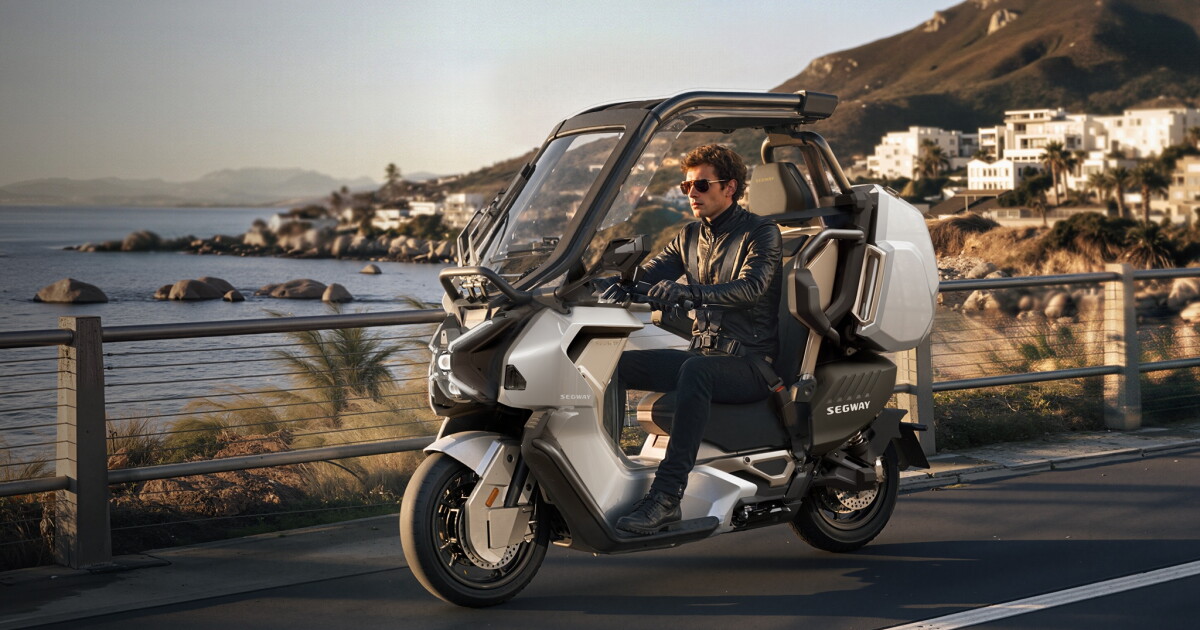
"Oh no, here we go again!" That’s exactly how I feel reading about Segway, one of the world’s most well-known electric scooter brands, reviving the roofed scooter conversation. It’s a concept that somehow pops up almost every year, and then dies down without much development, only to rise again the next year.Of course, it all kickstarted with BMW’s C1 in the early 2000s. The most recent iteration we covered last year was the German company’s Vision CE concept – one that received tons of media coverage … and raised eyebrows, as you’d imagine. There have been others, like the XYTE One, which built on the same idea, but with a far more realistic use case.Now, it seems Segway wants in on that action with the X Cruiser. The driving factor is, of course, motorcycle safety. So obviously there’s a roll cage … and seatbelts. The idea is to bring car-like safety to a two-wheeler without the additional wheels.Segway says it approached the scoot’s safety engineering with lessons drawn from automotive crash testing. It incorporates a combination of full and partial cage structures, protection against impacts from four directions, progressive energy absorption, and the aforementioned seatbelt restraints. It also includes some electronic assistance alongside all that hardware, with blind-spot detection and lane-change warnings included as standard. The X-Cruiser is scheduled to launch in China and Europe between 2027 and 2028Segway The company has also played around with just how much of the rider it wants to enclose. Some configurations look closer to conventional scooters, with a relatively open layout, while others go much further with substantial protective structures surrounding the rider.There’s one particularly dramatic version that caught my eye. It borrows from the race-car playbook, combining a heavily bolstered bucket seat and seatbelt with an extensive safety cage. That's the range-topping 350 GT Ultra, per Segway Europe's website, which currently lists three versions of the X Cruiser. This one gets a roof, making it the most weather-friendly of the lot, along with an electrically operated 55-liter top case and 4.5-kW charging through a Type 2 connector.The second is the 100 City that takes a more safety-oriented approach, featuring a five-point seatbelt, rollover protection on the sides and an electrically adjustable windshield. Its 2 cubic-foot (55-liter) storage box is optional, while charging capacity remains at 4.5 kW.Last of the three is the regular 350 GT, which gets adjustable backrests for both the rider and passenger, an electrically adjustable screen, and the option of 10-kW DC fast charging.Underneath, Segway uses its proprietary Cell-to-Body (CTB) construction, where the battery is integrated into the vehicle's chassis. The company is targeting a range of approximately 124 miles (200 km), although actual figures will depend on the final market-specific configurations. The X-Cruiser has been developed under a license from the BMW GroupSegway The hardware package also includes 15-inch front and 14-inch rear wheels shod with Michelin City Grip tires, a standard 10.25-inch TFT instrument display and the aforementioned electrically operated 2 cubic-feet (55 liter) storage compartment, available as an option.Apparently, Segway has developed the vehicle under a license from the BMW Group, covering intellectual property and technical know-how related to two-wheelers. The truth, though, is that there’s a fairly important distinction between borrowing automotive safety principles and actually meeting car-like crash standards.Thus, Segway is careful to point out that its descriptions reflect the vehicle's current design and equipment, not completed automotive-style crash certification. Details like performance figures, curb weight, and pricing are still under wraps, with final specifications expected to vary between markets as the launch gets closer.But what’s good news here is that unlike many a wild concept that never makes it past the show floor, the X Cruiser is actually headed for production. Segway is targeting launches in China and Europe between 2027 and 2028.Another unusual detail about its European prospects: in countries including Germany, France, Spain, Italy, Belgium, the Netherlands, Austria, Portugal and Switzerland, occupants could potentially ride without a helmet, provided they wear their seatbelts and local regulations permit it. The X-Cruiser boasts Cell-to-Body (CTB) construction, with the battery integrated into its structureSegway In much of Asia and Europe, scooters aren't recreational toys that come out only when the weather is nice. In fact, they’re much more practical than most motorcycles.And if one could offer some protection from the elements and build additional safety equipment into its construction, it only seems obvious that it could very well find a genuine audience. That's assuming Segway can keep the thing reasonably priced and avoid making it so heavy or complicated that it loses the very convenience that makes scooters attractive in the first place.Of course, real-world safety performance, affordability, and everyday usability are aspects we can only talk about when the real thing actually launches.Source: Segway
BMW dreamed up the roofed scooter, now Segway wants a piece
Full Article
Original Source
Read the full article at Newatlas →KhanList aggregates and links to publicly available news content. We do not host full articles from third-party sources. Always verify important information with original sources.