
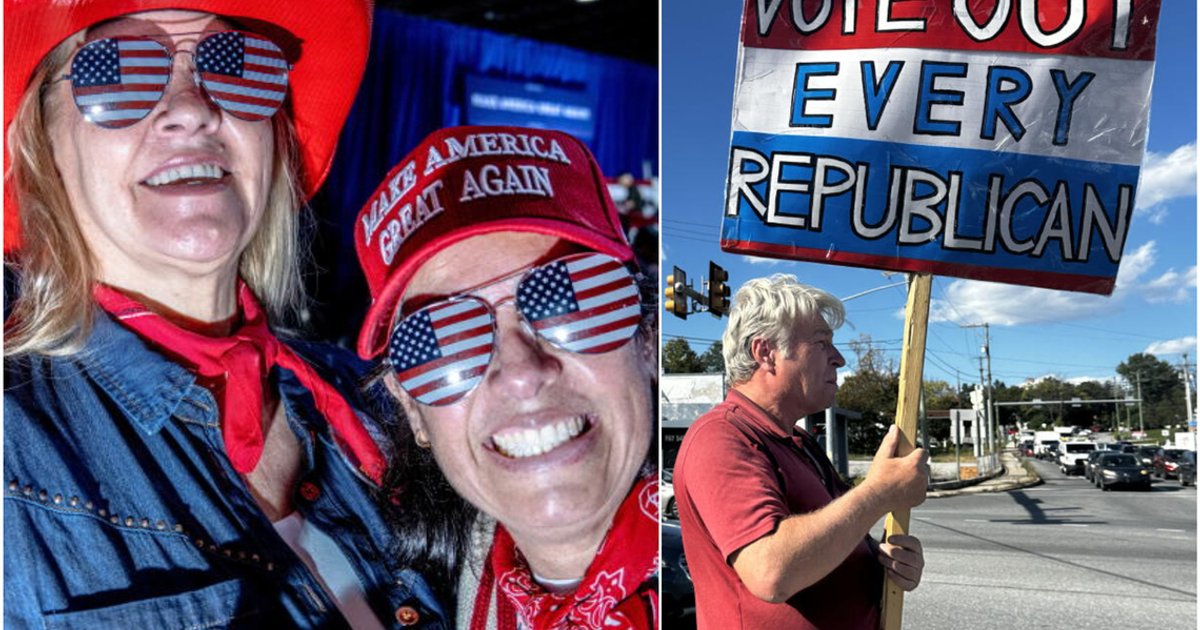
MARIETTA, Georgia – The “midterm” elections feel like a misnomer. Little about them feels intermediate, really.With more than 50 million early votes cast by Nov 1, the energy has matched a presidential year.Nervous attention is being paid to each new poll, the bubbling discontent counted and recounted: everything suggests a country preparing to pass judgment.The Democrats, defeated and dispirited just two years ago, are eyeing victories in races long conceded to the Republicans. Texas, South Carolina, Kansas, Iowa and Alaska – unassailably red until just weeks ago – now seem a hazy blue, within reach for a party still leaderless after Kamala Harris was bested in 2024.At 80, President Donald Trump is driving himself with an effort that would be almost superhuman, if it were not also desperate. In the month leading up to the Nov 3 vote, he has addressed more than 25 rallies. Tellingly, most have been in red states. On the eve of the elections, he will address seven “tele-rallies” – virtual events – in a five-hour marathon.But are we looking at a blue wave?It’s an imprecise term, but some pollsters define a wave election as one where the winning party takes the popular vote by around six points or more.The current RCP poll average – a poll of polls – puts the Democrats 8.5 points ahead in the generic ballot, a simple measure of which party voters want to see in Congress.A nine-point win would make for a historic Democratic night; anything over a 10-point win has not been seen in the modern era.There is another measure: how many seats change hands. In the 435-member House of Representatives, the balance now is 218-214 in favour of the Republicans, with one independent and two vacancies.The largest wave in recent times – a red tsunami – crested in 2010, the first midterms of the Barack Obama presidency. Back then, the Republicans gained 64 House seats and six Senate seats from the previous elections in 2008.The biggest blue wave came in 2018, the first midterms under a Trump administration, when Democrats won 41 additional House seats while ceding one in the Senate.This time both chambers are within reach. In the 35 seats up for grabs in the 100-member Senate which is split 53-47 now in favour of the Republicans, seven could decide control.The final NYT/Siena poll of the season said the Democrats were ruling them all – Michigan, Kansas, Texas, Maine, Ohio and, more narrowly, Alaska and Iowa.But the Cook Political Report, a well regarded reader of political trends, said both parties retain a viable path to majority. It listed the same seven states as “toss-ups” while describing the Democrats as “slight favourites”.There’s a good chance that the control of the Senate could be clinched by a single seat.In the House where 218 seats confer majority, Cook said that Democrats are favoured in 222 seats while 18 races are toss-ups.During travels over the last few weeks in states that chose Trump in 2024, including Pennsylvania, Ohio and Georgia, I met several voters whose unhappiness needed little prompting to find expression.“It’s changed for the better for him, for the worse for us,” said Tenedia Thomas, 68, a Democratic voter in the Republican stronghold of Lancaster county in Pennsylvania which Trump won in the 2024 elections.The villain is inflation – especially in food, fuel and housing – that has swallowed wage gains for most households, and Trump’s Iran war that has driven up the price of diesel and upended supply chain economics across the agricultural heartland.“That’s nothing that we have to read in a newspaper,” said Thomas. “We can see how much money we’re now spending on groceries, how little we can buy. We’re living it.”Tenedia Thomas, a Democratic voter in the Republican-held Lancaster county, says Trump's policies have favoured the wealthy while leaving the poor to struggle. ST PHOTO: BHAGYASHREE GAREKARThe minimum wage in Pennsylvania remains at US$7.25 (S$9.30) an hour despite rising costs of daily necessities, she said.“I consider myself poor, I live from pay cheque to pay cheque,” said Thomas. “I was just in a car accident, you can see my collarbone is protruding. I can’t take time off because I still have to pay bills and rent, because the handling of the economy is so bad that a 68-year-old woman has to work.”An hour’s drive away, in York county, which backed Trump by 25 points in 2024, John, who declined to give his full name, was mounting his own fightback. Standing at a downtown street corner, he swung a sign at passing motorists. “Vote out every Republican,” it read.He gave me his own poll. “Two-thirds of them give me a thumbs-up, a third flip me the bird.”A Democratic Party activist going by the name of John said the Republicans have to be ‘shaken awake’. ST PHOTO: BHAGYASHREE GAREKARA Democratic Party activist, he said the Republicans had to be “shaken awake”. But not everyone appreciated his effort.“This guy here says I can’t be here because it impacts his business,” he said, pointing at the auto shop behind him. “But it’s a public sidewalk, I don’t care what he says,” John said.The owner, a Republican, said he was calling the police.The testy exchange was a reminder of widespread public concern about election day safety and exaggerated Republican fears of fraudulent voting.In Marietta, Georgia, 36-year-old shop manager Yonas Lemma said he had used his day off to vote for the first time in his life.He voted for a Democrat as a senator but for a Republican as his governor; the split preference reflecting the divided loyalties in a swing state that narrowly backed Trump in 2024 after dumping him in 2020.It’s a preference likely to result in the re-election of Jon Ossoff, the only Democratic senator seeking re-election in a state that voted for Trump. His party’s gubernatorial candidate Keisha Lance Bottoms faces a harder path to become America’s first black woman governor.For Lemma, the clincher was Ossoff’s promise to expand access to healthcare. He said he had gone without any health insurance for several years.“From 26, when I aged out of coverage under my father’s health insurance and until I turned 32, I couldn’t afford insurance,” he said, adding: “Not that I am a socialist.”In Marietta, Georgia, Yonas Lemma said he voted for a Democrat as a senator but for a Republican as his governor. His split preference reflects the divided loyalties in a swing state that narrowly backed Trump in 2024. ST PHOTO: BHAGYASHREE GAREKARIn Marietta, Georgia, 36-year-old shop manager Yonas Lemma said he had used his day off to vote for the first time in his life.He voted for a Democrat as a senator but for a Republican as his governor; the split preference reflecting the divided loyalties in a swing state that narrowly backed Trump in 2024 after dumping him in 2020.In Marietta, Georgia, 36-year-old shop manager Yonas Lemma said he had used his day off to vote for the first time in his life.He voted for a Democrat as a senator but for a Republican as his governor; the split preference reflecting the divided loyalties in a swing state that narrowly backed Trump in 2024 after dumping him in 2020.The qualification speaks to a broader tension in these elections.A Gallup poll in September showed that 43% of Americans now have a positive view of socialism. It still trails capitalism and free enterprise in public favourability, but ranks ahead of big business.Anger at concentrated wealth has become a tangible part of the midterm campaign.I found it writ large, literally, in Pennsylvania. “Fund healthcare, not billionaires”, one sign read. “Tax the rich” was another.Californians on Nov 3 will also cast a vote on the world’s first “billionaire tax”, a measure to levy a one-time, 5% tax on billionaires. If it musters a majority, it would funnel a projected US$100 billion in revenues into healthcare.A sign in the Democratic Party office in McKinley Heights, near Youngstown, Ohio. Anger at concentrated wealth became a tangible part of the midterm campaign. ST PHOTO: BHAGYASHREE GAREKARIt is a new turn in American public life, a scrutiny on who benefits from American prosperity and who pays for it. It has propelled progressive and democratic socialist candidates in primaries, including Abdul El-Sayed in Michigan’s senatorial race. He leads Republican Mike Rogers by roughly 2 to 7 points across late October surveys.El-Sayed’s campaign also shows the vulnerability of nascent coalitions. Stealing the headlines, and forcing him into the defensive, was a last-minute decision by his defeated primary rival Haley Stevens. She announced on Nov 1 that she would vote for Rogers, citing in part El-Sayed’s failure to pull a political ad she described as anti-semitic.It shows two characters discussing high prices in a grocery store. One says American families cannot afford basic items like eggs and bananas because taxpayer money is instead being funnelled to Israel to fund “killing Palestinians”.Steven’s decision could tilt some voters in a state which has a sizeable Arab American and Jewish electorate.Elsewhere, the argument over wealth has taken shape in a backlash against data centres.At a time when the US economy is growing largely because of billions invested in AI infrastructure, the prospect of more gains for tech billionaires and Wall Street financiers has stirred resentment among voters struggling with a rising cost of living.Around Ohio’s capital Columbus, which has become one of the country’s largest data centre hubs, it has acquired shades of a grassroots revolt with consequences for statewide political races. Not in my back yard, is a common sentiment, often found fluttering gently as a yard sign, across Pennsylvania, another home to hyperscalers.Vivek Ramaswamy, hoping to be the red state’s first Indian American governor, has supported the aggressive expansion of data centres, calling them a “good thing” for Ohio’s economic future. Rival Amy Acton has positioned herself as a strict regulator of the industry, tapping into public frustration over rising electricity bills, noise pollution and water scarcity.She advocates a conditional moratorium on new data centres. He calls for financial offsets to compensate voters in the vicinity of a data centre rather than halting construction.Not far from a small town pub where Ramaswamy pushed to revive his flagging campaign, stood a pro-data centre billboard placed by Connected Ohio, an advocacy group created by the national Data Center Coalition which represents tech giants like Google, Meta and Microsoft.Yet even as voters question the influence of wealth, the midterm campaign has consumed record sums in what is the most expensive election cycle in American history, with political advertising projected to reach US$11.6 billion.That’s more than the US$11.2 billion spent in the 2024 presidential cycle and US$8.9 billion spent in the 2022 midterms.For all that spending, minds remain largely set in the deeply polarised nation. Studies have shown that pricey commercials do little to persuade voters.Turnout is the biggest question in these elections, said Matt Dallek, a historian and professor of political management at George Washington University. “The Democrats are now the party of the more reliable voters, the highly educated – a lower turnout election will tend to favour them.”That reverses a familiar advantage for Republicans who have historically benefited from more dependable supporters while the Democrats have struggled to bring their less committed voters to the polls.“And, there’s anecdotal evidence that some Republicans are just not feeling the Trump magic anymore. Those who liked his policies, thought he’d be good for the economy, they’re just deflated,” said Dallek.“They don’t want to vote for a Democrat but they don’t want to vote for a Republican,” he added.“So, the danger is they don’t turn out, that’s why we’re seeing red states like Kansas being on a knife’s edge.”Signs pointed to a Democrat comeback, he said. “The question is not: Are Democrats going to win, but how big is their win?”Voters like Woody Bickley in Youngstown, the home town of Acton, explain the pollsters’ nervousness even as the consensus has settled on a blue wave.“I have not decided yet but it’s hard to even think about voting for a Democrat; they are a danger to the US economy. But then Trump’s hardly done any good,” said Bickley, a steelworker who described himself as an independent who voted for Biden in 2020 before he returned to Trump in 2024.“I’m torn, it depends on what I am thinking when I am waiting in the line,” he said.Analysts at Cook foresee a “red undertow” rather than a blue wave. It is a better descriptor of the elections, the Republicans being pulled under by their own disillusioned supporters rather than a vote affirming the Democrats.Either way, a loss of Republican congressional majority will impose some limits on Trump, with consequences rippling beyond Washington. Democratic control of Congress could make the Iran war harder for Trump to fund and sustain politically.A verdict that reads as a backlash against data centres, for instance, will drag down demand for chips and servers being manufactured in South Korea and Taiwan.Questions will renew over Trump’s negotiating strength vis a vis China. Will he still show up in Shenzhen for the Asia-Pacific Economic Cooperation summit where he is set to meet President Xi Jinping for a third time in 2026? Will the Democrats force his hand on the pending US$14 billion arms package for Taiwan?A lot rests with voters like Bickley. Will they toe the party line or cross it?
Blue wave or red surprise? America’s most exciting and expensive midterms promise nail-biting finish
Full Article
Original Source
Read the full article at Straitstimes →KhanList aggregates and links to publicly available news content. We do not host full articles from third-party sources. Always verify important information with original sources.