
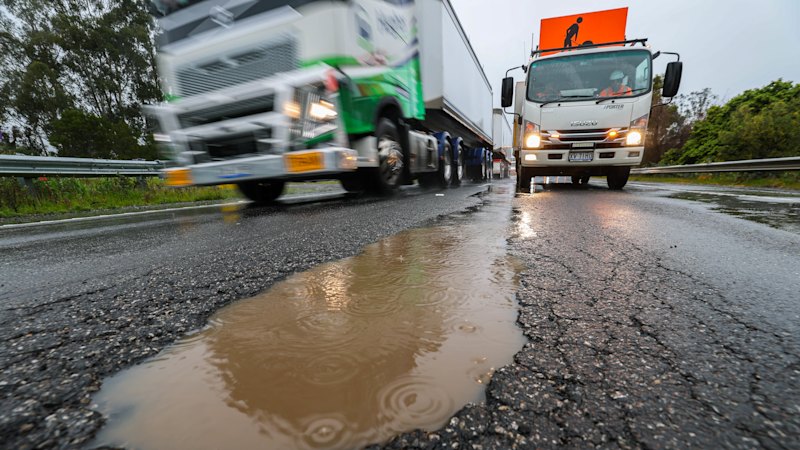
September 6, 2026 — 5:00amQueensland could teach Victoria a simple lesson about how to fix a pothole: mix 3 per cent bitumen and 1 per cent cement into granular pavement to make it more resilient.It’s one of many tried-and-tested solutions that could reduce potholes and help fix the now-politically charged pothole crisis playing out in every corner of Victoria.Potholes are a bottomless problem in Victoria.Joe ArmaoSuch are the levels of disquiet, rising to anger, about potholes in the state, Labor announced a plan to put Victorian inmates on the tools to help fix the mess – hoping it will appease fed-up drivers who have made an extra 10,000 complaints this year compared with last.In his latest pre-election pledge, Premier Ben Carroll said low-security prisoners could perform basic roadside maintenance such as mowing grass, removing graffiti and picking up rubbish.It’s part of the state government’s promise to fill 500,000 potholes, funded by a cash injection of $352 million. The opposition has its own $5 billion plan to fix 1 million potholes over four years.But experts urged Labor to keep prisoner roles limited to roadside maintenance.“Without casting any aspersions, I wouldn’t have thought the prison population would be skilled in the capacity to do rehabilitation treatments on road networks,” said Michael Caltabiano, chief executive of the independent not-for-profit National Transport Research Organisation (NTRO).“There are two parts to making the network [functional]. Part one is you must make it safe. You must get on the network and fix potholes immediately. Part two is you need to fix the problem properly. These are really skilled jobs.”Are there more potholes in Victoria this year? Data collected by the privately owned app Snap Send Solve says yes. The app has become a favoured method for motorists to report potholes to councils, and shows a 46.4 per cent jump in year-on-year complaints.It said 37,482 self-reported complaints of potholes were made in the year to August 16, compared with 25,595 in the previous 12 months.Clayton Keefe, who lives west of Ballarat, said: “I’ve been driving in Victoria for 48 years, and it’s never been this bad before.”Potholes on the two-way stretch of the Ballarat-Carngham Road – not a major arterial but one of three high-traffic roads used by locals – had become noticeably worse in the past six months, he said.“It’s all fun and games dodging potholes, as long as you can dodge them. We’re talking about a 100km/h road, with two-way traffic and trucks,” Keefe said.Potholes will be a hot-button issue in this year’s state election. Joe Armao“It’s not the worst road in Victoria, but it is still representative of the broader problem that doesn’t seem to be going anywhere.“I now mainly take back roads to get where I’m going.”Beyond the Snap Send Solve data, longer-term insights about prevalence of potholes is patchy.Ashim Debnath, a professor of transport engineering at Deakin University, is aware more people “are seeing more potholes recently”, but said he did not believe there was one scientific data source that had tracked trends.A road crew and damaged cars in Bunyip last month. Premier Ben Carroll has pledged extra cash to fix 500,000 potholes across the state.Joe Armao“I want to highlight a point here that rain during the winter season in Victoria is more common than other seasons,” Debnath said. “This can trigger the creation of potholes.”The Department of Transport and Planning tracks road hazards from road crew inspections, call centre reports, online inquiry forms and CCTV cameras. But there is no publicly available database.Politicians say they have solutions Carroll announced that a re-elected Labor government would “establish one simple website” for reporting and tracking pothole repairs.The Sunday Age contacted the government to clarify its plan, and ask how it planned to bring state and road maintenance programs “in-house”, and why the third-party app Snap Send Solve was favoured among motorists for making reports. The government was also asked how it planned to make “everyone” accountable for road safety, as described in its announcement.A spokesman responded: “A re-elected Carroll Labor government will deliver a comprehensive plan to improve the quality of our roads.“We’re doubling pothole and road repairs this year and will deliver a new set of rules for fixing them.”A spokesman for the Victorian Liberal Party said Labor had “copied” plans for its pothole reporting website.“Whilst Labor wants to patch potholes with prisoners, our team has a comprehensive $5 billion plan to repair and rebuild Victoria’s roads, eliminate 1 million potholes and prevent our roads from ever getting this bad again,” the Liberal spokesman said.Why do potholes emerge?To understand how potholes form, you first need to understand the hierarchy of roads, which are mostly made from asphalt in Victoria.At the top are full-depth asphalt pavement roads, which include major arterials such as the North East Link and the M80 Ring Road. They are constructed to withstand huge traffic volumes and heavy loads.They were more expensive but longer-lasting, Caltabiano said.At the other end are granular full-depth pavements with a thin, flexible seal on top. These pavements are a “cost-effective way of delivering high-quality roads when they are built properly”, Caltabiano said. The Western Highway is an example.Full-depth granular pavements are made from quarried product, which goes through a crushing and sieving process, before it is combined back together.Potholes can form within days, while others take weeks or months to emerge.Cracks can form on the surface because of water trapped beneath that freezes in a thaw-freeze cycle, as well as repetitive loading, Debnath said.“When a crack forms on the road surface, water goes through the crack and inside to the base and sub-base, and goes towards the sub-grade,” he said.“With repetitive loading of vehicles, this crack often gets wider, longer, and then we slowly start seeing a pothole.”Usually, potholes will open at the outer line of the road first, because as water gets into the pavement, it travels outwards but can’t escape, Caltabiano said.“If the seal [typically a thin layer of asphalt on top of roads] reaches end of life or is aged, water comes in from the top,” he said.Data from the Snap Send Solve app reports a big increase in the number of potholes in Victoria in the past year.Jason South“Water can also come in from the side. So when you’re driving down these highways, if you see grass and materials right up to the edge of the seal, once moisture gets in, it can’t get out.“That’s when that hydrostatic motion of a vehicle tyre going over the top of the pavement just blows the pavement up.”Did flooding make Victorian roads worse?Yes. At least when Victorian roads are compared with Queensland roads.In 2022, swaths of northern and western Victoria were hit with their wettest spring on record, which resulted in the state’s worst flooding crisis since 2010.A flooded street in Shepparton in 2022. Roads have suffered extensive flood damage across Victoria.Australian Financial ReviewThe crisis affected 63 out of 79 Victorian municipalities.Asked if the 2022 floods could have contributed to Victoria’s current pothole problem, Caltabiano said: “Yes, quite clearly.” He said 8400 kilometres of the state’s road network had been affected by flooding.In 2017, there was similarly disastrous flooding in Queensland, caused by Cyclone Debbie. But when the floodwaters subsided, parts of the road network were “unblemished”, Caltabiano said.Queensland’s roads largely withstood the flooding caused by Cyclone Debbie in 2017.Glenn HuntThey were treated with “foamed bitumen stabilisation” (made using air, water and hot bitumen).“If they had been doing that in Victoria for the same period, which Queensland has for over a decade now, then the outcome of the 2022 flood event [in Victoria] would have been far less,” Caltabiano said. “They would have been able to recover quicker and the bill to fix the network would not have been as astronomical as it is now.”How are potholes fixed?Transport Victoria oversees the maintenance plan for arterial roads including freeways and major state roads. There is a 10-year $6.6 billion budget for road maintenance.The authority manages 4000 kilometres of road in the metropolitan network and 23,000 kilometres across the state, which accounts for about 15 per cent of the state’s roads. It is meant to regularly inspect roads. Councils manage the rest of the state’s roads.Maintenance work is broken down into critical, needed (works to prevent deterioration in 12 to 24 months) and desirable (proactive works).Potholes on the Hume Highway. Jason SouthDebnath said there were two methods to fix potholes on asphalt.The first is a cold-mix asphalt for a short-term fix. It is pre-made and doesn’t have to be warmed but doesn’t last long.The second method, Debnath said, was filling potholes with hot mixes made from bitumen, crushed stone and recycled materials. They are mixed and poured into potholes and rolled over for a long-term fix.Beyond reactively filling in potholes, Caltabiano said it was essential to collect road maintenance data.Vehicles from the National Transport Research Organisation collect data nationally, but only records information about Victorian roads every two years. It began collecting information in 2021.Queensland has 13 years of continuous data via the research organisation, Caltabiano said, which had saved the state $1 billion on its road maintenance backlog.NSW has 12 years of continuous data, collected every two years.“You have to have the data sets to map the deterioration of your network to know the right treatment,” Caltabiano said. He said that after collecting data, a resilience plan was essential.The NTRO developed new treatments for Queensland roads that were more resilient, including using 3 per cent bitumen and 1 per cent cement in granular pavement to blend into new works and rehabilitation.“It makes the [pavements] moisture resilient,” Caltabiano said.And recycled materials, such as crumbed rubber seals from old tyres, could be used.“We’ve got an innovation pathway with Western Australia. They are now rolling out really highly rubber modified seals across their entire network in WA because it gives them enhanced life, better stick for the stone, so you don’t have stones hitting windscreens and driving people crazy,” he said.Why does it take so long to fix potholes? In Glen Iris, in Melbourne’s inner south-east, potholes on roads reported to the local council were fixed within a few days, resident Alan Ovens told The Sunday Age.That did not appear to be the case for state managed roads, he said.Ovens said that on July 29, his Mercedes-Benz E-Class was damaged by a deep pothole on Canterbury Road, Box Hill South, which left him with an initial repair bill of $4500.The Victorian government and state opposition have both pledged to repair the state’s pothole crisis.Justin McManusHe lodged a notice of incident and claim with the Department of Transport, but it was rejected because “no defect or hazard was identified at this location”.The department’s letter stated that the road was inspected on July 27, July 29 and August 1, in line with the required twice-weekly inspection schedule. Ovens disputed that, and he said his insurer might now pursue a legal claim.Caltabiano said when potholes emerge on major highways, traffic volumes made it “incredibly hard, and it is incredibly expensive” to close lanes down and fix the roads.Opposition Leader Jess Wilson and Anthony Marsh fill a pothole in Dromana while campaigning for the Nepean byelection.Instagram/@jesswilsonmpPermanent rehabilitation “may take some weeks as the full assessment of the type of damage and the nature of the fix has to be subject to an engineering assessment and then budgeted for”.Victorian Liberal MP Anthony Marsh grew so fed up with the state of roads that he coded his own free website for people to report potholes. It’s called Road to Ruin.When the website was limited to the Nepean electorate and the Mornington Peninsula, it received 170 reports of potholes between July 10 and August 31. But since it opened to motorists across Victoria from September 1, there have been a further 73 reports from 35 electorates across the state.Marsh, who won the Nepean byelection in May, agreed the state of Victorian roads was worse now compared with a few years ago.“In my own experience, I’ve had two tyres destroyed and one rim punctured in the past few months,” he said.“When speaking with locals, they tell me, ‘It has never been this bad.’”Start the day with a summary of the day’s most important and interesting stories, analysis and insights. Sign up for our Morning Edition newsletter.More:City lifeFor subscribersRoadsBen CarrollJess WilsonFrom our partners
‘Blows the pavement up’: How freezing water and car tyres create a pothole in just days
Full Article
Original Source
Read the full article at Smh →KhanList aggregates and links to publicly available news content. We do not host full articles from third-party sources. Always verify important information with original sources.