
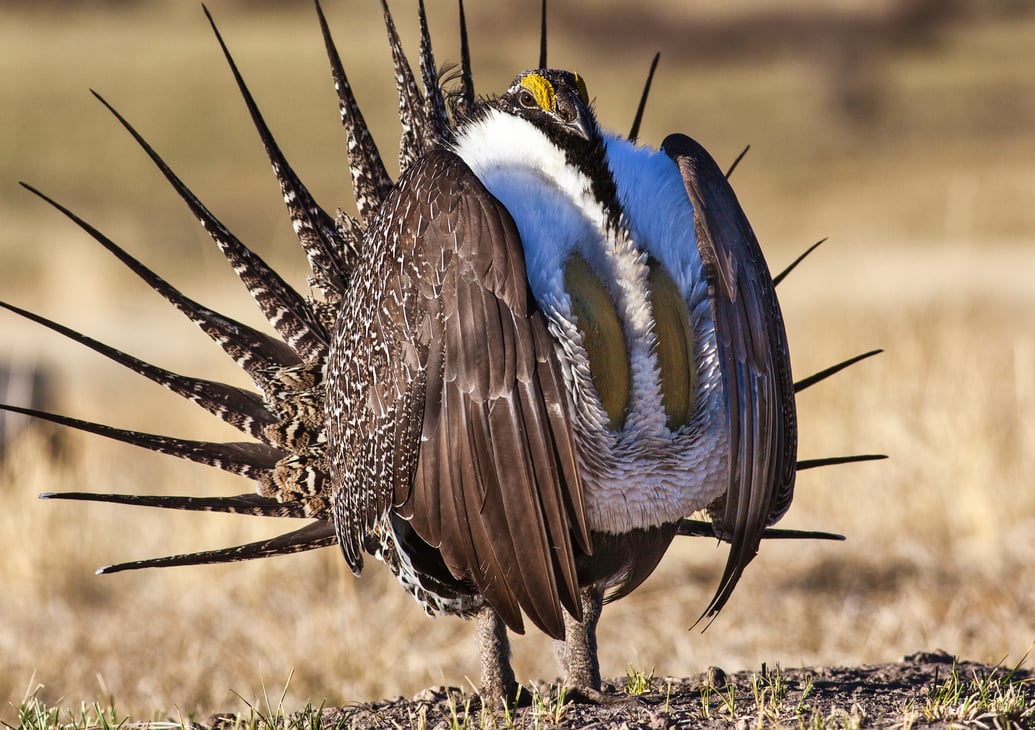
The judge didn't vacate the federal agency's assessment but said it required better information about the greater sage-grouse population in the area.(CN) — A federal judge on Friday ordered the U.S. Bureau of Land Management to address shortcomings in a 2024 environmental assessment of renewed grazing permits in Montana’s Grasshopper Watershed with respect to the impact on the vulnerable greater sage-grouse population.Chief U.S. District Judge Brian Morris granted in part and denied in part the cross motions for summary judgment brought by three environmental advocacy groups and the government.Morris, a Barack Obama appointee, didn’t vacate the BLM’s environmental assessment but said the agency must include all available data necessary to support a complete assessment of the status and populations trends of sage-grouse in the watershed.“Defendants seemingly didknow, or at least knew better than disclosed, the status and trend of the sage-grouse populations in the watershed,” the judge wrote. The National Environmental Policy Act “requires defendants to include all relevant data that supports the conclusions in their EA.”Likewise, the judge agreed with the environmentalists that BLM’s decision to exclude data about forb — plants like sunflowers, clovers, dandelions, and milkweed that provide food and shelter for grouse nests — from its habitat assessment in the environmental assessment without explanation was arbitrary and capricious.BLM, he said, must either include an analysis of forb height data in the environmental assessment or explain why forb height data doesn’t represent an appropriate metric when assessing the habitat at issue.“We are thrilled the court ordered the BLM to redo their analysis on how grazing affects sage grouse, Mike Garrity, executive director of the Alliance for the Wild Rockies, said in an email. “There are so few pristine and intact sagebrush ecosystems in their population, and their population has been in a continuous and precipitous decline across their historic range. This is why the Alliance went to court to stop this habitat-destroying project.”Earlier this year, Morris declined to block the grazing project in southwest Montana.The Alliance for the Wild Rockies, Native Ecosystems Council and Council on Wildlife and Fish sued the BLM in 2025 over its authorization of grazing, livestock management and range improvement projects in the area.The groups say the area contains highly valuable habitat for sage-grouse, a bird species native to the western U.S. and Canada that has been in decline for decades due to habitat loss.The conservation groups accused the agency of approving the projects without adequately analyzing the impacts they would have on sage-grouse, its habitat and the habitat of other wildlife. They unsuccessfully asked the court to block the agency’s approval of grazing, which typically starts on April 1.Specifically, the conservation groups argued the agency failed to disclose crucial baseline information about the sage grouse population in the watershed. From 2021 to 2024, the Montana sage grouse population decreased by around 30%. Between 2002 and 2024, the population decreased by nearly 50%.On summary judgement, Morris rejected a number of the nonprofits’ arguments, such as that the environmental assessment included no cumulative analysis of past spring grazing as applied to sage-grouse specifically, because that would involve undesirable micromanaging of the federal agency.“BLM chose to structure the cumulative impacts analysis around specific resource issues rather than individual species or each kind of authorized activity,” the judge said. “The court will not overly second-guess this choice.”Representatives of the Justice Department, which represents BLM in the litigation, didn’t immediately respond to a request for comment.Subscribe to our free newslettersOur weekly newsletter Closing Arguments offers the latest about ongoing trials, major litigation and rulings in courthouses around the U.S. and the world, while the monthly Under the Lights dishes the legal dirt from Hollywood, sports, Big Tech and the arts.Additional Reads
BLM ordered to fix environmental assessment for Montana grazing permits
Full Article
Original Source
Read the full article at Courthousenews →KhanList aggregates and links to publicly available news content. We do not host full articles from third-party sources. Always verify important information with original sources.