
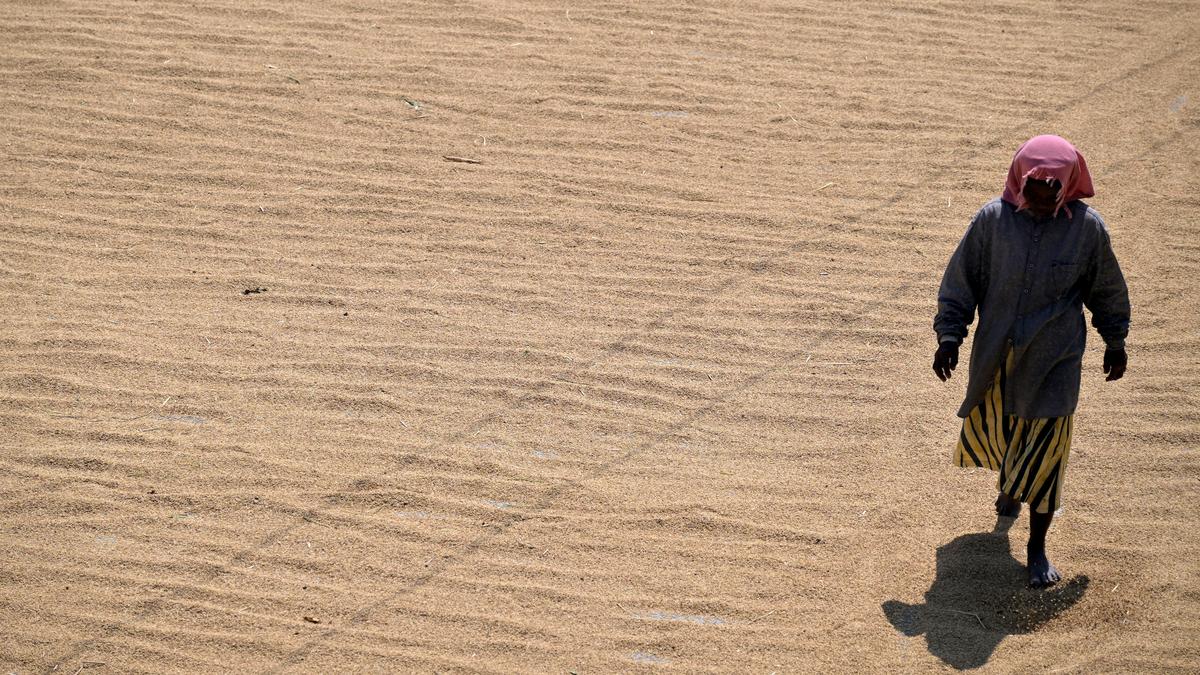
Temperatures crossed the 40˚C mark twice last week in Palakkad and are now dangerously hovering around heatwave threshold levels at many stations across the State. | Photo Credit: K.K. Mustafah Blistering heat, soaring ultraviolet (UV) levels, oppressive humidity amplified by rising heat index values, and the urban heat island effect are making life increasingly uncomfortable across Kerala during the peak of the summer with residents reporting unease amid the sweltering, sultry conditions, which are expected to persist until the first week of May.Visual story: How this year’s El Niño hit India’s farmsTemperatures crossed the 40˚C mark twice last week in Palakkad and are now dangerously hovering around heatwave threshold levels at many stations across the State, especially in Punalur and Palakkad. Coastal regions in north Kerala, including Kannur and Kozhikode, have also been experiencing sultry conditions due to unusually high relative humidity in the air, which drives the ‘feels-like’ temperature dangerously high.The latest weather bulletin issued by the India Meteorological Department (IMD) on Friday warned of above-average temperatures across the State. The agency has forecast maximum temperatures of around 40˚C at isolated places in Palakkad district, 39˚C in Kollam district, 38˚C in Kottayam district, 37˚C in Alappuzha, Pathanamthitta, Ernakulam, Thrissur, Malappuram, Kozhikode, Kannur, and Kasaragod districts, and 36˚C in Thiruvananthapuram district (2 to 3˚C above normal) until April 19.Alarming UV levelsIn addition, the rising mercury levels have put many regions in the State at high risk from UV rays, with several places recording alarming levels of radiation this season, according to Dr. M.G. Manoj, a scientist with the Advanced Centre for Atmospheric Radar Research (ACARR) at Cochin University of Science and Technology (CUSAT).Data recorded by the Kerala State Disaster Management Authority (KSDMA) show that UV Index (UVI) values of 8–9, classified as “very high,” pose significant risks of sunburn, skin damage, and eye problems, Mr. Manoj said. This rise in UV levels, coupled with the urban heat island (UHI) effect, which makes temperatures in densely populated cities as much as 2˚C higher than in rural areas, makes life more difficult in urban regions. Materials used in constructing buildings, roads, and roofs, such as concrete, asphalt (tar), and bricks do not transmit light and have higher heat capacity and thermal conductivity, driving the temperatures up in the urban areas, making hot and humid conditions uncomfortable during summer.‘Heatwave unlikely’However, according to IMD sources, a heatwave is unlikely to occur in Kerala this year as a weak La Niña, a climate pattern characterised by colder-than-normal sea surface temperatures in the central and eastern Pacific Ocean, is prevailing. It is expected that by the end of this month, summer rainfall will increase, preventing temperatures from reaching heatwave levels like those experienced in Kerala in 2024 during the El Niño period, the opposite of La Niña, which suppresses rainfall and causes dryness in the Indian subcontinent.For a heatwave to be declared, the maximum temperature should be 40°C or more (for plains), with a departure from normal of at least 4.5°C. For coastal regions, the maximum temperature should be greater than or equal to 37°C, with a departure from normal of 4.5°C. Additionally, such conditions must be recorded at least at two stations for two consecutive days, as stipulated by the IMD. This is unlikely under the present conditions, as departures from normal have mostly remained within the range of 1–3°C so far this season, according to scientists. Published - April 17, 2026 04:13 pm IST
Blistering heat, soaring UV levels and high humidity keep Kerala on its toes
Full Article
Original Source
Read the full article at Thehindu →KhanList aggregates and links to publicly available news content. We do not host full articles from third-party sources. Always verify important information with original sources.