
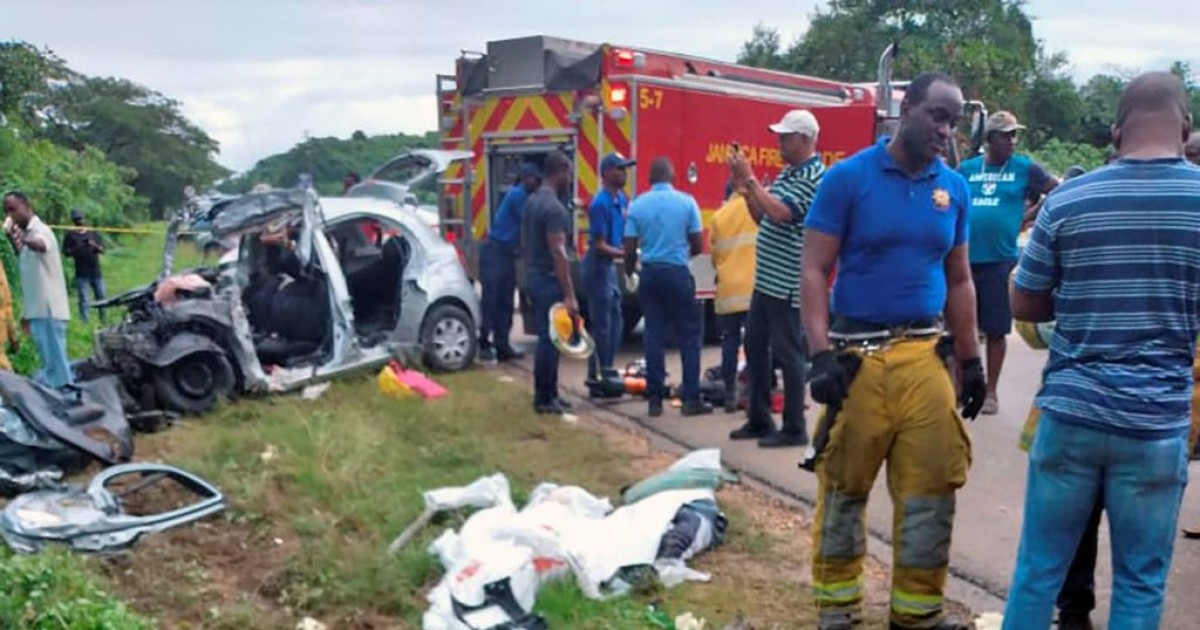
In this file photo rescue crew and civilians are at a fatal crash scene in rural Jamaica. THE Island Traffic Authority (ITA) has estimated the economic cost of road fatalities in Jamaica for 2025 was US$72 million (approximately $11.5 billion). The estimate factors in the number of crash victims, their age at the time they died in a fatal crash, and their projected earnings if they had lived to retirement age. According to the annual crash report, released this week by the ITA, the US$72 million was an increase of approximately US$4 million when compared to 2024 based on an increase in the number of lives lost last year. “This underscores that road safety is not only a public health issue but also a critical economic concern,” the ITA said. The report notes that 374 people lost their lives in 325 fatal crashes in 2025, a two per cent increase in fatalities and a three per cent increase in fatal crashes when compared to 2024. Despite the increase, the ITA remains optimistic that things are trending in the right direction. “Although the road-related deaths were slightly higher in 2025, it marks the second-consecutive year in which fatalities fell below the 400 mark,” said the authority “The reduction signifies a noteworthy stride toward national and global road safety targets, and offers an opportunity for reflection, recalibration, and momentum-building,” the ITA added. It noted that Jamaica‘s goal is to meet the United Nations Decade of Action for Road Safety (2020-2030) target, which is to reduce the tally of road fatalities that occurred in 2020 by half. “Jamaica‘s current progress towards this target is a reduction of 14 per cent. To meet the United Nations Decade of Action for Road Safety (2020-2030) target Jamaica‘s road fatalities on average must be reduced by 8.3 per cent per annum,” said the ITA. The report shows that St Catherine was the deadliest parish for road users in 2025 with 65 deaths. St Ann came next with 36, followed by St Elizabeth with 34, St James 32, and Westmoreland 31. St Andrew recorded 29 fatalities during the year, Clarendon had 26, Hanover and St Mary had 22 each. They are followed by Trelawny and Manchester, which each recorded 20 deaths. The three safest parishes for road users last year were Portland with nine deaths, St Thomas with 11, and Kingston with 17. As to what is driving the high number of crashes and fatalities, the ITA stated that “the majority of traffic crashes are rooted in driver behaviour, with excessive speed remaining the most dominant cause”. Last year 114 fatal crashes were attributed to speeding — continuing a trend over the last six years. This was followed by failure to keep to the correct traffic lane with 68 crashes; pedestrians walking or standing in the road led to 26 crashes; turning to the right without due care saw 13 crashes; and overtaking improperly on the offside resulted in 31 crashes. “These leading causes suggest a combination of aggressive driving and poor road discipline,” said the ITA, as it pointed out that the category “Others” represents the combined total of various other causes of road fatalities, accounting for 122 deaths in 2025. The ITA said understanding the demographic composition and timing of fatal road crashes is crucial for developing targeted, equitable, and impactful road safety policies. A bus involved in one of the many crashes on the nation’s streets last year. (Photo: Karl Mclarty) The data from 2020 to 2025 reveal persistent and concerning patterns regarding gender and age. Worryingly, road traffic fatalities continue to be overwhelmingly male-dominated. In 2025, males accounted for 85 per cent of all traffic deaths (318 of 374), while females accounted for 15 per cent. “The data reinforces that, while road safety strategies must address the general population, men — especially younger and middle-aged males — should be a primary focus for targeted road safety initiatives,” said ITA. The data also pointed to age-based analysis which reveals another layer of vulnerability. In 2025, the 25-29 and 30-34 age groups recorded 48 deaths each, accounting for 26 per cent of the total number of fatalities. “Individuals aged 20-60 years constitute the core of Jamaica’s workforce [and accounted] for 223 fatalities in 2025, representing a substantial economic loss to the country in terms of productivity and labour force capacity,” the ITA noted. Meanwhile, the elderly, aged 60 and above, recorded 71 deaths, an 82 per cent increase compared to 2024. The ITA said understanding when fatal crashes are most likely to occur is critical for effective road safety planning. It said the analysis of crash distribution across time — by month and day of the week — and road user category provide patterns that can point to potential behavioural and temporal risk factors. Over the past five years, the first quarter of the year (January to March) has consistently recorded high fatality numbers. However, in 2025, the third quarter reported the highest number of fatalities (106 deaths). The traditionally high-risk, mid-year months — July and August — saw a resurgence in 2025, with July recording the highest total crashes for the year (39 deaths). November recorded the least number of deaths in 2025 (24). In terms of day of the week, the data show that weekends remain disproportionately dangerous. The ITA said Saturdays and Sundays consistently record the highest number of crashes and fatalities. In 2025, Sundays recorded 58 crashes and 74 deaths, while Saturdays accounted for 52 crashes and 64 deaths. “These figures reflect persistent risks associated with weekend travel, which is typically characterised by leisure driving, night-time events, increased alcohol consumption, and higher traffic volumes and more varied traffic patterns associated with non-work activities,” added the ITA. Christmas Day emerged as the most dangerous holiday over the six-year period, recording the highest number of fatal crashes (17) and fatalities (19). This is followed by New Year’s Day (13 deaths) and Independence Day (12 deaths). “The data indicate that festive holidays tend to be associated with increased road traffic fatalities, likely due to higher traffic volumes, longer travel distances, and celebratory activities,” the ITA noted.
Bleeding billions
Full Article
Original Source
Read the full article at Jamaicaobserver →KhanList aggregates and links to publicly available news content. We do not host full articles from third-party sources. Always verify important information with original sources.