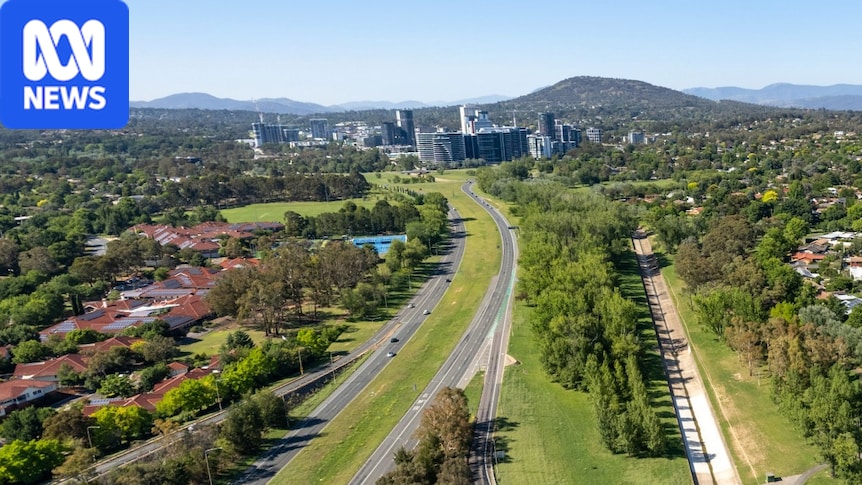
The ACT government is calling for public feedback on its plans for a development corridor through Canberra's south over the coming decades.The draft Southern Gateway Planning and Design Framework details the government's vision for growth along the future light rail line from Parliament House through to Mawson and Woden.It focuses on "sustainable growth" for the area to beyond 2050, when Canberra's population is projected to be 700,000.An artist's impression of a light rail stop proposed for Adelaide Avenue near Carruthers Street in Curtin. (Supplied: ACT government)Mid-rise housing would be developed closest to transport stops and shopping centres, with high-rise development reserved for the Woden Town Centre and north Curtin, according to the draft plan.The government said it wanted to hear from the community about "the places people value", about public spaces like sporting and community facilities and "how the area can continue to support jobs and services".A model inspired by European citiesACT Minister for Planning and Sustainable Development Chris Steel said the framework was aimed at providing more of the kind of housing that was missing from Canberra, while making it a more walkable and sustainable community.The draft plan for a development corridor in southern Canberra is available for public comment. (Supplied: ACT government)"The ACT government believes that the best place to put new housing is near high-frequency light rail and rapid bus stops and shopping centres," Mr Steel said."We're adopting a transit-oriented development approach, which is about locating more housing, providing opportunities for more people to live near high-frequency public transport connections and close to amenities, jobs and services."He said this model of development had been successfully adopted by cities "around the world"."The mid-rise housing focus as part of this plan is similar to what we see in European cities that Canberrans love to visit," he said."It's about providing sustainable and walkable communities that have good access to amenities and services around them."Mr Steel said the plan was consistent with Walter Burley Griffin's original vision for Adelaide Avenue."That envisaged more density along a multimodal boulevard, stepping down to the low-density housing in the suburbs and near the hills," he said.ACT MLA Chris Steel said Canberra was growing rapidly and more housing was needed. (ABC News: Callum Flinn)Mid-rise development is defined as about six or seven-storey buildings."We see some good examples along the corridor already; the Ambassador residences that are currently in place near Deakin shops is one example," Mr Steel said."Mid-rise housing is a current gap in the housing market."Mr Steel cited the Ambassador residences in Deakin as an example of mid-rise housing. (ABC News: Harry Frost)Mr Steel said the importance of transit-oriented development could also not "be understated"."It's about stopping urban sprawl and making sure that we build more housing in the places where it makes most sense," he said.In response to fears in the community about the impact of Canberra's growing population, the minister said there were no "significant levers" available to the government to curtail it."Canberra's a great place to live and people are coming here from interstate to ... take up the jobs on offer and the high quality lifestyle that we have in Canberra," he said."What we want to do through this plan is make sure that as the population grows, we keep that high quality of life that we enjoy in Canberra."Woden Town Centre is gaining high-rise buildings to support Canberra's population growth. (ABC News: Greg Nelson)'Any changes should be gradual'Nelson Tang from the Woden Valley Community Council said the council welcomed an increased population but said work needed to be done to ensure the area's facilities could handle it."We have been calling for more community facilities, like a community centre for young people and older Canberrans to come and meet," Mr Tang said."We don't have a town hall at the Woden Town Centre at the moment and facilities and meeting places like these are essential for an increased population."There are concerns from some about the way Woden Town Centre is growing. (ABC News: Greg Nelson)He called for more investment in sporting facilities, with plans to replace the Phillip Swimming Pool and relocate the ice skating rink to Fyshwick already underway."We have more concerns for the high rises that are proposed," he said."There have been discussions of 55-storey towers going into the centre of Woden, which will become the tallest building in Canberra if built. "The feedback from our community is that we love its suburban characteristics and any changes should be gradual."Transforming 'bleak motorways'The ACT government has previously announced plans to reconstruct the roundabout at the end of Yarra Glen into an intersection as part of the light rail stage 2B project.In May this year, it announced it would proceed with one of the initial options for extending Stage 2B, confirming it would run from Commonwealth Avenue, through the National Triangle, along the east of State Circle to Adelaide Avenue, and then on to Woden.The Public Transport Association of Canberra (PTCBR) welcomed the government's draft development report, but cautioned timing was key to a successful rollout of the project."This framework sets a fantastic vision for connecting land use with high-capacity public transport, which is exactly how a growing, modern city should plan," PTCBR chair Amy Jelacic said."To ensure we get the best possible outcomes, it will be important to align this new housing with the rollout of light rail stage 2B so that these new neighbourhoods are well supported from day one."Previously released plans show how the government intends to replace the roundabout connecting Woden to Yarra Glen with an intersection. (Supplied: ACT government)She said the plan proposed transforming the "bleak motorways" that were Adelaide Avenue and Yarra Glen into "multimodal, landscaped avenues"."Transforming our major arterial roads into human-scale, accessible avenues is an exciting opportunity," Dr Jelacic said."While this transition will take time, the long-term benefits for our city will be immense."Community engagement is open from 22 July to 15 September 2026, and a range of events will be held for the community to participate in.
'Bleak motorways' in Canberra's south to gain housing under draft plan
Full Article
Original Source
Read the full article at Abc →KhanList aggregates and links to publicly available news content. We do not host full articles from third-party sources. Always verify important information with original sources.