
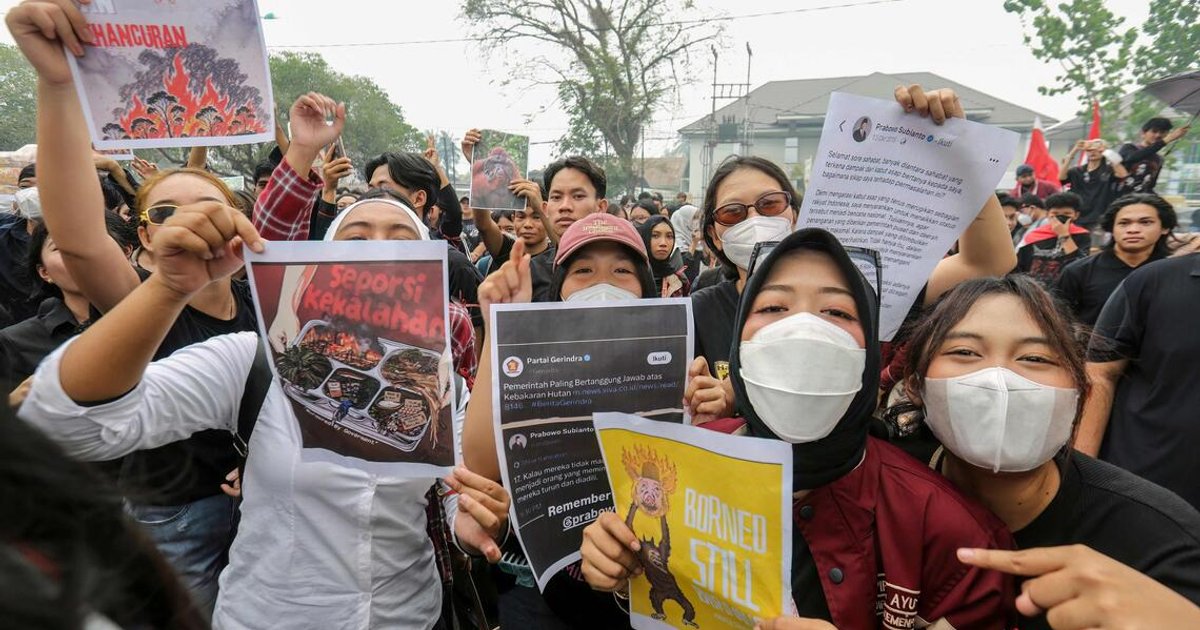
JAKARTA – A blame game has erupted between some of Indonesia’s provincial authorities and the central government as forest fires scorch Kalimantan and Sumatra.Central Kalimantan’s administration under Governor Agustiar Sabran, pressed by Jakarta to step up firefighting, has publicly complained that forest concession permits are issued by the central government, while provincial authorities and residents are left to deal with the fires.Similar complaints have not been publicly voiced by provincial leaders in Sumatra.Since the 2020 Job Creation Law centralised licensing powers, authority over business activities in forest areas has rested largely with Jakarta.The row has now spilt onto the streets, with rallies held by the students of a few universities in Central Kalimantan, adding further pressure on the local government.On Oct 19, a female university student led a protest outside the governor’s office in Palangka Raya, where she urged Agustiar to take bolder measures, including pressing the central government to declare the fires a national disaster. A TikTok video of the protest with 26,000 likes and 888 comments as of the morning of Oct 20 has since circulated widely.“We have suffered greatly for more than four months,” she said at the gate of the office.She then mocked a banner that read: “Central Kalimantan free of haze 2026. Preventing forest fires starts with us”, emphasising that both the provincial and central governments had been warned about the intensity of this year’s El Nino since February, but failed to take action.Agustiar listened calmly, surrounded by his deputies, aides and police officers, but did not respond. He promised to return to answer the protesters after praying, but he never reappeared, angering the students.The protesters’ demands went to the heart of the dispute. Among them was a call for provincial governments to regain the power to revoke companies’ concession permits. However, this would be a long, drawn-out process through Parliament and unlikely to succeed.In September 2026, Joni Harta, head of Central Kalimantan’s environment agency, said in a video posted on Instagram that drew 55,000 likes and more than 5,000 comments: “When the forest burns, why is Central Kalimantan province told to put out the fire? Why are the people of Central Kalimantan told to put it out? Not a single permit in forest areas was issued by the province. Should we be the ones putting it out?”“Don’t pass the buck and blame my governor whenever something happens,” he added.Joni also urged the forestry ministry to release funds owed to the province under the revenue-sharing scheme for a reforestation fund. “That money is our right. The central government should not hold it back,” he said.His agency, he said, had done what it could within its responsibilities, putting up banners and campaigning against land burning. “We monitor companies that got permits from the central government but have no firefighting equipment, and we will certainly sanction them. But our budget is not enough.” He added that the agency, and the environment ministry, was dealing with seven errant companies.Jakarta pushes backThe forestry ministry has pushed back, insisting that fire prevention and control are shared responsibilities. Responding to Joni’s remarks, the ministry’s public relations chief, Ristianto Pribadi, said on Sept 23 that fire management is a joint undertaking of the central and regional governments, law enforcement, businesses and communities, with authority determined by where a fire occurs, the status of the land, the type of business and the permits held.He noted that environmental approvals for companies and their supervision fall to the environment ministry or provincial environment agencies, depending on their respective powers, a role that includes Joni’s own office. He said the forestry ministry oversees permit holders’ compliance in forest areas, including their fire-control obligations.Putra Saptian, senior campaigner at peatland-focused non-governmental organisation Pantau Gambut, agreed, arguing that regional and provincial governments retain significant authority.“The claim that all responsibility shifted to the central government in 2020 is regarded as a fallacy,” he told ST, pointing out that provinces continue to have the authority to designate which land any company with a concession is entitled to operate on, and that provinces continue to have the power to halt operations of companies that breach a law.The ministry has also moved to show it is acting against companies. In September 2026, it revoked the permits of five companies in West, South and Central Kalimantan, covering concessions totalling 92,464 hectares. On Oct 20, it said it had imposed administrative sanctions on 32 companies over 12,926 hectares of burnt land across seven provinces, and was handling suspected criminal cases against 125 individuals and corporations.Who is ultimately responsible?The dispute raises questions about who is ultimately accountable for resolving fires in Indonesia, whose recurring haze crises have consequences far beyond its borders, particularly for Singapore and Malaysia.Writing on the news site Maklumat on Oct 18, Abdul Khalid Boyan, a social and political analyst at Universitas Arya Wangsa, argued that since the 2020 law moved forestry licencing to Jakarta, the permits that serve as the main tool of oversight now sit hundreds to thousands of kilometres from the land. That distance, he wrote, delays detection of violations and lets each side shift responsibility.But he did not spare the regions, noting that permits were handed out freely amid local political interests before centralisation in 2020. The answer, he argued, lies not in choosing between Jakarta and the provinces but in ensuring that whoever holds authority can be held to account. And early detection and action are also key.Haze-hit residents in Sumatra and Kalimantan are urging President Prabowo Subianto to replace police chiefs and territorial military commanders in regions where fires have spread out of control.They argue that stopping small fires from becoming major blazes requires early detection and rapid intervention, and that only the police and military, with personnel deployed down to village level, have the reach to do this effectively.“The military and police have resources and people across provinces and regencies. They can carry out prevention,” Ponco Pramono, 46, owner of shrimp paste noodle shop in Palembang, South Sumatra, told The Straits Times on Oct 16.He added: “Previously (under then President Joko Widodo), we understood there was a policy that provincial police chiefs and regional military commanders would be replaced if fires in their areas spread out of control. That is no longer the policy now under President Prabowo.”Adi Siswoyo, 43, a farmer in Banjarbaru, South Kalimantan, said: “A field police officer (during Widodo administration) confided that he could do little during the dry season besides patrol and hunt for hotspots, because his superior feared being replaced.” Adi said it is no longer the case under Prabowo, who took office in October 2024.But in a possible sign of change, during a visit to Riau on Aug 24, Prabowo praised the province’s military commander, Major General Agus Hadi Waluyo, and police chief Inspector-General Herry Heryawan, and promised both promotions if the fires there were brought to an end.
Blame game erupts between Jakarta and provinces as Indonesia fires rage
Full Article
Original Source
Read the full article at Straitstimes →KhanList aggregates and links to publicly available news content. We do not host full articles from third-party sources. Always verify important information with original sources.