
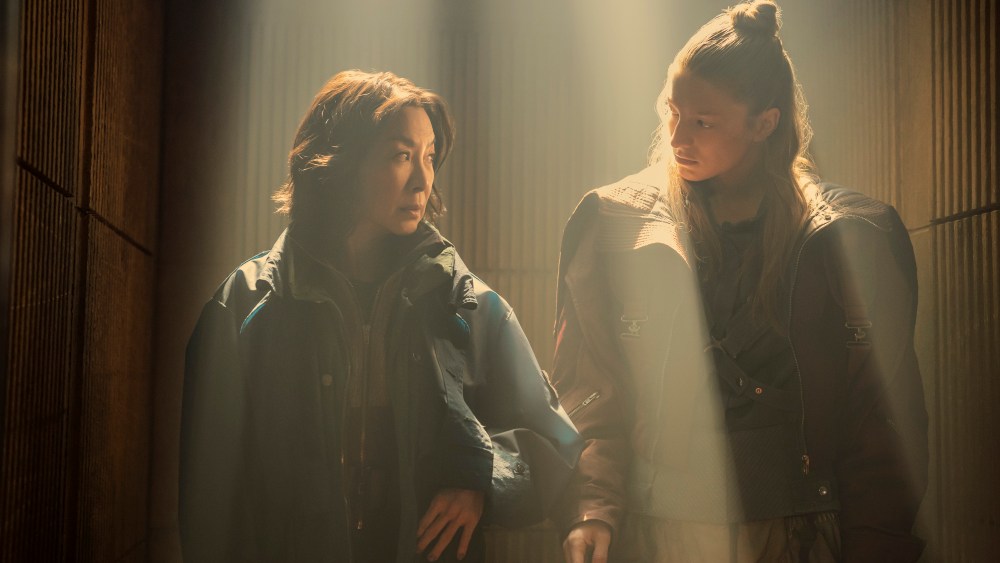
The first “Blade Runner” film — and the Philip K. Dick novel upon which it was based before it — was about a human hunting replicants, the artificial entities created to help colonize other planets. The second, 2017’s Denis Villeneuve-directed “Blade Runner 2049,” was about a replicant hunting other replicants, moving questions of soul and authentic emotion even closer to the story’s core. For the franchise’s first-ever venture into television, the eight-episode limited series “Blade Runner 2099,” creator Silka Luisa (“Shining Girls”) follows this trajectory to its next logical step. In the latest iteration of “Blade Runner”’s far-future dystopia, replicants have finally carried out their long-feared rebellion, and the titular profession’s job description has flipped: Blade runners are now replicants who track down disobedient humans. Of course, the plot of “Blade Runner” isn’t all that’s kept Dick’s vision alive for more than half a century. Ridley Scott’s 1982 adaptation created an incredibly influential tableau of an environmentally devastated L.A. lit by Tokyo-inspired neon signs; “Blade Runner 2049” employed legendary cinematographer Roger Deakins to update that template, winning Deakins an Academy Award for his efforts. Originally greenlit by Amazon Prime Video in 2022, “Blade Runner 2099” took more than four years to make it to the screen. Part of that delay was caused by the Hollywood strikes of 2023, but it’s also clear that Luisa and producing director Jonathan van Tulleken (“Shōgun”) took their time to meticulously expand their inherited world. The audience experiences said world through the eyes of two protagonists, with “Blade Runner” doubling in focus to match a series’ extended runtime. Michelle Yeoh, who’s no stranger to either action or TV science fiction after a stint on “Star Trek,” plays Olwen, a replicant reaching the end of her pre-programmed lifespan and reckoning with the limitations of her kind’s new social power. (Replicants may be the new boss of humans, but they’re still stuck with the pre-planned obsolescence their creators gave them.) Olwen’s new partner Marion (Hunter Schafer) has a secret: She’s really a human named Cora, going undercover as a blade runner to track down an artifact that could undo her species’ downfall. After breaking out in “Euphoria” as a transgender teen experimenting with her sexuality, Schafer has since shown a concerted interest in genre, whether horror (“Cuckoo”) or YA blockbusters (the first “Hunger Games”) prequel. “Blade Runner 2099” is the actor’s biggest platform yet, and the best showcase for all she’s able to do. In the first episode alone, Cora leads the blade runners on an extended chase through a grimy, industrial cityscape, then has a hand-to-hand fight with a much larger opponent. The character gets a standard motivating backstory in her disabled younger brother Elias (Lewis Gribben), but the exposition isn’t necessary for Schafer to broadcast the intensity of Cora’s emotions, from fear of being found out to hostility toward the replicants she blames for the death of her adoptive mother. Casting Schafer opposite Yeoh gives the feeling of one established action icon handing the baton off to an ascendant one. Schafer and Yeoh’s performances are augmented by a veritable army of artisans. Costume designer Helen Huang outfits Yeoh in a multilayered trench and Schafer in a leather jacket with exaggerated, linebacker shoulders, enviable getups for the unenviable drudgery of their day-to-day tasks. Cinematographers Rob Hardy, Ula Pontikos, Vanja Cernjul and Damian Garcia frame their faces with grids of grate-filtered light, or bathe them in the yellowed sun of a polluted beach. Production designers Paul Inglis (also lead concept designer) and Chloe Arbiture create a succession of eye-catching spaces for Olwen and Cora to navigate: an arch-filled memory bank in Mexico; a red-lit rental shop for replicants to play-act human experiences like parenthood and aging; a replicant bunker that serves as a layer cake of levels for Cora to crash through mid-fight scene. “Blade Runner 2099” dutifully incorporates the franchise’s visual and thematic touchstones. Despite the passage of time, computer screens still have the blocky, vintage look of early PCs; a psychotically violent replicant named Clotilde (Amy Lennox), an early convert to a cult of personality that promises her and Olwen’s kind eternal life, is a clear echo of Daryl Hannah’s cartwheeling Pris from the original film. “Blade Runner” has always hewn to the beats of a detective noir, and over time, has acquired mainstays of its own that “2099” dutifully nods to. Though continuity isn’t of too much concern: the climactic revelation of “2049” that replicants and humans can biologically reproduce has been set aside in favor exploring what it means for replicants to lack family. “We made sure they had nothing to fight for,” a Tyrell Corporation sales rep (played by “House of the Dragon” actor Freddie Fox — joining his castmate Matthew Needham, who portrays another blade runner — in a welcome cameo) brags in the prologue. Clearly, the replicants’ inventor miscalculated. But if the difference between replicants and their makers is really one of nurture, “Blade Runner 2099” asks, doesn’t that mean it can be overcome with a few tweaks, like emotional attachments and the time to foster them? Schafer, Yeoh and their backing army of artisans put a fresh and compelling face on some familiar ideas. (You certainly feel the leads’ absence in the rare scenes in which neither is present.) The question of what defines humanity is an age-old one, if especially relevant in the age of AI. It’s in showing a precocious child administer the infamous Voight-Kampff test, which uses invasive questions to gauge its subject’s emotional response, or Olwen’s bond with a former work partner in flashback that “Blade Runner 2099” finds its own angle. The wider canvas of television gives “Blade Runner” room to explore this sad and strangely beautiful future and for its thesis to wear a little thin. Fortunately, the former largely wins out. All eight episodes of “Blade Runner 2099” are now streaming on Amazon Prime Video.
‘Blade Runner 2099’ Review: Hunter Schafer Cements Her Status as a Genre Star, With Help from a Stunning Backdrop
Full Article
Original Source
Read the full article at Variety →KhanList aggregates and links to publicly available news content. We do not host full articles from third-party sources. Always verify important information with original sources.