
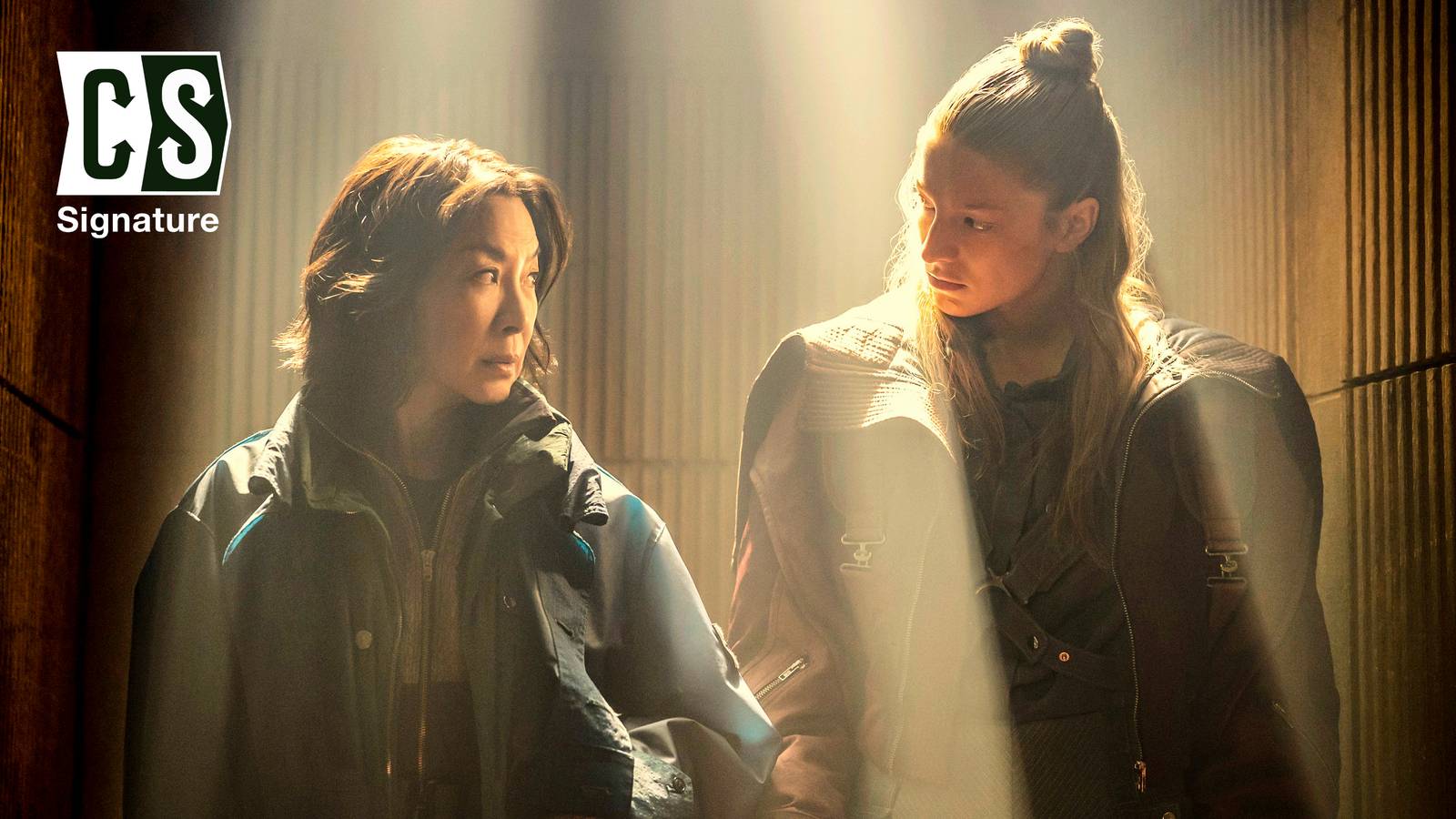
Image via Prime Video Showrunner SIlka Luisa gets into the nitty gritty of the Prime Video limited series. Published Nov 27, 2026, 9:00 AM EST Therese Lacson is a Senior TV Editor who has been with Collider since 2021. She got started in this business over ten years ago working primarily as an interviewer and critic. At Collider, she works closely with the features team to support the writers and also ideates and develops content daily. She has covered major industry events including Cannes Film Festival, Sundance Film Festival, SXSW, Toronto International Film Festival, and San Diego Comic-Con. Although she reviews and covers both film and television, her focus is in television and her expertise is in fantasy and sci-fi genre shows. Her favorite shows to cover include House of the Dragon, Bridgerton, Fallout, 9-1-1, and Rivals. Editor's Note: The following contains spoilers for the entire season of Blade Runner 2099. If you have burning questions after that Blade Runner 2099 finale, then you're not alone! From the seismic shift in the world 50 years after Blade Runner 2049 to the truth behind who Cora's (Hunter Schafer) mother, Helena (Sheila Atim), really is, the new Prime Video series is chock-full of intriguing new ideas for this beloved franchise. The finale saw Cora and Olwen (Michelle Yeoh) finally confronting Julius (Tom Burke), who destroys Tyrell's memory just as Olwen is at death's door. The series ends with an ambiguous tone as audiences are left wondering just what fate befell Olwen and where Cora is meant to go from here now that she's back in the LAPD. Elsewhere in Los Angeles, Bebeto (Dimitri Abold) and Elias (Lewis Gribben) learn the truth behind Ray's (Maurizio Lombardi) intentions for the memory — he is working for Tyrell and wants to use the Nexus model designs. Shocked by this revelation, the two characters take separate paths as Bebeto considers Ray's offer to work together, forcing the black market merchant to push his moral boundaries once again. Meanwhile, Elias, shaken by the revelation of who Helena really was and Cora siding with Olwen, decides to take over the broadcast and take credit for the bombing of the birthing facility. Collider spoke with creator and showrunner Silka Luisa to really dig into these major series finale twists and reveals. Luisa discusses where she drew inspiration from, including Philip K. Dick's novel Do Androids Dream of Electric Sheep? and how blurring the line between replicants and humans is at the heart of the franchise. She reveals a cut storyline where the series would have explored more of Helena and Julius' past. She also discusses the ending and the importance of ambiguity in a Blade Runner ending, but she also gets into the meaning behind the decisions of characters like Bebeto, Elias, Clotilde (Amy Lennox), Cora, and Olwen. Finally, she reveals her perspective on the final scenes of the show without completely giving away the mystery. 'Blade Runner 2099' Creator Silka Luisa Gets to the Heart of the Prime Video Series "That muddiness is so baked into the conceit." COLLIDER: Before I get into spoilers for the finale, I really like the inclusion of the Mercerites and the Nexus-1s in this series, but there is a lot of lore to build upon with this show. You have the original film, Blade Runner 2049, you have the novel. How did you decide what you wanted to prioritize without the show feeling too jumbled? SILKA LUISA: Early on, we decided that we were definitely not going to continue to use the same characters, and so the most important point, even just from a logic standpoint, is we are 50 years in the future. It's new main characters at the heart of the show, and that was really important to try to create an entry point for people who might not have seen one or both of the films and/or read the book. Other than that, it was really open, to be honest. Something like Mercerism; I was just always so fascinated with that concept. I could have unpacked that even more and really gone into how it fell and all the story of the book. But I think just the idea that there's a religion that uses technology to try and build collective empathy, but everyone is isolated, it feels so timely, and what's so special about P.K. Dick is he does have these playful ideas and pops to the world that I think help tonally lift the series overall. A lot of what the series plays with is what makes a replicant a replicant, what makes a human a human. By this point in the universe's storyline, do you think there's really a line anymore? Because it feels like this show is emphasizing that line doesn't really even exist anymore. LUISA: That's always been my interpretation also of the films; that muddiness is so baked into the conceit. The more emotional storylines are always with the replicants, and that is such a beautiful idea, that it's really a mirror that's being held up to us, that helps us rediscover our own humanity. I think we're all feeling that right now with AI, but you weirdly need to look at a reflection of what humanity is in order to really appreciate what makes us special. Will There Be More to the 'Blade Runner 2099' Story? "My hope is that there's more Blade Runner to come in terms of the world overall." Image via Prime Video Going into spoilers, given the way the show ends and how it feels like we're on this precipice — I know the show is a limited series — but it does feel like the show is primed to add more to the story. Is there more of the story in the works? Is there any intention to continue that storyline? LUISA: No, the ending was meant to be a conclusion, and there are definitely open threads, just like there are in both films. We were really trying to define what is a Blade Runner ending, and there is a level of ambiguity and open space for your imagination to fill the gaps. As a viewer, I really loved that about the endings. My hope is that there's more Blade Runner to come in terms of the world overall. In just writing this, there are so many pockets to explore; there are so many places in the world I'd want to see. Off-world is still such a mystery box. It's such a rich universe. Luisa Reveals the Mindset Behind Both Bebeto and Elias After the Ray Revelation "...there is no help coming from unknown forces off world. There's just capitalism..." Image via Prime Video I want to talk about some of those open-ended storylines because one of the most interesting scenes in the back half of the series is seeing Bebeto and Elias working with Ray. When you actually find out that Ray is working for the Tyrell Corporation, he wants to make Nexus-1s again, and that's been the agenda behind this whole thing, why doesn't Bebeto just walk out of there? Why does he consider Ray's offer? LUISA: This is somebody who has already fought the war. This was his last hope, and I think there is a resignation in Bebeto, which is a really tragic ending for him, in the sense that he was always romantic about preserving humanity and hoping that there was going to be a return to the world that he was born into, and he realizes that is just not going to happen. Ray is very much a noir character in the sense that there is no help coming from unknown forces off-world. There's just capitalism, and carving out your own future in whatever new landscape there is. I think Bebeto's reaction to that is understanding the circumstance and realizing that it might be futile to keep fighting. I think Elias is younger, and he didn't fight in the war, and he still has more hope. Talking about Elias, I thought it was so interesting to see his character sort of developing as he learns the truth about Mexico City and the fact that, as you said, there's no safe haven waiting for them. By the end of the series, he actually takes credit for the bombings he didn't commit. Why do you think he uses that moment to step forward, especially after he's had this fracture with his sister? LUISA: I wanted to give him agency, and he's realized that there is no revolution. We're not in a rebellion story, but at the same time, he wants to be a force for change, and so his thinking is, I can be the spark that could start something. It felt believable that he could take ownership of that, and people would believe it, and that would be enough of an act for him to really step into the light himself; somebody who'd really, at the beginning of the season, been living in the shadow of his sister. Luisa Teases Where Olwen Ends Up by the Finale of 'Blade Runner 2099' "...I liked the idea of her returning off-world and how we saw her at the beginning of Episode 2" Image via Prime Video Clotilde is such an interesting character; where did you see her character going beyond this? Because we don't get to see so much of her after she's reborn, and now there are no birthing centers, there's this uncertainty in the air, and she seems to be the only person who has the key. LUISA: I just love Clotilde. I loved writing her; I loved Amy [Lennox]'s performance. I love the idea that there is just this loose Clotilde with this knowledge out in the universe, who, I mean, she just is Id. She's such a wild card, and yeah, you're 100% right; I think she has an ace up her sleeve, and she's out in the wilds. A character like her is so fun to try and imagine what she would do with that. One of the scenes that I was surprised at the most was seeing her and Olwen finding that balance between them. Obviously, it comes from Olwen saving her life, but at the end, I mean, I think I'm correct in assuming that Olwen has a new body when she leaves Earth. Is that her coming out of the bag? LUISA: [Laughs] That's one of the ambiguities. It's so funny. Everyone has different guesses; everyone has different guesses. I wanted Clotilde to feel like she'd been in Julius' shadow for the season, and then, at the end, she's really the one who's left with that knowledge. I was watching the scenes over and over again, and I was like, I'm pretty sure that's Michelle's hand. LUISA: So interesting. It's like a Rorschach test. Because I was thinking, why would she not stay on Earth? Olwen's decision to go to space, whether or not she's dying, is an interesting choice. But it's an even more interesting choice if she has a renewed life and chooses to leave Earth. Can you talk a little bit about that and why you chose to end with that? LUISA: The idea of Olwen is that she is the birther of worlds. I can't remember when that concept came up in the writers' room, but she's been the first being on planets, and that is such a powerful entity. I liked the idea that she was going back to off-world, which is really where she's from; it's her home. It's where she was doing something, which was creating. Now she's been a cop in Los Angeles, which is such a smaller life, right? Hunting people. It's such a diminishment of everything that she was before, and so I liked the idea of her returning off-world and how we saw her at the beginning of Episode 2. Luisa Reveals the Helena and Julius Storyline That Was Cut From 'Blade Runner 2099' "We definitely had a much larger backstory to Helena and Julius that we didn't get to tell..." Image via Prime Video Making Helena into Cora and Elias's mother was a stroke of genius, but I'm curious why her and Julius are so different. I think Helena has more aspects similar to Olwen than Julius, but obviously they were created together. So, why are they so different in their approaches? LUISA: I think a lot of the replicants are all very, very different from each other. We definitely had a much larger backstory to Helena and Julius that we didn't get to tell, which was just their whole upbringing, which is how Tyrell kept them hidden, how he raised them differently, that Helena was his favorite, and that really forged a difference in their mindsets later on as adults. Obviously, they're born as adults, but I think that fundamentally they are different from the beginning, but then also how Tyrell treated them contributed to that. I think that Helena knew what he was going to do with the memory, and that is why she's on that island, to keep it from him. Luisa Dives Into Cora's Humanity and Theories About Her Origins "... why she's able to pass as a replicant and pretend to be a Blade Runner is because she is really no longer a person." Image via Prime Video When Cora goes undercover, her ability to blend in with the replicants makes her suspicious to me in many regards. The previous film did deal with human and replicant children, and there is a part of me that makes has a crazy theory about Cora. LUISA: [Laughs] That's interesting. Yeah, I see what you're saying. Because she's so able to adapt, I wonder: what is the truth here? Is it more that her upbringing by Helena helps her become more like a replicant? LUISA: I mean, there is... I almost don't want to spoil it because one of the pleasures of unpacking the films and trying to fill in the lore was the fact that there were these unknowns that had been left unanswered by the films. Like, what was the first Nexus-1, right? That you can fill in. And obviously, Cora and Elias' original birth parents — we'd never talk about them. So, that's an interesting theory. I think on an emotional, character level, what mattered to me was that she was a human who had, through survival, been stripped of her humanity. And if you're looking at the difference between replicants and humans, it is empathy, right? That's what we're told. That's what the Voight-Kampff Test is measuring, that one quality, and it's a strange and interesting marker, because you obviously can gain empathy or lose empathy, and so at the beginning of the season, why she's able to pass as a replicant and pretend to be a Blade Runner is because she is really no longer a person. She's been stripped of her humanity. Luisa Explains the Meaning Behind That Final Scene With Cora and Greta "I really loved those scenes for both Olwen and Cora because they're on their back foot." Image via Prime Video Greta is a really interesting concept for a character, and the fact that replicants are using children to conduct these tests. I want to ask you, where did that notion come from? And talk a little bit about that final scene between Cora and Greta, and what we are meant to take away from that. LUISA: I'm trying to think how Greta came about. It was really just from seeing that scene and having that pilot scene in my head, and then creating the backstory, and then remembering the Voight-Kampff Institute in the book, and then building out and trying to think out the logic of how it would have evolved over the years and what the needs of the replicants are in 2099. She was such a fun character because she's a minor, she's a human in a replicant building, in the LAPD, but at the same time, she holds so much power because she is the test giver. I really loved those scenes for both Olwen and Cora because they're on their back foot. They're both characters who are very strong all the time, and you rarely get to see them struggling, and it's this young girl who's basically got them in the hot seat. That final scene with Cora and Greta is obviously a mirror to the one in the pilot. However you interpret the ending, the most important thing for me is that this is someone who's regained their empathy, and she fails the test, which is really, in a sense, the result that you want, right? In her relationship with Olwen and her understanding of who Helena really was, and making a sacrifice for them, all of those things, she's become a person again, and Cora, in so many ways, is almost talking to her younger self. Their dynamic is so mirrored. Greta seems like she's lost her humanity, stuck in the circumstances that she's in, but Cora's telling her, "No, you were loved once. You know what empathy is, you know what connection is, and that spark inside of you is there, and you can be who you're meant to be again." Blade Runner 2099 is now streaming on Prime Video. Release Date 2026 - 2026-00-00 Network Prime Video Showrunner Silka Luisa Directors Jonathan van Tulleken Writers Silka Luisa, Ryan Willison, Claire Kiechel, Kirsa Rein, Tom Spezialy Cast
'Blade Runner 2099' Creator Reveals the Storyline That Was Cut From the Sci-Fi Series
Full Article
Original Source
Read the full article at Collider →KhanList aggregates and links to publicly available news content. We do not host full articles from third-party sources. Always verify important information with original sources.