
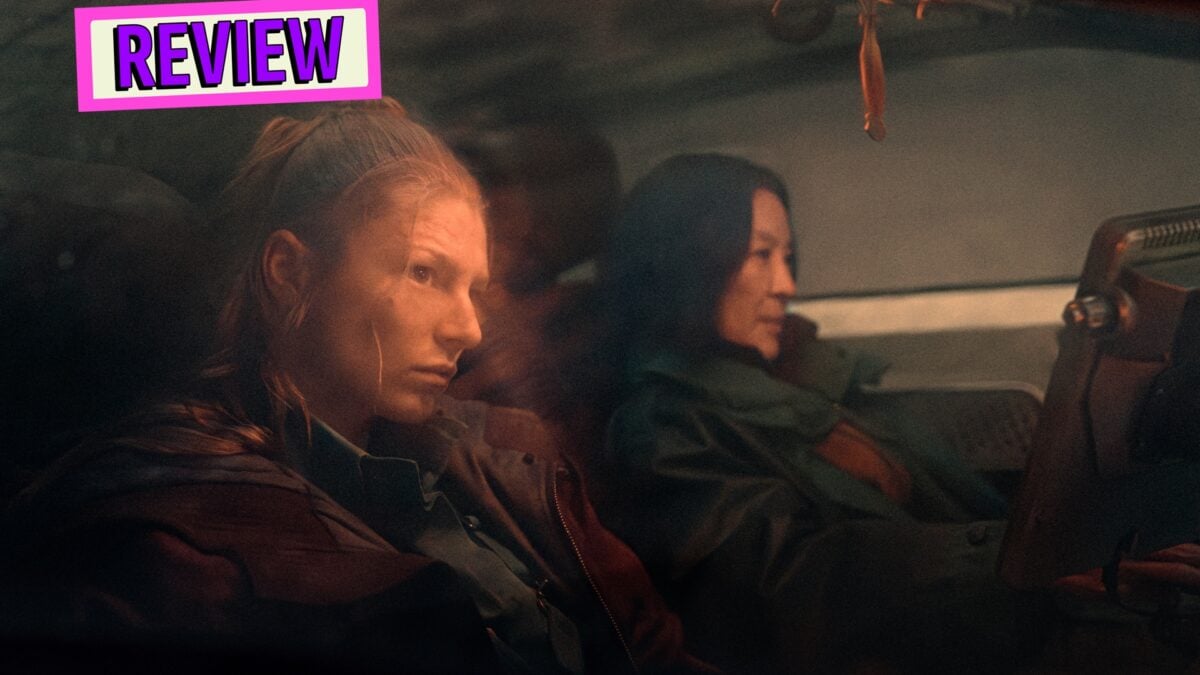
It’s been 50 years since the events of Blade Runner 2049, and the status quo in dystopian Los Angeles has flipped upside down. In Blade Runner 2099, Replicants are now the dominant class, and Blade Runners—an all-Replicant squad in an all-Replicant LAPD—are tasked with hunting down humans who step out of line. Like Ridley Scott’s 1982 Blade Runner and Denis Villeneuve’s 2017 sequel, the franchise’s first live-action series grapples with the tensions between these two populations while pulling on the thread of a consequential mystery. Blade Runner 2099 faithfully recreates the grimy, neon-tinged production design of the groundbreaking first film, including its fetish for tech that hasn’t felt futuristic since the ‘80s. (The flying cars are still cool, though.) It also advances the sequel’s depiction of Earth’s environmental deterioration. There’s erratic weather that shifts between a blistering sun and pelting rain. Crumbling infrastructure. Seedy diversions. Constant surveillance that leads to oppressive paranoia. © Clay Enos/Prime This bleakness is enhanced by a score that blends melancholy ambient electronics with moody saxophones, exactly fitting Blade Runner’s signature brand of sci-fi noir. Created by Silka Luisa and starring Michelle Yeoh and Hunter Schafer, 2099 feels like an authentic continuation of what’s come before, though you don’t need to have seen either movie or have read the 1968 Philip K. Dick novel to follow its story. (Newcomers may miss out on certain Easter eggs and references but will still be able to hang with the narrative.) It explores themes familiar to the Blade Runner franchise, especially “What does it mean to be human?” The stakes for Cora (Schafer) and Olwen (Yeon) have shifted in the decades since Blade Runner’s Rick Deckard confronted that same question. In 2019, Replicants were routinely sent off-world to perform grueling tasks ill-suited for humans. After a violent rebellion, they were declared illegal on Earth. By 2049, there’d been some progress; Replicants in Los Angeles still did dirty jobs—like Ryan Gosling’s K, a Blade Runner tasked with retiring his own kind—but they were allowed to coexist with humans. In 2099, after an uprising tipped the scales and enabled the “more human than human” population to take control, regular humans are barely scraping by. They do the menial labor once reserved for Replicants and rely on an underground network for both basic needs and illegal workarounds. © Clay Enos/Prime Before Blade Runner 2099 really gets going, it refreshes us on the franchise history that matters most here. We flash back to 2008, where a Tyrell Corporation salesperson is touting the company’s hot new product to a skeptical customer. There’s no need to worry about your super-strong robot slaves overpowering their puny human bosses, he says. Replicants are pulled out of a vat fully grown and have a limited lifespan. With no history and a ticking clock affixed to their future, they have “nothing to fight for,” right? As we see in the new series, humans have long since realized how wrong that was. The fallout is especially pronounced in Los Angeles, which we’re told has the highest human population on the West Coast. Cora isn’t really an insurgent at heart, but she’ll do whatever it takes to eke out an existence and protect her younger brother, Elias (Lewis Gribben). She’s already living under a false identity when she agrees to a risky scheme: going undercover as a Replicant in the LAPD’s Blade Runner unit to steal something from the evidence room. It’s supposed to be a quick mission, but it soon becomes dangerously complicated. This is how Cora encounters Olwen, a veteran Blade Runner with just over a week left to live. Olwen’s LAPD coworkers are as unsentimental about saying goodbye as you’d expect, advising her that it’s time to “make room for others.” Her body is starting to break down—fear not, we still get plenty of scenes of Yeoh capably kicking ass—and she’s seemingly accepted her impending end. Olwen’s last job is unusual; it involves tracking down a particularly significant Blade Runner who’s gone off the grid. The fugitive Replicant also has ties to the object Cora was trying to pilfer from the police. Unlikely partners Olwen and Cora may have different motivations, but they’re equally obsessed with uncovering the truth. © Clay Enos/Prime We obviously won’t spoil the details here—io9 watched all eight episodes ahead of this spoiler-free review—but Blade Runner 2099’s central puzzle swirls around a MacGuffin that taps into the franchise’s most poignant existential dilemmas. Multiple characters grapple with the terrors of being alone. There’s also the agony of being chained to a fate that cannot be altered. “There’s no place left to go” is a line repeated across the series. Woven into that is the idea of pretending to be someone you’re not. Cora is the most prominent example, posing as a ruthless Replicant Blade Runner. But it echoes throughout the narrative, in wildly different ways—including a scene where Cora and Olwen visit a peculiar shop that offers Replicants a taste of what it’s like to inhabit a human body. Later, in a different context, one character reminds another that “You can’t be something else if you’re still you.” And then there’s Olwen, whose bravado over her date with death may not be what it seems. Memory is another key theme in all Blade Runner iterations: the artificial memories implanted into Replicant minds, human memories preserved in marble-like spheres to be replayed later, and vivid memories in living minds, both human and Replicant, that impact choices and shape desires. Blade Runner may be sci-fi, but its characters often make a habit of holding onto the past, and 2099’s Cora and Olwen are no exception. Yeoh and Schafer make for compelling co-anchors in roles that are as physical as they are emotional. The tentative bond that forms between Olwen and Cora feels believable, as does the way each character approaches reframing their place in this punishing world. © Clay Enos/Prime By the time it reaches its ambiguous end, Blade Runner 2099 has added a satisfying new chapter to the franchise’s endless pursuit of what it means to have a soul. Though the show is billed as a limited series, it does leave the door open for more stories. In looking forward, it poses more potent questions: what should the future of this world look like? And who gets to decide? Blade Runner 2099 arrives November 25 on Prime Video. Want more io9 news? Check out the best movies and TV shows to stream this month and all the upcoming sci-fi, fantasy, and horror books that should be on your radar.
‘Blade Runner 2099’ Adds a Gripping New Chapter to the Sci-Fi Franchise
Full Article
Original Source
Read the full article at Gizmodo →KhanList aggregates and links to publicly available news content. We do not host full articles from third-party sources. Always verify important information with original sources.