
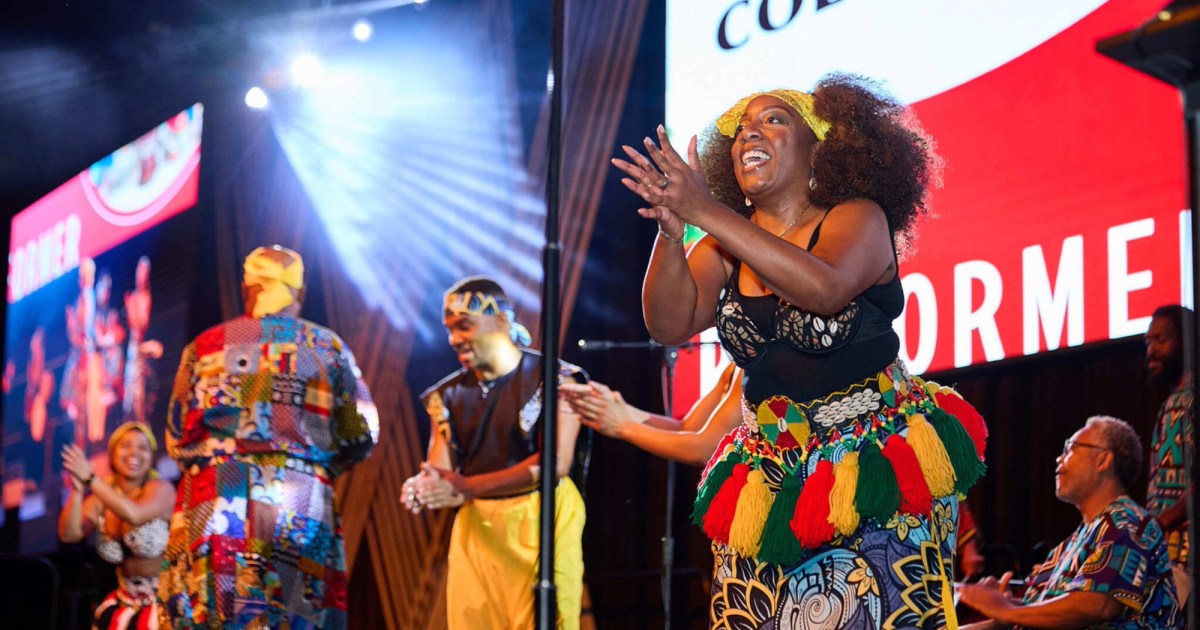
Performers at Race Forward's 2026 Facing Race conference in Raleigh, North Carolina, held November 12 - 14. Courtesy of Race Forward Get your news from a source that’s not owned and controlled by oligarchs. Sign up for the free Mother Jones Daily. After a slew of historic firsts on November 3, including the election of the first Black woman governor in US history, Georgia’s Keisha Lance Bottoms, the internet was flooded with posts crediting Stacey Abrams, the first Black woman to run for governor on a major-party ticket, with helping make Democrats’ big wins in the South possible. About a week later, Abrams received her flowers for real at Facing Race, the country’s largest multiracial racial justice conference, in Raleigh, North Carolina. At the center of Facing Race was people power—and what to do with it next. On Thursday—the day after Senator-elect Scott Colom was declared the winner of a race that will make him Mississippi’s first Black senator since Reconstruction—thousands of community organizers, public servants, artists, and activists gathered for three days in the home of the South’s oldest historically Black college, Shaw University, birthplace of the Student Nonviolent Coordinating Committee. Video by Anna Yeo The mood in Raleigh was celebratory yet cautious, as racial justice practitioners took stock of their hard-fought victories while preparing for the battles ahead, including the need for ongoing resistance to authoritarianism and greater political investment in the South. “I ended up being extremely proud of what we were able to see in Alabama and especially across the South,” said Tamela Glover, a 39-year-old native of Selma and organizer with the nonprofit Alabama Rise. In Glover’s home state, House Rep. Shomari Figures was resoundingly reelected in a district that the state GOP redrew to try and oust him. “But I also know that we can’t just celebrate. The real work begins with holding everybody accountable.” Facing Race’s location and theme—“rooted in resistance, powered by solidarity”—were chosen long before Democrats flipped North Carolina’s state House and ended a GOP supermajority in the state Senate, former North Carolina Gov. Roy Cooper flipped an open Senate seat, and Democrats flipped several House seats redistricted to favor Republicans: a map drawn to secure Republicans an 11-3 split in North Carolina’s House delegation is now poised to end up 11-3 for Democrats. “It’s great to celebrate the wins we saw,” said Glenn Harris, the president of Race Forward, the nonprofit that organizes Facing Race. “But the thing that we can always celebrate is the history of Black organizing in this country.” “Using North Carolina as an example,” Harris said, “that was not just about what’s happening in the political moment. That was about years of building statewide infrastructure that allowed folks to take advantage of that moment.” Stacey Abrams speaks onstage during the Clinton Global Initiative’s annual meeting in New York City, September 22, 2026.JP Yim/Getty for Clinton Global Initiative Friday kicked off with a keynote address by Abrams, who briefly outlined her rise to national prominence: beginning in 2018, when she narrowly lost the Georgia gubernatorial race to then–Georgia Secretary of State Brian Kemp, whom President Trump later repudiated for refusing to help him rig Georgia’s 2020 election results. The same year, Abrams founded Fair Fight Action, a nonprofit dedicated to fighting voter suppression—a practice her opponent had been accused of by multiple civil rights groups in a 2018 lawsuit. Abrams and Kemp faced off again in 2022. Abrams has since launched numerous other initiatives to fight authoritarianism and protect diversity, equity, and inclusion programs. (“I’m basically the Costco of democracy,” Abrams said during her keynote.) A couple of days before Facing Race, Abrams published a Substack newsletter titled “After the Wave, the Work,” in which she noted that despite Democrats’ new majorities in both chambers of Congress, Republicans still controlled the executive and judicial branches. We’re “living through,” Abrams wrote, what political scientists Steve Levitsky and Lucan Way call “competitive authoritarianism,” where certain components of democracy like elections continue imperfectly while the party in power exploits and redraws the government’s institutions in their favor. In her keynote address on Friday, Abrams laid out a ten-step framework for understanding how authoritarianism occurs and characterized the current “moment of opportunity” as a “time where people have been so angry that they could not keep their voices contained, where they were so outraged by the outrage of the Supreme Court to strip us of our voting rights that they showed up anyway.” While Democrats spent tens of millions on other Senate races, critics said funding for candidates in the South was too little, too late. Spurred by the Supreme Court’s erosion of the Voting Rights Act in April’s Louisiana v. Callais decision, which gave the go-ahead for GOP-controlled legislatures to gerrymander majority-Black districts in the South out of existence, droves of Black voters showed up to the ballot box and voted overwhelmingly for Democrats. “They proved that participation does not eliminate discrimination,” Abrams said. “But they were never going to let it stop them from having the patience and the perseverance to make change.” According to the Nationhood Lab, a project of Salve Regina University’s Pell Center, CNN exit polls showed democracy was a top voter concern—behind only the economy—in Georgia, South Carolina, Mississippi, and Florida, where Democrats made significant gains. In my conversations with the people attending Facing Race—from the Deep South; to the nation’s capital, which just elected its first democratic socialist mayor; to Midwestern cities that were the sites of aggressive ICE operations and powerful resistance—all emphasized that they saw the midterm victories as merely a starting point for defending democracy. Andrea Pérez-Maikkula, a 43-year-old DEI practitioner born in Puerto Rico and living in Minnesota, said she was excited about the blue wave, especially Peggy Flanagan’s Minnesota Senate win, making Flanagan the first Native American woman to secure election to the upper chamber. But Pérez-Maikkula is also “concerned about what’s going to happen when the excitement dies down,” adding, “If we just stay complacent with the results alone, we’re not going to be in a good place a couple of years from now.” Glenn Harris, the president of Race Forward, speaks at the 2026 Facing Race conference in Raleigh, North Carolina, held November 12 – 14.Courtesy of Race Forward Another consensus was that Democrats could have won even bigger prizes had they invested more in races in the South previously considered long shots. Cultural critic, sociologist, and University of North Carolina Center for Information, Technology and Public Life professor Tressie McMillan Cottom, another keynote speaker, challenged the prevailing assumption in the media and in national Democratic circles that rural means white. According to a Politico analysis of initial election data, majority Black counties in the South saw “the greatest surges in turnout this cycle compared to the 2022 midterms.” Cottom also spoke about Democrats’ neglect of the South, naming Florida—where state Rep. Angie Nixon, the Democratic Senate nominee, lost by less than three percentage points to Republican incumbent Sen. Ashley Moody—as a prime example of a lost opportunity for Democrats. “People are being very hesitant in terms of funding Black women, especially in the South,” Nixon herself told MS NOW weeks before the midterms, arguing that Florida isn’t a “red state; it is an underinvested state.” Nixon won the state’s most populous county, Miami-Dade, by more than seven points, defying all expectations for a self-proclaimed democratic socialist in a place where the label “communist”—which has more negative resonance in Miami than perhaps anywhere else in the country—was relentlessly weaponized against her. (Then–Vice President Kamala Harris lost Miami-Dade in 2024 by more than one and a half times that margin.) Nixon has suggested that she’ll run again in 2028. “We’ve got to find them courage…because they are going to start to believe that these seats are theirs and not yours.” Up until the week before the election, Black and Latino lawmakers, and their allies, were arguing that they needed more funding from the national party. While the Democratic Senatorial Campaign Committee and Senate Majority PAC poured large sums of money into competitive races in other parts of the country, critics said their funding of Senate candidates in the South was too little, too late. The Senate Majority PAC and its affiliates, reportedly gave $150 million to Sherrod Brown in Ohio, $67 million to Josh Turek in Iowa, and the same amount to Abdul El-Sayed in Michigan—after Democratic Senate leader Chuck Schumer and the establishment initially hesitated to embrace him; $65 million to Troy Jackson in Maine; and tens of millions more for races in Texas and Kansas. But Colom received just $2.2 million from SMP for Mississippi, and South Carolina’s Annie Andrews just $750,000. Nixon, in Florida, and Jamie Davis in Louisiana—who both ran stunningly close Senate races in Republican strongholds—seemingly went without any direct funding at all. Davis, like Colom, would have become his state’s first Black senator since Reconstruction; he lost by less than two points. Just days after his win, Colom—whose national funding mainly consisted of a modest last-minute injection of ad money—told NBC’s Meet the Press: “In the South, we had to do more with less. In Mississippi, we got it out the mud,” adding that “what we need to do now as a Democratic Party is understand we can’t continue to allow that lack of investment.” As Adam Mahoney of Capital B pointed out, some of the country’s closest Senate races were those in Louisiana, Florida, Mississippi, and South Carolina, where the Democratic establishment spent significantly less on advertising than in other races. The ongoing work of building multiracial democracy came up again and again; Abrams emphasized it towards the end of her speech with an impassioned call for attendees to hold their newly elected officials to account. “We’ve got to start showing up in their offices and reminding them of their intention,” Abrams said. “We’ve got to write bills for them and make sure we find voters for them. We’ve got to find the power and the confidence for them. We’ve got to find them courage while we’re at it, because they are going to start to believe that these seats are theirs and not yours.”
Black Voters Swung the South. Their Message to Democrats: Don’t Squander This.
Full Article
Original Source
Read the full article at Motherjones →KhanList aggregates and links to publicly available news content. We do not host full articles from third-party sources. Always verify important information with original sources.