
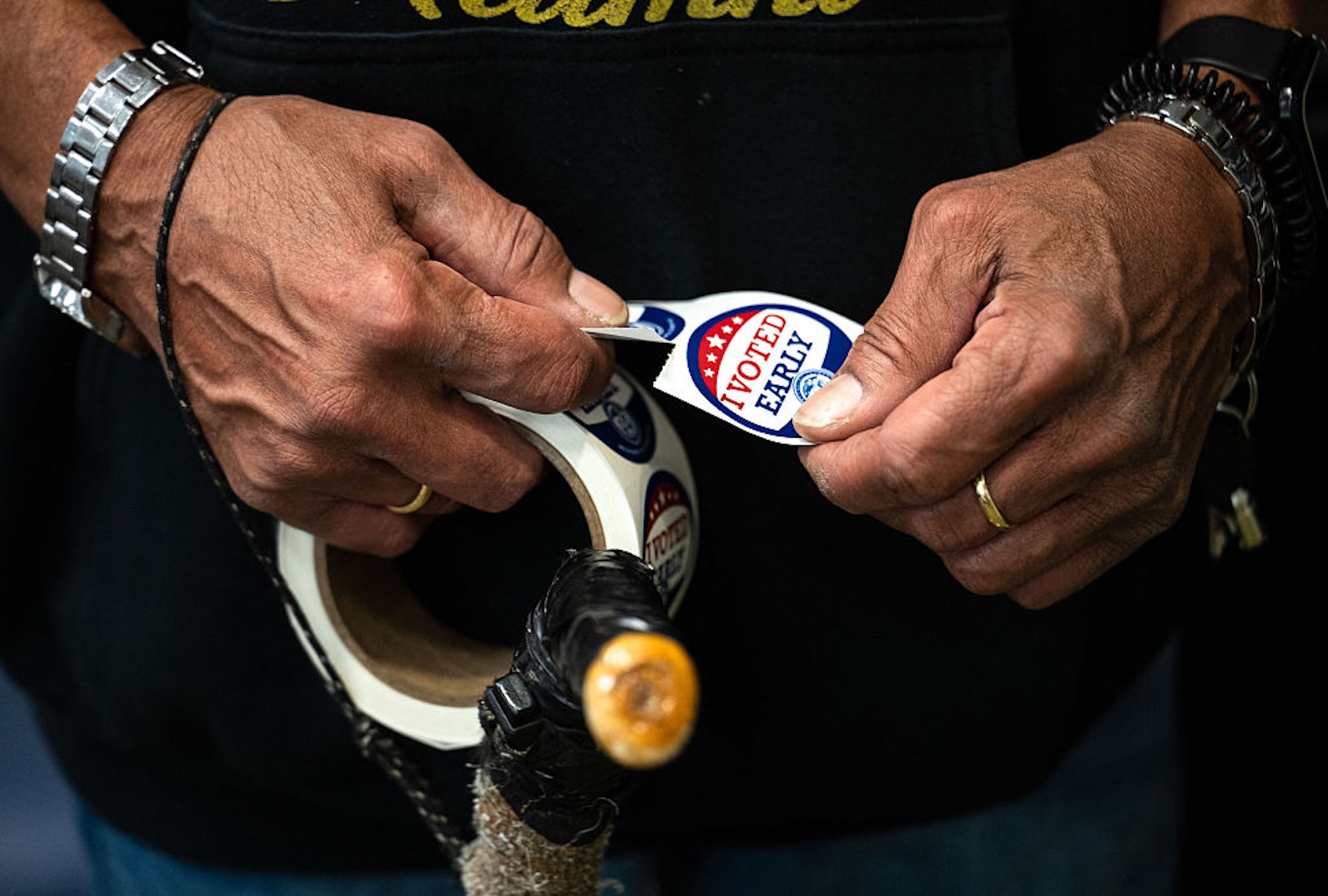
commentary SCOTUS gutted the Voting Rights Act. Early voting numbers indicate that Black Americans are fighting back Published November 3, 2026 6:30AM (EST) A voter takes a sticker after casting their ballot on the final day of early voting ahead of the midterm elections in Charlotte, North Carolina, on Oct. 31, 2026. (AM STEWART / AFP via Getty Images) Loss aversion is a phenomenon in psychology and behavioral economics. Defined simply, it means that the pain experienced from a loss is felt twice as much as winning. In politics, that intensity manifests itself in motivation. If you take something away from people, they are going to feel it more acutely than promising them something, and the theft produces a backlash. That’s what appears to be happening right now with Black voters. Across the country, they have been lining up to vote early, presumably against Donald Trump and the Republican Party’s MAGA agenda, in astonishing numbers, particularly in the South. That this comes only six months after the Supreme Court gutted the Voting Rights Act in Louisiana v. Callais should not come as a surprise. In the Trump era, Republicans have become experienced at taking rights away from the American people. For women, it was the roll back of their constitutional rights when the Supreme Court overturned Roe v. Wade in 2022, sparking a backlash in that year’s midterm elections. Since Trump returned to office in January 2025, immigrants have come under assault from a xenophobic administration intent on carrying out mass deportations via masked, secret police rampaging through neighborhoods. The LGBTQ+ community, and trans people in particular, have seen their rights stripped away. To many Black Americans, the GOP’s agenda and behavior will not have come as a surprise. After all, it’s been at the core of their history going back to before the country’s founding. These policies have come as a shock to some Americans who never thought Trump would go there, and they have also opened the eyes of others to the cruelty at the heart of MAGA, overseen by the highest court of the land. But to many Black Americans, the GOP’s agenda and behavior will not have come as a surprise. After all, it’s been at the core of their history going back to before the country’s founding. Black Americans know what it means to have their civil rights taken away from them. They understand fully the fear of being targeted by brutal, marauding gangs of armed men. In the decade following the Civil War and the passage of the 14th and 15th Amendments, Black people began to participate fully in civil society. Mississippi elected two Black U.S. senators and a lieutenant governor, and former slaves and their offspring enjoyed freedom of speech, movement and opportunity. But the white members of Southern society would not let that stand, and as soon as the federal government withdrew its troops, they stepped in with legal and social barriers to deny Black Americans their rights, this time backed by vigilante and state violence that became Jim and Jane Crow. Almost a century had passed by the time Lyndon Johnson signed the Civil Rights Act in 1964 and the Voting Rights Act in 1965, a period characterized by subjugation and violence by the white majority. But Black America kept fighting, against all odds, until they won. This year, we have seen yet another attempt by reactionary politicians and judges to turn back the clock. After the Callais decision, several Southern states reverted immediately to form and radically redrew their congressional districts to favor the white majority, making it much more difficult for voters to elect a Black federal and state representatives. They may come to regret that decision. This isn’t 1955 (or 1855) anymore, as much as Donald Trump would like to make it so, and the Black community is once again mobilizing. According to experts, early voting data is showing something unexpected: The vote is being driven by young voters rather than just those who went through the earlier battles. It’s muscle memory for the Black community. After 2024, when Trump won a surprising 15% of the Black vote — nearly doubling his share of 8% in the 2020 election — Republicans thought they were defying history to make great inroads within the community. Then, incredibly, the administration began attacking Black America. The result is what some politicos are calling a “Blacklash,” and it could very well be decisive in some places where nobody expected the Democrats to do well. And even if it doesn’t result in flipping seats, it’s a shot across the bow. Want more sharp takes on politics? Sign up for our free newsletter, Standing Room Only, written by Amanda Marcotte, now also a weekly show on YouTube or wherever you get your podcasts. In Mississippi, prosecutor and former judge Scott Colom, who is Black, is running an excellent race against Sen. Cindy Hyde-Smith, the GOP incumbent. Colom has made some very clever advertisements which have garnered a lot of national attention, but Republicans and Democrats alike had largely ignored the race until just a couple of months ago. Polling has tightened, and the GOP has dispatched an influx of luminaries, including Trump himself. For the first time in years, Democrats from Bill Clinton to Kamala Harris, along with a long line of senators, have descended on the state to support Colom. Former President Barack Obama even cut an ad for him. Mississippi has the largest population of Black voters of any state in the country. If Colum gets a big Black turnout with just enough disaffected whites, he could win. Louisiana, after giving birth to the case that saw the Supreme Court’s conservative majority gut the Voting Rights Act, has been winnowed down to one majority Black district in a state that is one-third African-American. But there has been a surge in Black participation akin to what is seen in presidential years, which could prove decisive in a race for Louisiana’s open Senate seat that has been a sleeper until the last couple of weeks. According to a recent poll, Republican Julia Letlow and Democrat Jamie Davis are tied. Among voters who have already cast their ballot, Davis — who is Black — holds a six-point advantage, and 34% of early votes have been cast by Black Louisianans. Then there’s South Carolina, which has seen Trump make three desperate appearances to shore up Darline Graham’s torpid campaign. The endangered incumbent, foisted upon South Carolina Republicans by the president himself following the sudden death of her brother, Sen. Lindsey Graham, is not getting the job done. As numbers cruncher Nate Silver pointed out, a recent New York Times poll showing the race essentially tied is not an outlier; she is in deep trouble. As of late October, the Times reports, “Black voters accounted for around 28 percent of early votes, while making up around 20 percent of the overall electorate in recent cycles. The trend is not unlike what we’re seeing in Georgia and North Carolina thus far.” If that holds true through Election Day, we could see the biggest upset of the whole campaign, largely due to Black South Carolinians saying “Enough is enough.” In a few short hours, all the ads, mailers, signs and rallies will mercifully come to an end. I am cautiously optimistic, but like many, I’ll never celebrate prematurely again. There is good reason, though, to feel more positive than we have in a long time. Trump and his acolytes have overreached. Opting for the big tech credo of “move fast and break things,” they vastly overestimated their abilities — and the American people’s tolerance. They have also aroused a group of Americans who know what it is to lose their rights and privileges. With all that history and so many battles, Black Americans have shown what it takes to never give up. Related Topics ------------------------------------------ Related Articles
Black voters could sway the midterms in surprising places
Full Article
Original Source
Read the full article at Salon →KhanList aggregates and links to publicly available news content. We do not host full articles from third-party sources. Always verify important information with original sources.