
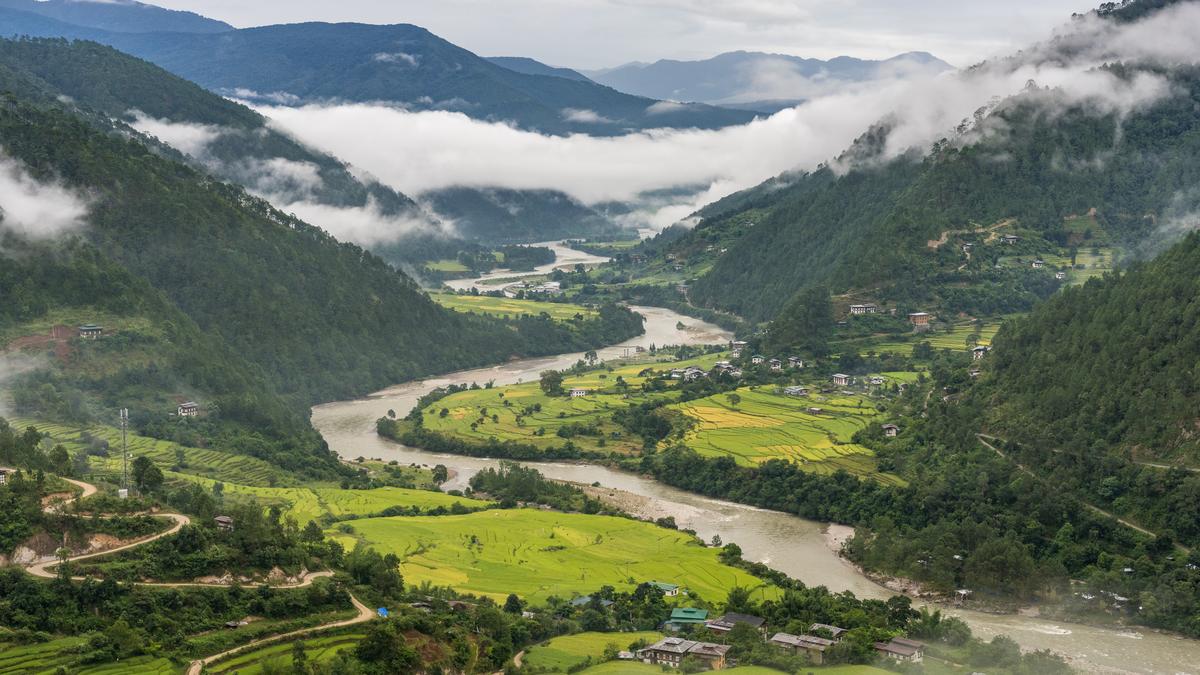
Isn’t it ironic that I came to Bhutan seeking some breathing space, and yet I am struggling to breathe? At 10,170 feet above sea level, the air is thinner and I find myself unnerved by the fact that I am huffing and puffing with each step.We are en route to the western valley region, but make a pitstop at the famous Dochula Pass, which connects the capital city of Thimphu with the historic valley and former capital, Punakha. Although I consider myself relatively fit, the unfamiliar sensation of mountain sickness leaves me panic stricken. “Don’t worry, I will hold your hand, and we can climb up slowly,” says my 24-year-old guide Kinley. Dressed in the traditional kira (an unstitched ankle-length dress), her porcelain skin glowing, her calm demeanour reassures me. My efforts are amply rewarded. I not only get to see the Himalayas in 360 degree glory — across which the endangered black-necked cranes migrate to Bhutan from the Tibetan Plateau — but also Gangkhar Puensum, the tallest unclimbed mountain (at 24,840 feet) in the world. The endangered black-necked cranes If slow, conscious travel is your thing, then Bhutan ticks all the boxes. This diminutive mountain kingdom is one of the most elevated places on Earth, and its spiritual and geographical isolation create an aura of mysticism. It also delivers a masterclass in environmental awareness through one-of-a-kind experiences channelled by the local community.A place of quietPunakha is in a valley and the stillness hits me like a ton of bricks. No beeping notifications on the phone, no customary television in the room.We are on our way to see a fortress or dzong. “Punakha was Bhutan’s capital for more than 300 years, and every Bhutanese king has been crowned in Punakha Dzong,” Kinley explains. “Despite frequent fires and a severe earthquake, the dzong was finished in 1638 and served as the seat of government until the mid-1950s.” Bhutan | Photo Credit: Ben Richards A quaint cantilevered wooden bridge serves as the only access point to the fortress, and a trail of purple jacarandas brighten the white washed walls. As I smile for the camera, a line of schoolgirls wait patiently for me to finish. None of them asks me to move aside. Then, as I walk a few steps, I trip and the girls dart forward to help me. They offer water and biscuits, and a tattered Band-Aid. This small exchange gives me insight into a society where Buddhist beliefs and non-materialistic practices of compassion are woven into the fabric of daily life. Where the concept of Gross National Happiness (and not Gross National Product) — a philosophy that measures well-being according to spiritual not materialistic indexes — unites every citizen. A Bhutanese child in Bumdeling | Photo Credit: Amp Sripimanwat Stay in a tentTo explore this fragile ecosystem responsibly, we choose a property that embodies sustainability. Pemako Punakha, a luxury tented villa property set across 75 acres of hillside, is the first high-end, Bhutanese-owned and operated property here. The name Pemako translates to “hidden lotus land”, referring to a fabled Tibetan beyul (valley) traditionally accessible only through a sacred waterfall. Fittingly, this property is accessible via a suspension bridge dangling precariously over the Mo Chhu River. The resort was conceptualised by American architect Bill Bensley, who pays tribute to the Bhutanese aesthetic in dramatic hues of dark carved wood, locally crafted art and artefacts, against a colourful backdrop of kasaya (outer robe worn by Buddhist monks) orange.Other options: The five Amankora lodges also offer a seamless luxury experience across Bhutan. You can also choose between Postcard hotels, Six Senses, Como, and Gangtey Lodge.Meet the thrung thrung karmoThe next day, I get a chance to meet the dashing Kelly Dorji. The Bollywood actor lives in Bhutan, and a common friend, yesteryear supermodel Sherie Meherhomji, makes the introduction. “In spite of my work in the film industry, the lure of my homeland was too strong,” Kelly shares.Passionate about wildlife, much like his father Dasho Paljor J. Dorji, founder of the Royal Society for the Protection of Nature, Kelly tells us how his childhood experiences with wildlife shaped his life. “In the early 1980s, His Majesty the Great Fourth King of Bhutan [Jigme Singye Wangchuck] sent my father on a fact-finding mission to the Gangtey Valley of Phobjikha. The aim was to find out if there were enough black-necked cranes to outweigh the importance of logging the valley for national interest,” he says. Phobjikha is the wintering ground for these protected birds, called thrung thrung karmo locally, that are now listed as a globally threatened species. The thrung thrung karmo Punakha Khamsum Yulley Namgyal Chorten “So Apala took me and my younger brother along to count the cranes! What was to be a three-day trip turned into two weeks as a blizzard locked us into a valley without water or electricity. We spent our days roaming the valley, counting around 88 cranes. Upon our return, my father reported to the king and was granted Phobjikha valley for conservation and preservation.”Connections in stillnessKelly’s story drives home how this diminutive kingdom rises like a Goliath to save the environment. The valley remains one of the few places in the world where these birds can still be seen. “The cranes have since increased in annual numbers and during some winters have numbered upwards of 500,” he says, as he shows us around the conservation centre with two recuperating cranes, Pema and Karma, in tow. The arrival of the cranes, from November to April, is celebrated every year with a festival (on November 11), as locals believe they are symbols of longevity and luck. Monks in Bhutan | Photo Credit: Ben Richards Fact fileTravelling to Bhutan follows a rhythm unlike anywhere else in the world. Entry requirements, daily fees, licensed guides and logistics are carefully regulated and must be arranged in advance.Getting there: Bhutan has two national airlines, DrukAir and Bhutan Airlines. Direct flights from the international airport in Paro connect you to Bagdogra, Guwahati, Kolkata and New Delhi.Visa and entry rules: Visitors from India will need a permit to enter the country and are required to hold an Indian passport or an Indian voter ID card. Those under the age of 18 may enter with a birth certificate or passport, and must be accompanied by a legal guardian. Indian nationals are eligible for a permit on arrival. Visitors are also required to pay a Sustainable Development Fee of ₹1,200 per person, per night.When to visit: Bhutan is a year-round destination. There are four seasons: summer (June to August), autumn (September to November), winter (December to February) and spring (March to May). But because of the range of altitudes, and the influence of the north Indian monsoons, the climate is incredibly varied.Low-impact itinerariesMy trip also includes a stop on the outskirts of Thimphu to sample traditional cuisine — think ema datshi (chilli and cheese) and phaksha paa (pork curry) served with red rice, complemented with salted butter tea — at Babesa, a local favourite housed in a bucolic century-old farmhouse. We watch a local artist weaving textiles nearby and although we have a museum and monastery visit lined up, we abandon them to stick around until the fabric is woven and available for sale. Bhutanese dishes served in Bumdeling | Photo Credit: Amp Sripimanwat As the clock ticks, I realise this holiday is best enjoyed if it champions low-impact itineraries, community-led experiences, and a slow travel framework. After all, this is probably the only country in the world that eschews traffic lights because traffic jams are reserved for herds of yak and horses.The writer is based in Mumbai.
Black-necked cranes: yet another reason to visit Bhutan
Full Article
Original Source
Read the full article at Thehindu →KhanList aggregates and links to publicly available news content. We do not host full articles from third-party sources. Always verify important information with original sources.