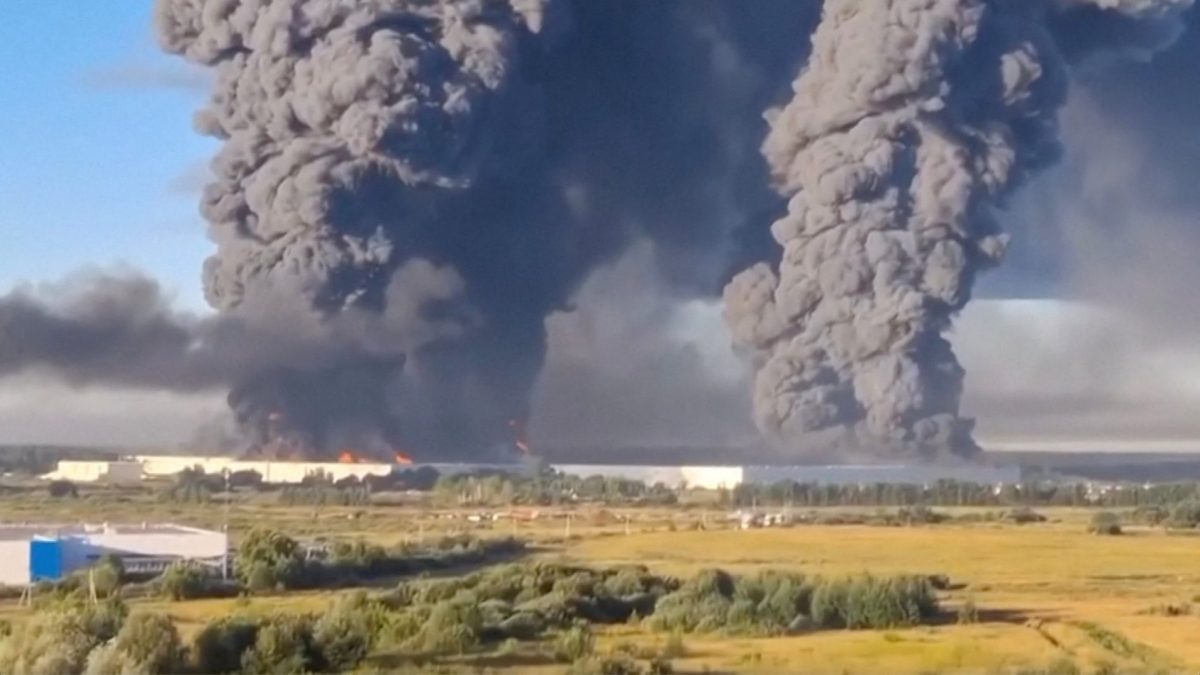
Once again, Russia is burning. Ukrainian drones hit two warehouses belonging to the country’s biggest online retailer on the outskirts of Moscow, killing eight people, after reported strikes on petrochemical plants and a major oil refinery earlier this week. Ukrainian President Volodymyr Zelensky said the strikes had hit “major logistics facilities” which had been used to “supply sanctioned components for drone production and navigation equipment”. They came in response to the mass killing of Ukrainians, Zelensky said. Unverified images circulating online showed plumes of black smoke rising from the site, which is often described as Russia’s version of Amazon, with dozens of workers running into a car park. It is the latest in a wave of Ukrainian attacks hitting Russia where it hurts; at home. Shorts Ukraine has been targeting Russian oil and gas facilities in a bid to stop the Kremlin from using fuel exports to fund its war. And it is having an impact; more than two-thirds of the country’s federal entities have reported government or privately imposed restrictions on gasoline and diesel sales, and retail fuel prices have risen 3 per cent in the past week, according to a report from thinktank RUSI. Since late May, a surge in Ukrainian strikes has cut gas production by roughly a quarter and hiked up jet fuel prices at Russian airports by 17 per cent since early June. “For years, the Kremlin has fought a war that most Russians could watch from a distance. Ukraine is beginning to change that,” said Petras Katinas and Natia Seskuria from RUSI. “Its sustained strikes on Russia’s energy infrastructure are turning the war into a daily economic burden, forcing the Kremlin to choose between export revenues and domestic stability.” Caption: A local resident takes a picture of the smoke of a fire at the Russian e-commerce firm Wildberries’ logistics complexes in the town of Elektrostal outside Moscow. (Photo by TATYANA MAKEYEVA / AFP via Getty Images) Last month, President Vladimir Putin publicly acknowledged for the first time that Ukrainian attacks on energy infrastructure were creating “problems” and shortages of fuel. Kyiv has been using drones to target Russian tankers sailing across the Sea of Azov, a key inland sea off the south of Ukraine that connects to the Black Sea, Eastern Europe and the rest of the world. In Crimea, which has been a target of Ukrainian attacks, Russian authorities declared a state of emergency last month amid fuel shortages and power cuts. Photographs showed queues of cars waiting for fuel, while video footage reportedly showed traffic jams as residents attempted to flee Crimea over the Kerch Bridge into Russia. “Ukraine’s sustained strikes on Russian refineries are not only damaging infrastructure and squeezing Russia’s oil industry, they are forcing the Kremlin to spend more to keep fuel flowing at home while earning less from exports,” Katinas and Seskuria said. “Many Russians have endorsed the imperial project in principle, but the fear of being directly affected by the war – through Ukrainian strikes on Russian cities or mounting economic hardship – is steadily eroding enthusiasm for rallying around the flag and sacrificing more lives.” Smoke rises from an oil refinery facility following a reported Ukrainian attack in the town of Noginsk outside Moscow on 18 July 2026. (Photo: AFP via Getty Images) As peace talks stall, and battlefield frontlines remain largely unchanged, these types of attacks are designed to help move the needle in Ukraine’s military fortunes. This is particularly important as the attention of US President Donald Trump – considered one of few in the world able to force Russia into a peace agreement – appears to be turned to the World Cup at home and Iran war abroad. “After a long period of battlefield stagnation and a US policy pivot that risked relegating Ukraine behind other crises, Kyiv is reclaiming momentum by hitting Russia where it is most sensitive,” Katinas and Seskuria said. If Ukraine can sustain this pressure, Putin may be forced into accepting more of Ukraine’s negotiating positions. “One option is to recognise that Ukraine’s deep‑strike campaign is affecting Russia’s domestic political situation and that these costs will only rise if the war drags on,” they added. A local resident takes a picture of the smoke of a fire at the Russian e-commerce firm Wildberries’ logistics complexes in the town of Elektrostal outside Moscow on 18 July 2026. (Photo: Tatyana Makeyeva/ AFP via Getty Images) “That would mean re‑entering negotiations with fewer ultimatums and, indirectly, accepting that Russia is unable to conquer Ukraine’s eastern and southern regions. So far, however, there is no indication that Putin is prepared to abandon any of his maximalist demands.” Another alternative is to double down on efforts on the battlefield. Putin is reportedly mulling another round of mass mobilisation to increase his troop numbers – although the last attempt at this led to hundreds of thousands of military-age men fleeing the country. These narrowing options show that Ukraine’s strategy – though bloody – is working, making the war “material, immediate and inescapable for those the Kremlin has tried hardest to shield,” Katinas and Seskuria said. “It is this interaction that will determine whether Putin can sustain his maximalist ambitions or is eventually forced into a negotiated retreat on far less favourable terms.”
Black clouds are hovering over Russia – and may force Putin towards peace talks
Full Article
Original Source
Read the full article at Inews →KhanList aggregates and links to publicly available news content. We do not host full articles from third-party sources. Always verify important information with original sources.