
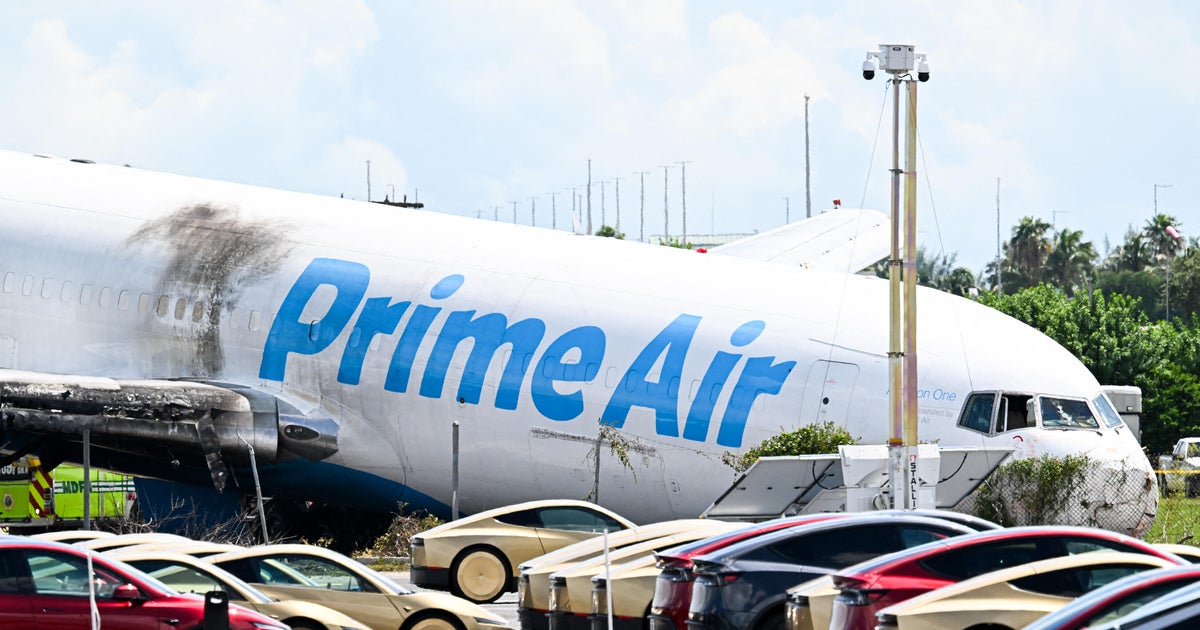
By Ana Maria Soler is a digital content producer for CBS Miami and the South region. Read Full Bio Updated on: September 7, 2026 / 6:11 PM EDT / CBS Miami Add CBS News on Google The National Transportation Safety Board provided an update Monday afternoon on its investigation into what caused an Amazon cargo plane to overshoot a runway at Miami International Airport and crash into two vehicles before coming to a stop and bursting into flames on Sunday. Five people were killed, and at least five others were injured, officials have said. All those who were killed were in the two vehicles that were hit, NTSB Chair Jennifer Homendy said Monday during a news conference. The NTSB also said it recovered both the flight data recorder and the cockpit voice recorder. Jennifer Homendy, chairwoman of the National Transportation Safety Board, holds a news conference on Sept. 7, 2026, on the investigation into the Amazon cargo plane crash at Miami International Airport. Joe Raedle / Getty Images NTSB says all victims were in the 2 vehicles hitHomendy said the flight, Amazon Air Flight 7598, was a Boeing 767-33 Alpha operated by 21 Air LLC. It had arrived from San Juan, Puerto Rico, and was on its third flight of the day, having gone from Cincinnati to Miami, then Miami to San Juan and back to Miami. The plane overran runway 30 on landing, struck navigational aids, and hit a 2012 white Ford Econoline van owned by the Professional Ocean Service Corporation, a contract cleaning company for the airlines, Homendy said. Seven people were inside the van at the time.The plane then tore through a perimeter fence and struck a Toyota Corolla Cross LE that was traveling on Northwest 67 Avenue. It continued into the grass and hit another fence line in an area where Tesla robotaxis were stationed. In total, the plane traveled about 1,300 feet past the paved surface, Homendy said.Homendy said all victims were in those two vehicles. The van was inside the airport, while the Toyota was outside."I would describe it in one word: devastating, utter devastation," Homendy said. "The Econoline van is torn apart. You can see airbags, the surrounding airbags. You can see components from vehicles, both passenger vehicles and the aircraft itself. Certainly navigation components, some debris from the airport, and then certainly fencing everywhere. It's pretty extensive." Damaged vehicles are seen at Miami International Airport after an Amazon cargo plane crashed into them on Sept. 7, 2026. Joe Raedle / Getty Images NTSB says it recovered recorders inside the planeThe NTSB said it has recovered both the flight data recorder and the cockpit voice recorder. Both were being sent to NTSB headquarters for download and analysis. Homendy said the agency has some speed data from other sources but wants to confirm it against the flight data recorder before releasing it. The agency has 32 people on the ground. Homendy said investigators could not fully access the aircraft yet because recovery operations were still ongoing and fuel was being removed from the plane.No interviews have been conducted yet. Homendy said the transportation disaster assistance team is scheduling them, but she said she had not yet confirmed who they had been in contact with. Investigators continue work to determine what caused the crash of an Amazon cargo plane at Miami International Airport. Joe Raedle / Getty Images What NTSB says it is looking for as it continues to investigateStarting the next day, the team will break into specialized groups covering human performance, airplane systems, power plants, air traffic control, aircraft performance, structures, meteorology and airport survival factors.One area investigators will examine is whether an Engineered Materials Arresting System, known as EMAS, should have been installed at the end of the runway and whether it could have made a difference. The EMAS is a crushable, lightweight material placed at the end of a runway designed to safely stop an aircraft that overruns it. Homendy said it is not required at every airport. Investigators will also look at the contractual relationship between Amazon and 21 Air."This is an Amazon operation for transporting cargo, but it's actually contracted to 21 Air," Homendy said. "We're going to want to see what that relationship is, who does what, what safety provisions might be in any sort of contracts or any sort of policies." Officials investigate a Prime Air cargo plane at Miami International Airport after it overran the runway on Sept. 6, 2026. CHANDAN KHANNA /AFP via Getty Images The plane was manufactured in 1994. Homendy said the age and ownership history of the aircraft would be examined as part of the investigation.Homendy said the NTSB would not be determining probable cause while on scene. The agency's goal at this stage is to document the scene and collect perishable evidence. She said the team expects to be on the ground for at least a week.She also addressed the broader pattern of runway excursions, saying the NTSB has investigated more than 3,000 such incidents since 2008."We can only work to prevent the next one if our recommendations at the end of an investigation are implemented," Homendy said. "If we are in the business of repeatedly investigating an accident or tragedy and our recommendations are not implemented, then we're here again and again and again."Homendy thanked federal, state, and local officials for their assistance in the incident, as well as expressing her condolences to the families. The NTSB said it plans to hold another briefing on Tuesday. Anyone with photos or videos relevant to the investigation was asked to submit them to witness@ntsb.gov. In: Miami-Dade Fire-Rescue Plane Crash Amazon South Florida Miami National Transportation Safety Board Miami-Dade Sheriff's Office Miami International Airport Miami-Dade
Black boxes recovered from Amazon cargo plane crash in Miami, NTSB says
Full Article
Original Source
Read the full article at Cbsnews →KhanList aggregates and links to publicly available news content. We do not host full articles from third-party sources. Always verify important information with original sources.