
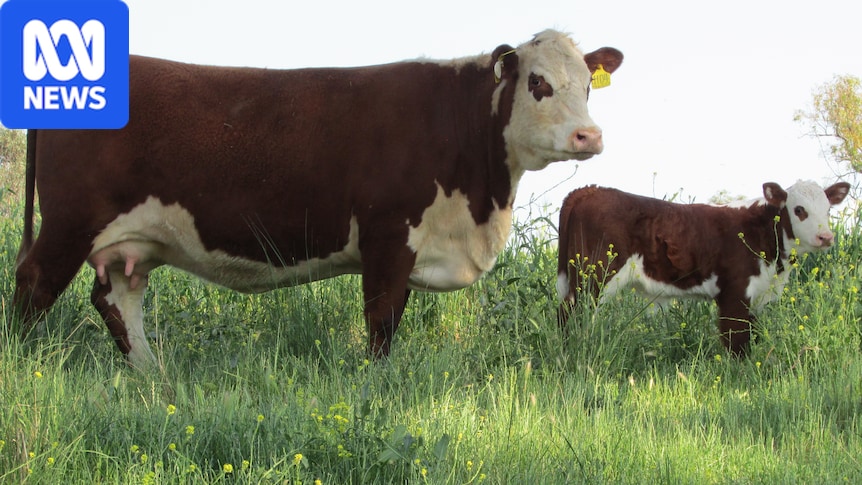
It may seem like a fickle fashion trend, but as far as the Australian cattle industry is concerned, brown is out and black is in.Just ask Stephen and Jodi Peake, who, after six decades of breeding Hereford cattle in north-west New South Wales, are selling off their entire herd.The two have spent years perfecting their stock and genetics, broken weight-gain records with their steers and even once sold a prize bull for more than $60,000.Stephen and Jodi Peake from the Bowen Pastoral Company based in Gunnedah and Barraba. (ABC New England: Juno Robertson)But as the Peakes near retirement, they have decided to focus on two of their other breeds: Angus and Wagyu."Angus are a worldwide popular breed. They tick a lot of boxes for the end consumer as well as the producer," Mr Peake said."Every breed has their day in the sun."Angus were a minority breed 30 years ago. (Supplied: Stephen and Jodi Peake)An Angus boomHereford cattle were first brought to Australia 200 years ago and have historically dominated its beef industry.In 1990, farm survey data from the Australian Bureau of Agricultural and Resource Economics and Sciences showed the breed was the country's most popular, making up just over a quarter of the national herd.By comparison, Angus cattle were just over 4 per cent.Fast forward 35 years and the black cattle breed has surged in popularity through savvy marketing, fast-food branding and export markets.Charles Boog says that, based on available information, Angus beef has become dominant. (Supplied: Charles Boog)According to a recent Meat & Livestock Australia (MLA) survey, Angus led national herd growth between 2023 and 2025, gaining 1.76 million head.Market analyst Charles Boog said it was difficult to accurately study long-term breed preferences in Australia because there is no mandate to record cattle breeds at saleyards.But looking at a "patchwork of information", one thing is clear: Angus has taken the lead."As one indicator of current breeding demand, [trade publication] Beef Central recorded 11,328 Angus bulls sold at auction in 2025 compared with 1,780 Herefords," he said.More money, more marketingBrad Hine from peak body Angus Australia said the breed's success was partly a marketing story.The Angus name strengthened in 1995 when the association established guidelines for a verified label.Beef exports to Japan also grew significantly through the 90s, with the foreign market offering a premium for black cattle."Verified Angus Beef" must contain a minimum of 75 per cent Angus-breed content with no dairy characteristics. (Supplied: Stephen and Jodi Peake)McDonald's premium-branded Angus products, marketed globally from 2009 until June this year, also helped establish the breed as a known commodity.Dr Hine said sale data from AuctionsPlus showed farmers now made more money per head on Angus cattle.The nation's Angus herd grew by an estimated 1.76 million head between 2023-2025. (Supplied: Stephen and Jodi Peake)A mixed cattle futureHerefords Australia chief executive Hamish Chandler said despite a historical departure from the breed, the association's membership numbers have stabilised over the past five years.He said he was confident the breed would play a critical role into the future, as genetic research improved."Over the last two to three years, the number of Hereford cows in the national breeding herd has increased by around 26 per cent," he said.Hamish Chandler says there is still a role for Herefords. (ABC New England: Juno Robertson)Agriculture consultant Alastair Rayner said Australia's cattle breed mix would likely stabilise around where it is today, with a possible "increase in tropically infused cattle" in the future.The MLA survey pointed to a similar trend, with Santa Gertrudis and Droughtmasters the second and third fastest growing herds, respectively.Both are crossbreeds with European and Indian origins.Crossbreeds like the Droughtmaster are gaining in popularity. (Supplied: Droughtmaster Australia)Mr Rayner said unlike in the past, "there's never going to be just one breed" dominating the industry, as different environments call for different types of cattle."Rather than choosing a breed and trying to make everything fit, work out what you need and find the breed that best fits you," he said.
Black beats brown as marketing changes the makeup of Australian cattle herd
Full Article
Original Source
Read the full article at Abc →KhanList aggregates and links to publicly available news content. We do not host full articles from third-party sources. Always verify important information with original sources.