
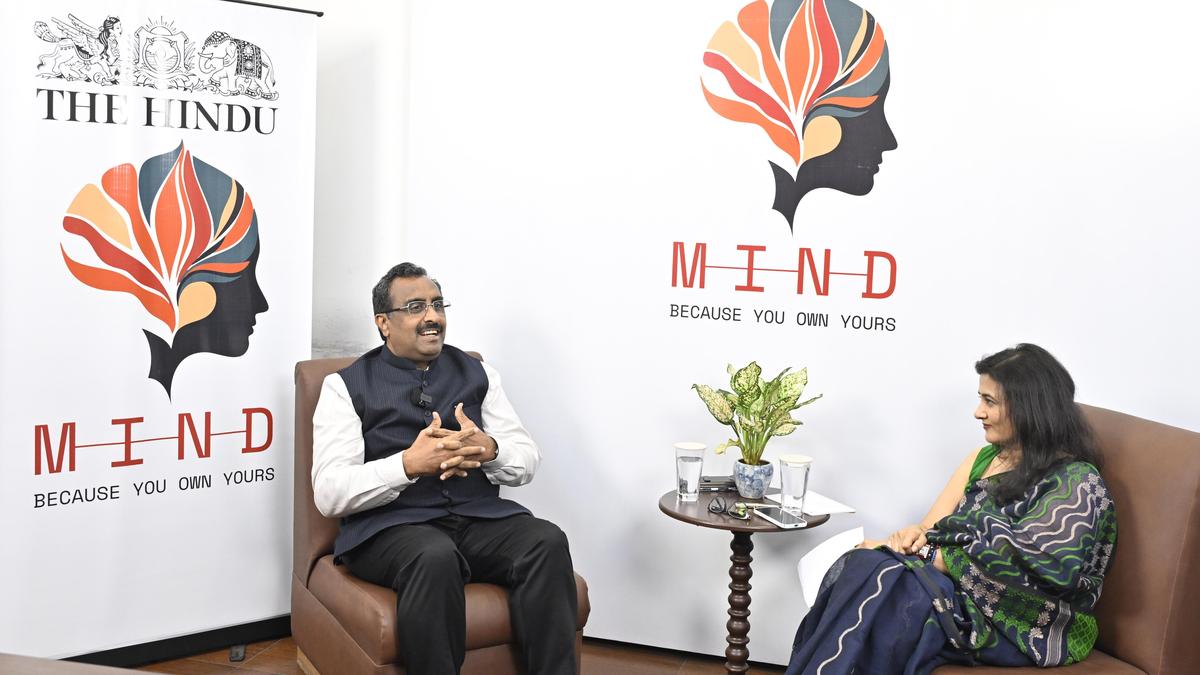
The newly appointed national vice-president of the Bharatiya Janata Party (BJP), Ram Madhav, has worn many hats, from Rashtriya Swayamsevak Sangh (RSS) spokesperson in the early 2000s to party general secretary in charge of States like Jammu and Kashmir and Assam, head of the conservative think tank India Foundation, and foreign policy commentator. He shares his views on the challenges facing the party, Gen Z protests, and India’s relations with its neighbouring countries in a wide-ranging conversation at The Hindu MIND event moderated by Nistula Hebbar. Edited excerpts: You returned to the BJP organisation after a break, having first joined it at the start of the Narendra Modi government’s first term. What challenges does the organisation face now, after 12 years as the ruling party? We always see the challenge to BJP as the BJP itself; where we are today and where we have to reach next year. In politics, you will have a number of contemporary issues to tackle and a number of challenges that come up from time to time. Sometimes it can be so-called Gen Z protests, sometimes it can be a challenge posed by the Opposition, but the real issue is how we go from this year to next year, this election to the next election, and this general election to the next general election. Looking at that, I would say the BJP continues to grow as the most important political organisation in the country. I don’t think there is any challenge for the BJP. In 12 years, the BJP has grown and grown bigger in this country, not just in terms of its electoral or organisational footprint but also its ideological influence, and its reach in the country. It has grown very big. You are an out-and-out RSS man. This is also the centenary year of the RSS, the BJP’s parent organisation, but it also seems to have walked into a perfect storm of the Ayodhya donation embezzlement case and the moral implications of it. How do you view what has happened and how do you think the RSS can extricate itself from it? In the centenary year, that’s not exactly how you should look at the RSS. What happened at the Ram Temple was a minor aberration that was immediately addressed. This was not something to do with the RSS per se, but with the management of the temple, of a lacuna in the day-to-day donation management. I would only like to say that it was the result of an oversight, an aberration, which was immediately identified and is being very seriously addressed. The people accountable for the issue accepted moral responsibility and stepped down. A new CEO is being appointed. But that is not the prism through which the centenary of the RSS should be viewed. Started by a former Congress person, Dr. [Keshav Baliram] Hedgewar, in 1925, it is, 100 years down the line, today the biggest challenger to the Congress ideology. It has grown into the most formidable challenger to that world view because of what happened between 1925 and 1947 – or I would say since 1950, the first 25 years of independence – it created such an important ideological divide within the Congress. One section, what we call in our terminology Nehruvian ideology, had its day for the first three or four decades in the country. And as for the other stream of the independence movement, of which the RSS was also a part, the RSS ideology has become the most dominant thought process in this country. Another major development in the last few months has been the Gen Z protests. How do you see the BJP handling this? We are creating many categories nowadays, there is Gen Z, Gen Alpha. For me, this is the youth of our country and their aspirations have to be addressed. We understand that there are certain concerns. Those are not just limited to the NEET exam. It was an immediate trigger for whatever happened. We are dealing with a country where more than half of the population is below 35 years. Obviously, as a political party, we have to keep that in mind while picking office-bearers and deciding our agenda. That’s why today the BJP has a president who is in his mid-40s. A lot of youngsters have found a place in the team in important positions. And you would have already read in the papers that right from Ministers in the government to functionaries in the party, we are, in a big way, engaging with the youth of the country. We will be reaching out to them in universities, colleges, and other places. There will be continuous engagement with them. We consider it as one of our priorities. There was also a feeling that, in terms of social media, the medium of outreach to this particular cohort was kind of missed by the BJP and its social media communication. Also, the tonality of some of its interventions on social media did not go down well with young people. Look, there are two things I would mention here: number one, it’s always easy for those in the Opposition to use all platforms to attack the government. When we were in the Opposition, we also used it very effectively as you only have to criticise. As an Opposition, you only have to create a meme and throw it. Secondly, remember, social media is algorithm-driven. I mean, if you are able to generate sufficient content, then it continues to generate content on its own through algorithms. So, if there are 10 memes that get so much amplification that they will start influencing people, it means that for every 10 memes I should be able to produce 20 memes as the ruling party to counter that effect. Our team tried its best to tackle this challenge. But it’s a competition. Social media is the most democratic media in the country, everybody has space on it. You have also been one of the founders of a think tank in the conservative space, the India Foundation. What was the reason behind venturing into that realm? And do you think you have been successful in framing a pedagogic structure pertaining to your ideology? Not many people know that the India Foundation came into existence in 2009. Over the last 15 years, it has created a place for itself in the think tank world. We felt that there is a need for this kind of intellectual engagement. For example, within the country and outside, there is a big section of intelligentsia that wants to engage with our movement. They may not come to our day-to-day shakha (branch), the RSS day-to-day activity, but when it comes to the thought process, they are ready to align with us. For such intelligentsia organisations, the India Foundation definitely helped as a good platform. There was no existing right-wing intellectual ecosystem in this form. There are a few other think tanks that were created by like-minded people. I think they have served a great purpose in creating a strong ‘right-wing ecosystem’ in the country. Speaking of ecosystems, the Prime Minister has said the country should be aware of a category called ‘dimagi Naxals’. What do you think he meant by that? To put it simply, it is what the United Progressive Alliance government under (Dr.) Manmohan Singh told the Supreme Court in an affidavit: that certain intellectuals in this country are more dangerous than those Naxals who are in the forests, in the jungles. ‘Dimagi Naxal’ means those who are supporting this kind of idea intellectually – through intellectual forums, intellectual platforms, their writings, speeches, and other articulations. So, that is basically what he meant as I understand it. Congress leader Rahul Gandhi quoted the Manusmriti and made a call to ‘smash the patriarchy’. The BJP’s response was to term him ‘anti-Hindu’. The Manusmriti is an old scripture that contains many things. The stanza quoted by Mr. Rahul Gandhi was there, no doubt, but it also states that if a woman is unhappy in a marriage she can separate, it gives four situations for opting for separation. What is important, however, is to remember that the Manusmriti was a moral code at that time, alongside at least 12 other such codes. No king in India ever made any of these smritis their Constitution. As far as we are concerned, we are guided by the Constitution of India; it is our smriti today. I don’t want to create a religious discourse, but aren’t there similar provisions about women in the Koran and the Bible? If you quote only from one set of scriptures, you will be blamed and called anti-Hindu. Why isn’t Rahul Gandhi quoting from other scriptures too to make the point about discrimination against women? That’s because Rahul Gandhi has an agenda. Nobody agrees with that proposition (a specific sloka in the Manusmriti); our track record reflects it. It is the NDA (National Democratic Alliance) government that nominated a tribal woman to be elected as the President and [brought] relief to Muslim women via the triple talaq Act. Look at Rahul Gandhi’s father Rajiv Gandhi’s record in terms of women’s rights: when the court granted relief to Shah Bano, it was his government that brought in a law to overturn that. So, when Rahul Gandhi quotes from only one scripture, he will be questioned on his selectivity and what it says about him and his commitment to women’s empowerment. How do you evaluate the developments in Jammu and Kashmir since Article 370 was revoked? It has been seven years since it was made into a Union Territory and there have been demands that Statehood should be restored. What is your view on that? First of all, the question is not about restoration. The erstwhile State was split into two Union Territories (UTs). The residual UT, what is today J&K, needs to be granted Statehood. This residual UT will get the full Statehood as promised by the Prime Minister and the Home Minister in Parliament. Now, when will it happen? Why seven years? Let me ask you a counter question then. Article 370, which was abrogated seven years ago, was introduced as a temporary provision yet it remained in place for 70 years. If a temporary provision can remain there for 70 years and you happily enjoyed that status, why can’t you wait for Statehood for a few years? Nobody is asking you to wait for 70 years. It has only been seven years now. It will be given to the people of J&K, the current UT. The appropriate time is for the government of the day to decide. You are also quite well-versed in the politics of our neighbourhood. Why does it feel like India is under siege from its neighbours, except possibly the Taliban in Afghanistan? First, that is not true. We have very good relations with several of our neighbours, including Sri Lanka, Bhutan, and Nepal. One country with which we have never had a good relationship with is Pakistan. Now, those who know about the trajectory of our foreign policy in the last six to seven decades know that this kind of situation has existed in our neighbourhood all the time. When regimes changed, we faced challenges, new situations, and new equations. We are seeing that kind of situation in one or two countries in our neighbourhood. In the case of Pakistan, especially since 2008, we have not had good relations. In between Prime Minister Modi tried to improve it for a couple of years, but then we realised that it was not going to happen because of the mindset there. But there were periods when we had good relations with them also in the last 50 years. On a philosophical note, which political belief of yours has changed the most over the years? I really don’t think any of my core political beliefs and commitments have changed over the years. I have always been fully committed to India’s democratic system. I always believe that is the only way India can really grow and progress. My only difference, probably, with some people from within the larger ideological family that I belong to is that sometimes I tend to take a slightly middle path kind of approach. That’s my temperament, I don’t like to take any extreme positions and for that I faced certain consequences. Since you talked about the formation of the [BJP-Peoples Democratic Party coalition] government in J&K, yes, there was strong opposition to it in my own ecosystem. But then there was a given political situation, which prompted us to take that stride, and we did it. It is not the first time, if you look back at the Samyukta Vidhayak Dal (SVD) governments in 1967, in eight States, there were some where both the Jana Sangh of those days and the Socialists, and in one or two cases even the Communists, were part of the same government. At that time also, this was a big question: how can you share a bed with Communists or Socialists? In fact, someone told me the story of how one famous person had told [Pandit] Deendayal Upadhyaya about the consequences of the SVD governments: ‘Chaku karbuja par gire, karbuja chaku par gire, katega to karbuja hai (Whether the knife falls on the melon or the melon on the knife, it is the melon that gets cut).’ That whether you go with ideological rivals or they go with you, you will be the victim. Then I had to explain to him, ‘No, there should not be any political untouchability, you have to be pragmatic and all that.’ Remember V.P. Singh’s government? V.P. Singh refused to share the dais with BJP leaders during the [1989] campaign, but afterwards we worked with him for one and a half years. So, certain political situations ask you to take some kind of middle path. I am a believer in the middle path. That also has not changed over the years.
BJP’s challenge is the BJP itself, says Ram Madhav
Full Article
Original Source
Read the full article at Thehindu →KhanList aggregates and links to publicly available news content. We do not host full articles from third-party sources. Always verify important information with original sources.