
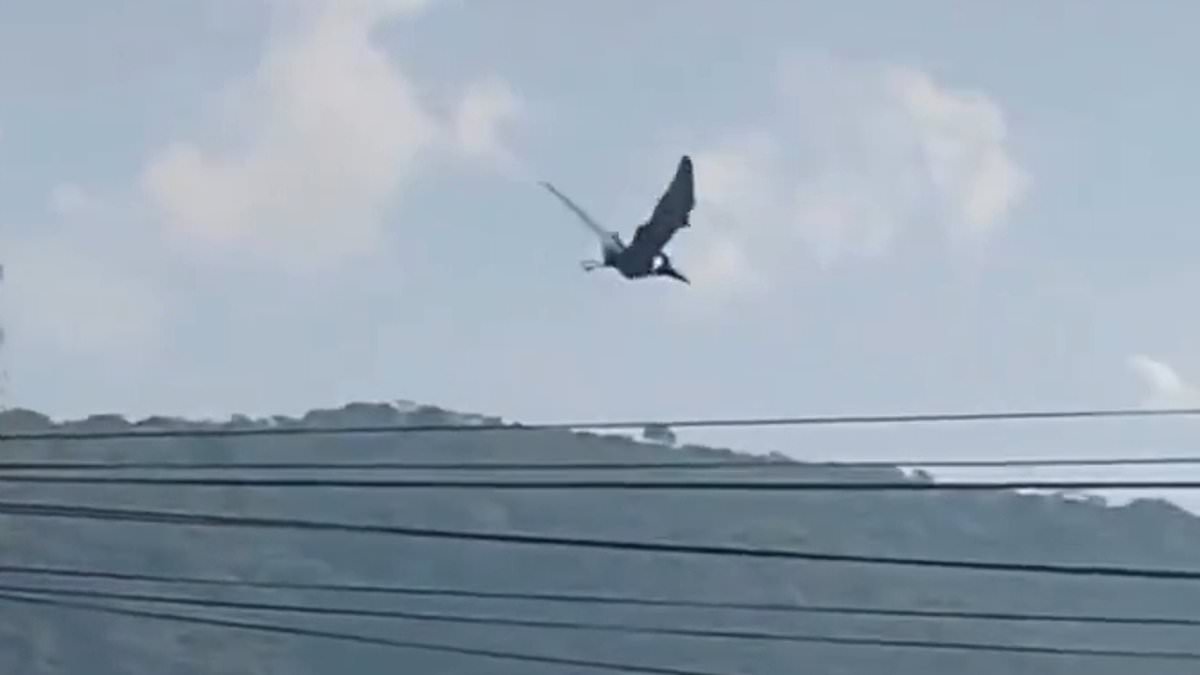
Videos claiming to show a mysterious 'dark-winged' creature near the US-Mexico border have taken the internet by storm.The bizarre clips sparked comparisons to a pterodactyl, alongside accusations that the footage was created using AI.Several videos claiming to capture the creature are circulating on X. One, shared by UFO investigator Jaime Maussan, purportedly shows a winged silhouette over the Juárez Valley at night, which he said was recorded by a home security camera.Another clip is said to show a similar figure flying over Ciudad Juárez during the day.The uncertainty has done little to dampen speculation online. 'There was a Pterodactyl in Mexico! Who let the monster out?' one user wrote.Another posted: 'A pterodactyl shows up in Mexico. Scientists claim it's a bird. Nice try, Jurassic Park. We're not falling for that s***.'Ciudad Juárez’s municipal Civil Protection director, Sergio Rodríguez, dismissed the prehistoric-animal claims as unsupported, describing the videos as digital entertainment without a factual basis, according to local outlet Radio Net.Separately, TV Azteca cited unnamed specialists who suggested the figure could be a great blue heron, although the report provided no named expert or detailed analysis supporting that identification. The bizarre clips appear to show a large, winged creature with a long, narrow skull and a prominent crest extending from the back of its head, sparking claims of a living pterodactyl and accusations that the footage was created using AIMaussan has offered his own speculative explanation, asking on X: 'Is the creature recently filmed in the Juárez Valley evidence that a dimensional portal is located there?'He was suggesting that the figure might have entered our world through a supposed gateway to another dimension, a theory for which he provided no scientific evidence.In an episode of his program Interestelar, Maussan also revised his identification of the alleged creature, saying that what he had previously described as a pterodactyl was, in his view, a Pteranodon.'We were mistaken,' he acknowledged, arguing that its apparent size and head crest supported his revised interpretation.The program presented a third recording, reportedly filmed on November 7 around 11pm local time at the intersection of Margarita and Arroyo de las Víboras streets in the Felipe Ángeles neighborhood.A narrated report attributed the footage to a boy named Fernando Arteaga, who allegedly witnessed the figure attacking a dog before taking flight.'According to his account, the strange creature attacked a dog and tried to carry it away, releasing it at the last moment. It then took flight,' the report stated.The broadcast said the boy began filming as the figure rose into the night sky, turned and disappeared from view. That account has not been independently corroborated.A local claimed to have captured the creature soaring over the city earlier this month The video shows a winged silhouette over the Juárez Valley at nightThe report pointed to the Franklin Mountains in nearby El Paso, Texas, as a geographical reference visible in the background.According to the broadcast, Maussan Television collaborators Eduardo Gamaliel and Marcos Carrera visited the location where the boy said he made the recording.The program also highlighted a sound it attributed to the flying figure, although its source was not independently established.Its identification of the alleged creature relied partly on what the team interpreted as a crest extending from the back of its head.'This characteristic is fundamental to establishing that it is a Pteranodon,' the narrated report stated.Maussan acknowledged that the images remained under investigation, while also describing the evidence presented on his program as 'absolutely authentic.' TV Azteca cited unnamed specialists who suggested the figure could be a great blue heronHe urged critics to base their objections on research, saying his team had visited Ciudad Juárez and remained in close contact with local investigators.He also challenged a separate suggestion that the figure could be a shoebill, asking how the African birds could have reached the Mexican border city.That objection concerned a different species from the great blue heron suggested in TV Azteca’s report.Great blue herons are familiar North American birds with a distinctive appearance in flight.According to Cornell University’s Lab of Ornithology, they fly with broad, rounded wings, their necks folded back and their long legs extending beyond their tails.Those are general identifying features, however, rather than confirmation of what appears in the disputed clips.Pterosaurs, meanwhile, were flying reptiles that lived alongside dinosaurs but belonged to a separate group.Their wings consisted of membranes supported by an exceptionally elongated fourth finger, unlike the feathered wings of modern birds.They disappeared in the mass extinction approximately 66 million years ago.
Bizarre 'pterodactyl' filmed near US border sparks claims ancient predator is on the loose
Full Article
Original Source
Read the full article at Dailymail →KhanList aggregates and links to publicly available news content. We do not host full articles from third-party sources. Always verify important information with original sources.