
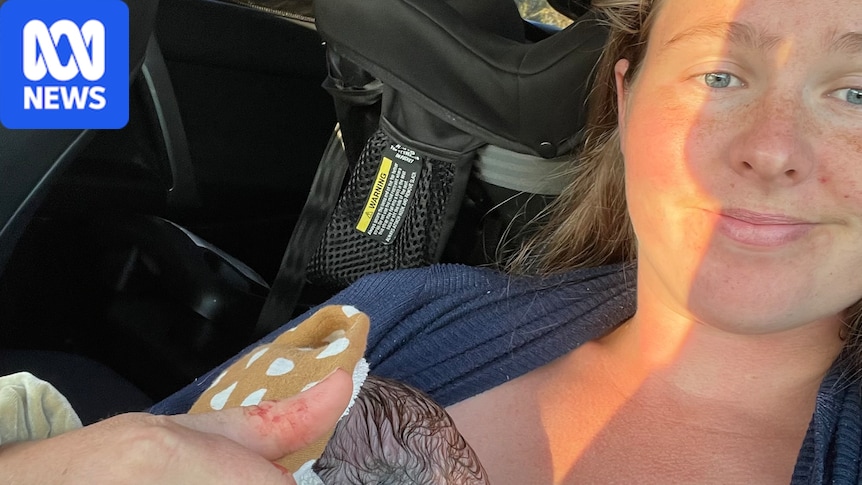
When Shara Kimpton gave birth to her third child five weeks early in 2023, she was in a rest area on the Sturt Highway in the New South Wales Riverina.She and her mother were on their way to the Griffith Hospital, more than 90 kilometres from home, but the baby was in no mood to wait."It was quite the rush and everything was a blur," Ms Kimpton said."But I just had to follow my instincts because that was the only thing I had."There was lots of flies and trucks going past … out in the elements."Shara Kimpton says she was forced to give birth among flies and with trucks going past. (Supplied: Shara Kimpton)Stories like Ms Kimpton's are becoming more common.Twenty-five years ago, the rate of babies being born before arriving at hospital in NSW was similar whether you lived in a regional or a metropolitan area.But that figure has long been diverging, with rates since doubling in regional local health districts.In outer regional and remote areas, it has more than tripled.Rates are highest on the Central Coast and northern NSW, where one in 67 babies is now born before making it to hospital.The NSW Health data includes: planned homebirths before a midwife arrivedfreebirths, which is distinct from a homebirth and occurs without a registered midwife or doctor present, before a hospital presentationbirths at home or in transit before a planned hospital birthThere is no breakdown of those categories.Perinatal social worker and regional maternity advocate Jen Laurie said anecdotally many were those in transit, known as "roadside births".Ms Laurie has spoken to dozens of women about their birthing experience and through her Bush Babies campaign, lobbying the NSW Government, with many sharing stories of births at rest stops and in toilet blocks."I sometimes wonder if it's going to take a catastrophic outcome for somebody to be really creative and start listening and do something about it," she saidJen Laurie says the regional maternity system is a "networked mess". (ABC News: Peter Sanders)NSW Health Minister Ryan Park said he wanted to "get that number down" and would consider a target if it was advised by the recently appointed inaugural chief midwife."It is still small as a percentage of all births, but every time that happens, it causes concern, particularly for mums and families," he said.Ms Kimpton said despite her history of quick deliveries, when she fell pregnant again with her fourth child she was not offered an appointment with her local clinic until about halfway through her pregnancy, and was not given any alternative options other than driving in for the delivery.Homebirth was not an option available to her so she planned to freebirth at home despite the known risks, which can include undetected complications, and then presented to hospital as she did not want to risk giving birth on the side of the road again."Our only option is go to your closest local midwifery-included hospital or even further, pretty much for centralised care," she said.Shara Kimpton opted to give birth to her fourth child at home, fearing another roadside birth. (ABC News: Ian Cutmore)In a statement, a Murrumbidgee Local Health District apologised that Griffith Hospital was not able to provide Ms Kimpton with an antenatal visit before the recommended 14 weeks, and that maternity staff aim to provide ongoing support and information for birth and emergency options."We continue to listen to and learn from women about their experiences to help us plan and improve the care provided within our maternity services to meet the needs of the local community," the statement said.Ms Kimpton said if Hay, the closest town to her property, still had a birthing option like it used to, she could have planned to go birth there instead.The birth certificate for Shara Kimpton's son shows he was born at "Birdcage Rest Area". (ABC News: Ian Cutmore)Birthing options centralisedMs Laurie said she felt the reason behind the increase was clear."The reduction of services and the centralisation of services," she said."A lot of these regional rural remote places that are no longer offering birthing previously did."Dozens of birthing services have closed or been suspended under both Labor and Coalition governments across NSW over recent decades.Examples of mothballed maternity units include the unit at Parkes, which has lay dormant since 2019 because not enough staff want to work there, but Ryan Park said he was still working towards opening it.The barely used birthing suite in Parkes remains closed due to a lack of available staff. (ABC Central West: Xanthe Gregory)There was also Muswellbrook, which closed in 2022, forcing expectant mothers to travel 100km to Maitland.The Upper Hunter Shire Council has expressed fears Scone could be in a similar situation when its only obstetrician retires at the end of 2026, with recruitment still underway.The closure of the maternity ward at Yass in 2004 has seen women give birth on the Barton Highway on the way to Canberra.In Tumut, birthing has been suspended after its only obstetrician was banned from practising at the hospital, with women being sent more than 100km away to Wagga Wagga until the position is filled.Mr Park acknowledged there had been a "change in the midwifery model" over time with a "focus on safety", which he said also had challenges."It has to be a service that operates around the clock, and that's why governments of all persuasions probably over the last 25 years have concentrated those services around major hubs and major hospitals," he said."What we've tried to do, and our approach is slightly different, we're trying to get more women to be able to birth as close to where they live as possible."We've expanded homebirthing and we've expanded midwifery group practices."Ryan Park says he wants to see more birthing options closer to home, while balancing resourcing challenges. (ABC News: Billy Cooper)There is strict criteria around location and pregnancy risk for women wanting a homebirth, and midwifery group practices generally provide antenatal and postnatal care.Mr Park also said more than 300 new midwifery places had been filled since 2023, with half of those in rural and regional areas.He said there was "more work to do"."I've made it clear to the department I want the focus on trying to open up these birthing services, but I've got to balance that out with making sure that we've got the staff in place."A statewide maternity service plan is also due at the end of the year.Midwives working in 'pressure cooker'On the Central Coast, the measured impact of the closure of a private maternity unit last year is not clear as the data only goes up to 2024.Gosford-based doula and educator Gemma Wilson said with Wyong's maternity ward also closed since 2020, the situation on the Central Coast was "dire".There is currently only one maternity ward to cater for more than 3,500 births each year.Gemma Wilson is a doula and educator based in Gosford. (ABC News: Tamara Penniket)"It's been a bit of a snowball effect that's continued to happen here," she said."[Midwives are] trying to provide the best care and do the best that they can, but they are literally working in a pressure cooker right now in that system."Ms Wilson said while the federal government had allocated $10 million to provide additional support to Gosford's remaining maternity ward, there had not been much improvement.Gosford Hospital has the only remaining maternity ward on the Central Coast. (ABC News: Tamar Penniket)She also said while a publicly funded homebirth service opened on the Central Coast in 2023, it did not counter the impact of losing Wyong's birth centre."We have nowhere for women in the north end of the coast to birth at," she said.NSW Health said while there has been a small increase in the number of women birthing at Gosford Hospital since Gosford Private closed its ward, it was not as much as predicted.Broader impactTim McEwen from the Australian Paramedics Association (NSW) said the data showing an increase in births before arrivals correlates with what paramedics see on the ground.He also thought a reduction in services was behind the trend."In a lot of regional towns there's only one ambulance on duty, and that ambulance may not be in town at the time of the medical emergency," Mr McEwen said."So the potential for having no maternity unit and no ambulance or backup ambulance available is really quite a frightening prospect both for the public and us as paramedics."In a statement, NSW Health said local health districts were focused on filling midwifery and obstetric vacancies through targeted workforce planning, university partnerships, internal pathway programs and tertiary study subsidies."We strongly encourage all pregnant women to consult with registered healthcare providers early in their pregnancy, for personalised advice about the best options for themselves and their baby, including options for pregnancy care and birth location," the statement said.
Birthing among 'flies and trucks' becoming more common in parts of NSW
Full Article
Original Source
Read the full article at Abc →KhanList aggregates and links to publicly available news content. We do not host full articles from third-party sources. Always verify important information with original sources.