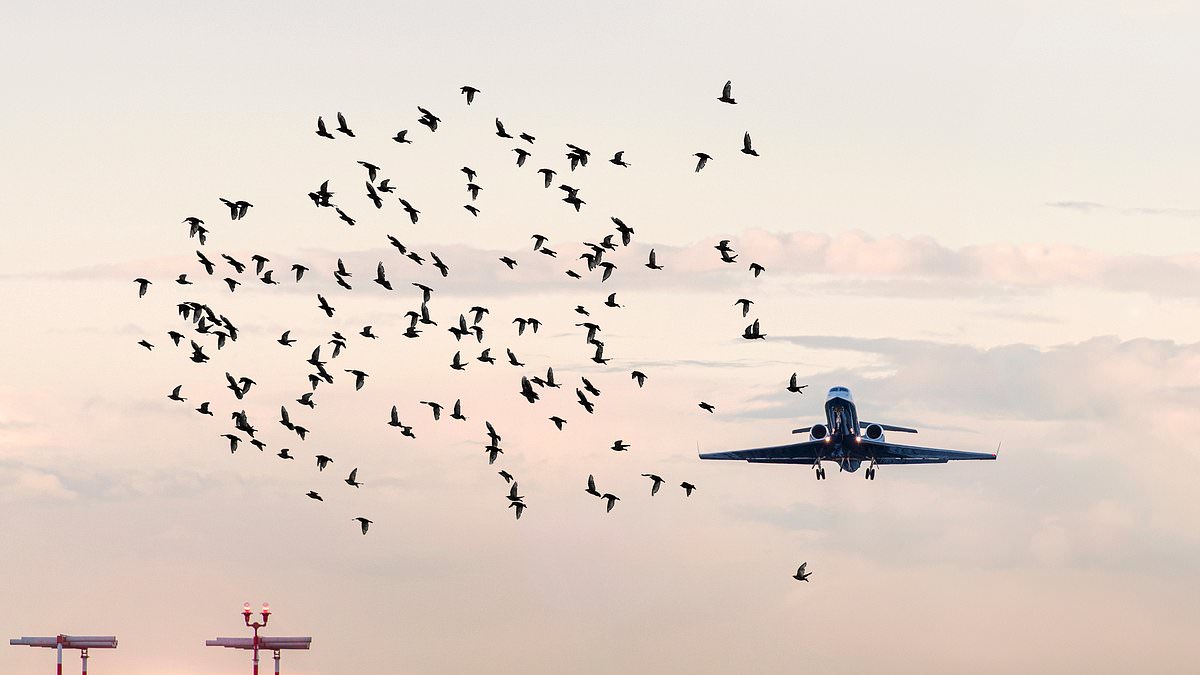
Last month Ryanair passenger Ljubiša Karović, from Serbia, was partially sucked out of a window at 20,000ft.A piece of the engine is reported to have broken off and hit the window, depressurising the cabin. The plane was headed from Greece to Germany when the incident happened and was forced to turn back and make an emergency landing at its departure airport in Thessaloniki. The passenger received medical assistance when the flight landed.But now an ongoing investigation into the events by the US National Transportation Safety Board (NTSB) has revealed that there were four suspected bird strikes to the plane's number two engine reported by the crew in the 12 months before the accident. 'Bird remains were reportedly found in two of the cases,' the preliminary report said, according to Reuters, but no damage was found afterwards during maintenance. A loud bang was recorded less than ten minutes into the journey and fractured fan blades were found in the engine as well as three loose fan blade fragments. Ryanair declined to comment when approached by the Daily Mail about the investigation. It comes after a string of other events linked to bird strikes. An American Airlines plane saw flames shoot from its engine after it hit birds on August 10, CNN reports.The aircraft was forced to make an emergency landing and bird remains were found on the runway.Meanwhile, back in January an Air New Zealand flight heading to Brisbane was cancelled seconds before take-off due to a bird strike. According to the Civil Aviation Authority (CAA) there were 1,702 confirmed reported bird strikes in the UK but, just how dangerous are they to flights? The incident on a Ryanair flight in July where a man was partially sucked out of a window could be linked to a bird strike How often do they occur?Former airline captain Emma Henderson tells the Daily Mail: 'Bird strikes are quite common despite airfields going to great lengths to control bird populations around airfields.'She adds: 'When a bird strike happens we have to report it to the aviation authority but we also have to get the aircraft inspected to make sure there is no damage that we can't see.'The CAA describes how 'bird strikes are a cause of damage to aircraft and have the potential to cause an accident. 'The risk of a bird strike can, however, be minimised through the application of appropriate and effective bird control measures adopted by aerodrome operators, working in conjunction with other organisations and specialists.'The number of bird strikes each year in the UK seems to be increasing gradually. In 2019 there were 1,579 confirmed instances. This dropped to 739 in 2020 – during the pandemic – when travel was limited for some time.In 2021 there were 741, and – as travel returned to normal – the total shot up to 1,445 in 2022. The year 2023 saw 1,676 incidents and in 2024 there was an increase to 1,712.Captain Henderson, who is now a professional speaker, recalls experiencing a bird strike when taking off from Corfu. 'It was an egret and it made a loud bang but there was no change to the way the aircraft or engines were operating so we ran through our decision-making process and continued the flight,' she says. 'It was inspected by an engineer on arrival and there was a small smudge of blood on the engine and then nothing else apart from a horrible smell.' Bird strikes are quite common, according to Captain Emma Henderson, but passengers don't need to be concernedAre bird strikes dangerous?Bird strikes are usually not dangerous given the size of the plane and high-performance technology that goes into aircraft, Pilot Institute reports.Captain Henderson emphasises that 'passengers don't need to be concerned'. Fatalities from such incidents are relatively rare. Across the globe, wildlife strikes involving civil and military aircraft have led to 649 deaths between 1990 and 2025, according to a report by the US Department of Transportation Federal Aviation Administration and the US Department of Agriculture Wildlife Services. But there are 'several vulnerable areas' on a plane that could cause problems if a bird were to hit it. Pilot Institute identifies the propellers as being particularly problematic as they are not designed to take an impact when rotating.A bird colliding with a propeller could cause damage such as shock load to the engine. Engines have the potential to be disrupted if a bird enters them, as well as probes supplying data to the cockpit. However, there are 'several vulnerable areas' on a plane that could cause problems if a bird was to hit itHow pilots navigate bird strikesPilot Brian Smith previously explained to The Telegraph the measures in place to help prevent serious bird strikes. 'In flight we rarely fly above 250 knots below 10,000ft and never below 5,000ft. This reduces the energy released if a bird should be struck at these lower altitudes, and therefore the damage they cause,' he said.The pilot added that when a plane begins its descent, external lights are turned on that birds can see and try to avoid. “It is impossible to manoeuvre an aircraft away from a bird,' he said.Mr Smith explained how if a pilot tried to fly around a bird it would 'almost certainly result in putting the aircraft into an undesirable attitude near the ground'.Airport authorities also have methods in place to help prevent bird strikes, such as studying migration patterns and bird scaring.
Bird strike blamed after Ryanair passenger sucked through window at 20,000ft - but just how dangerous are they to flights? Experts reveal the risks
Full Article
Original Source
Read the full article at Dailymail →KhanList aggregates and links to publicly available news content. We do not host full articles from third-party sources. Always verify important information with original sources.