
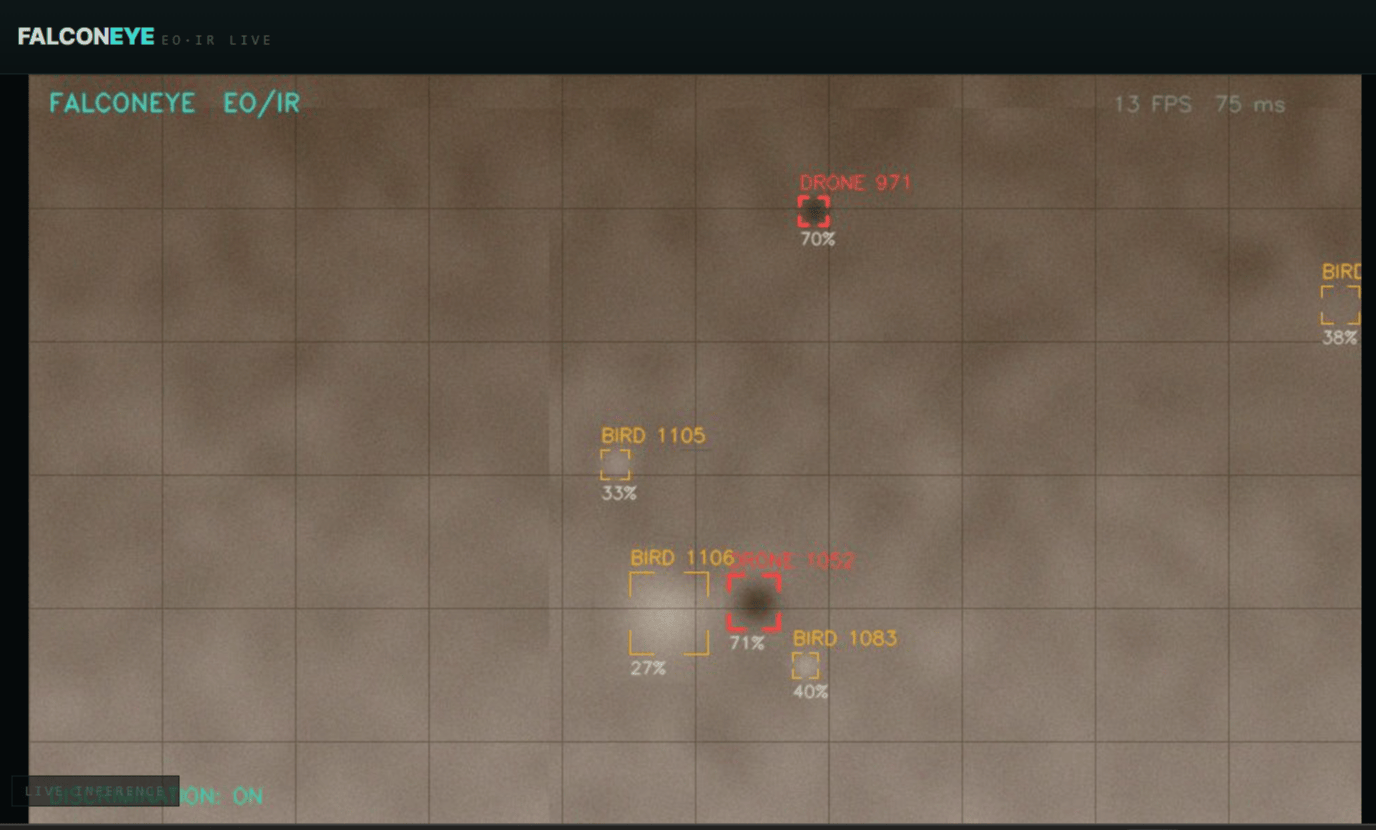
A counter-drone system can have a million-dollar radar, a steerable thermal camera, and a rack of GPUs, yet still be undone by a seagull. This is the bird vs. drone problem, and it is the most consequential unglamorous challenge in counter-unmanned aircraft systems (C-UAS). It sounds trivial. A human standing in a field can usually tell a hawk from a quadcopter in a second or two. But asked to do it automatically, from a tiny smudge of pixels half a mile away, in changing light, fast enough to act, and without crying wolf at every gull and pigeon in the sky, and the problem turns brutal. And getting it wrong in either direction is expensive in ways that decide whether a system is deployable at all. This article is about why a bird and a drone are so hard to tell apart, the handful of physical signatures we can actually exploit, why each of those signatures has a hole in it, and what a serious system has to do to close the gap. Why this is the problem that matters Every fielded C-UAS deployment eventually runs into the same wall: false alarms. A system tuned aggressively enough to catch every small drone will also fire on birds, insects, weather, and reflections, and it will do so constantly. The result is alarm fatigue. Operators stop trusting the alerts, start ignoring them, and the one time it matters, the real threat slides through behind a hundred false ones. A counter-drone system that cries wolf isn’t just annoying; it manufactures the exact complacency an attacker needs. So, it can also be a technique that the enemy will notice and use against. The dominant source of those false alarms is biological. Birds are everywhere, they’re the right size, and they move through the same low-altitude airspace drones do. So in practice, “drone detection” is really “drone discrimination”, which is the ability to confidently separate the machine from the animal. That capability, not raw detection range, is what separates a demo from a system you can actually leave running over a live airport. Why a bird and a drone look the same to a machine The confusion isn’t a failure of engineering. It’s baked into the physics. Drones and birds belong to the same unforgiving target class that defense engineers call LSS: low, slow, and small. Everything that makes that class hard applies to both. To radar, they’re nearly identical. The radar cross-section of a small consumer quadcopter is frequently indistinguishable from that of a bird of similar size. Worse, their slow, low-altitude flight gets tangled up with other slow echoes, including vehicles, wind-blown vegetation, and ground clutter. So, radar alone tends to detect that something is there while struggling to say what. To a camera, they’re a handful of pixels. Most object detectors are designed for medium-sized objects in the frame. A drone at operational range is small, low-contrast, and often moving against a cluttered or shifting sky. Distant targets with weak contrast and poor visibility are exactly where appearance-based models degrade fastest, and at that scale, a drone and a bird genuinely do present near-identical silhouettes. Both have moving parts that betray them, and disguise them. A drone’s spinning rotors and a bird’s beating wings both produce a micro-motion signature. That’s a gift, because the signatures differ. But it’s also a trap, because under the wrong conditions those signatures collapse into ambiguity, as we’ll see. The asymmetry nobody designs for Before the methods, the single most important conceptual point, and the one most systems get wrong: the two ways of being wrong are not equal. A false positive is flagging a bird as a drone, and it costs you a wasted response, operator time, and, accumulated over a day, the alarm fatigue that erodes trust in the whole system. A false negative is dismissing a drone as a bird, and it is a catastrophic miss. It’s the failure that lets the threat through. It’s the headline. These errors trade off against each other: push the classifier to never miss a drone, and it flags every bird; push it to never bother you with birds, and it eventually waves a real threat through. There is no single “accuracy” number that captures this. A model that’s 95% accurate sounds great until you learn its mistakes are concentrated in exactly the case you can’t afford. The honest way to specify a C-UAS classifier is to fix one error rate and report the other: at a detection rate high enough to be operationally credible, what is the bird false-alarm rate? That number, the bird false-alarm rate at a pinned detection rate, is the real benchmark of the entire problem. Everything else is engineering in the service of moving it. The signatures we can actually exploit There are essentially four physical cues that distinguish a drone from a bird. Each is real. None is complete. 1. Appearance: what it looks like This is the computer-vision approach: feed the imagery to a convolutional network or a modern detector and ask it to draw a box and assign a label. It’s the most intuitive cue and the one that improves fastest with data and better models. The research bears out both the promise and the catch. On benchmark drone-vs-bird datasets, two-stage detectors have historically led, and in one comparison, a Faster R-CNN with a feature-pyramid backbone reached a mean average precision around 0.894, with an older YOLOv3 close behind near 0.823, while, tellingly, some newer architectures scored far worse on the same task. That’s the first lesson of appearance-based discrimination: this is not a “use the latest model” problem. The small-object, low-contrast regime punishes general-purpose detectors that excel on everyday photos, and architecture choices that help with normal objects can actively hurt here. The field has converged on a few patterns: a two-stage pipeline that first proposes candidate moving regions (via frame differencing or background subtraction) and then runs a dedicated classifier to sort each candidate into drone vs. bird vs. clutter; purpose-built datasets like the community Drone-vs-Bird Grand Challenge and various public collections of tens of thousands of labeled drone and bird images; and architectures specially tuned for small-object feature localization. Data is the perennial bottleneck, as annotated sets are smaller and less diverse than in mainstream vision, and class imbalance and inconsistent labelling are recurring complaints. The hole: appearance alone fails precisely when you need it most, and at long range, in poor light, against clutter, when the target is a few ambiguous pixels. At that point, a drone and a bird simply look the same in a single frame. 2. Kinematics: how the body moves If a single snapshot can’t separate them, the path through the sky often can. The gross body motion of a drone and a bird obeys different rules. A quadcopter can hold a perfect hover, hang motionless, accelerate in a straight line, and execute sharp, geometric, almost machine-precise turns. A bird soars, glides, wheels on thermals, flaps in intermittent bursts, and traces the fluid, slightly irregular paths of a living thing optimizing for energy. Plot enough of the trajectory, and the two diverge in ways a single frame never reveals. Crucially, trajectory-level features have a property that appearance lacks: robustness. Motion patterns are far less sensitive to sensor quality, illumination, and weather than appearance features are, so they tend to generalize from the lab to the real surveillance feed. This is why the strongest modern approaches classify the track, not the frame: they accumulate evidence over time and ask how the thing moves, not just what it looks like in one instant. The hole: kinematics need time and a clean track. A drone deliberately flown to mimic a bird’s meander, or a bird flying a momentarily straight line, can blur the boundary over short windows. And a hovering drone versus a soaring, gliding bird can both look near-stationary for seconds at a stretch. 3. Micro-motion: wings beat, rotors spin Zoom in on the moving parts, and a sharp difference appears. A bird’s wingbeat is slow and rhythmic, on the order of a few hertz, commonly around 4 to 6 Hz for the kind of birds that trigger alerts. A drone’s rotors spin at hundreds of hertz. That order-of-magnitude gap in oscillation frequency is one of the cleanest discriminators available, and it can be read optically by a camera fast enough to resolve it, or extracted from the signal in other modalities. The hole: and it’s a big one, it is that birds glide. A soaring hawk or a gull riding a thermal stops flapping entirely. In that moment, the wingbeat signature vanishes, and the bird presents no micro-motion at all — looking, to a frequency-based classifier, exactly like a smoothly cruising aircraft. The very cue that most cleanly identifies a bird is the cue the bird periodically switches off. 4. Micro-Doppler: the radar fingerprint The radar analog of micro-motion is the micro-Doppler signature: the tiny frequency shifts a target’s moving parts impose on the reflected radar signal, on top of the bulk Doppler shift of the body itself. Both drones and birds generate one, rotor blades for the drone, flapping wings for the bird, but the structure of the signature differs. A bird’s micro-Doppler tends to appear as narrow, periodic “flashes” timed to its wingbeat, with a relatively limited spread. A drone’s spinning blades produce a broader, more continuous, harmonically rich signature. Controlled experiments across radar bands have repeatedly shown these are separable in principle. The hole is the same one that haunts micro-motion, plus a few more. When a bird glides, its micro-Doppler flashes disappear, and the signature flattens out. Researchers have literally watched a seagull drift through a radar beam and glide away, producing no wingbeats at all — a textbook discriminator quietly switched off. And micro-Doppler depends on viewing geometry, target aspect angle, and radar frequency, so the same bird can present differently from different angles. Reading it reliably demands coherent radar, high sampling rates, and careful time-frequency analysis. Why no single cue wins: and the adversary makes it worse Lay the four cues side by side, and a pattern emerges: every one of them has a blind spot, and the blind spots are correlated with the hard cases. Appearance fails at range and in bad light. Kinematics need time and degrade against deliberate mimicry. Micro-motion and micro-Doppler both collapse when the bird glides or the drone simply cruises smoothly. And then there’s the adversary, who gets a vote. A serious threat actor isn’t a cooperative target. Drones can be flown in deliberately bird-like, meandering paths to defeat trajectory classifiers. Flapping-wing ornithopter drones exist specifically to mimic a bird’s micro-motion and silhouette. As the stakes rise, the bird-vs-drone problem stops being a passive perception challenge and becomes an adversarial one, where the threat is actively engineered to land in the ambiguous zone. The conclusion every line of research keeps arriving at is the same: no single signature is sufficient. The robust answer is fusion, which combines cues so that where one goes blind, another still sees. When the bird glides and the micro-Doppler vanishes, the trajectory still looks avian. When the target is too distant for appearance, the kinematics still separate the machine from the animal. The discriminative power lives in the combination, not any one channel. What a serious system actually does Pulling this together, the design principles for credible bird-vs-drone discrimination look like this: Classify the track, not the frame. Single-image classification throws away the richest discriminator there is, motion over time. Sequence models that operate over a target’s track, rather than isolated detections, have been shown to cut the false-positive rate of drone tracks substantially. Accumulating evidence across frames is how you survive the moments when any one frame is ambiguous. Fuse complementary cues so blind spots don’t line up. Pair appearance (strong up close, weak at range) with kinematics and micro-motion (strong over time, robust to conditions) so the system degrades gracefully instead of failing all at once. For a vision-first system, that means marrying a small-object appearance classifier with explicit temporal and trajectory modelling: what it looks like and how it flies. Engineer for the asymmetry on purpose. Decide deliberately where to sit on the false-positive/false-negative trade-off, tune the operating point to it, and quantify the system honestly: bird false-alarm rate at a fixed, operationally meaningful detection rate. A system that can confidently clear a bird is worth more than one that merely detects drones, because clearing birds is what keeps operators trusting the alerts. Treat data as the core asset. The models are increasingly commoditized; the labelled, diverse, hard-case imagery - gliding birds, distant drones, bad light, partial occlusion, motion blur - is what actually moves the benchmark. The edge cases that break the system are exactly the ones underrepresented in convenient datasets. The bottom line The bird vs. drone problem is the quiet benchmark the whole field is really being measured against. Detection range makes the brochure; discrimination makes the deployment. A bird and a drone sit at almost the same point in every sensor’s feature space, the cleanest discriminators switch themselves off at the worst moments, and a motivated adversary will aim straight for the ambiguity. The systems that win won’t be the ones with the longest-range sensor or the trendiest model. They’ll be the ones that fuse what a target looks like with how it moves, classify patiently over time instead of reacting to single frames, and can prove, at a detection rate that matters, just how rarely they mistake a gull for a threat. Tell the seagull from the quadcopter, reliably and without crying wolf, and most of the rest of counter-UAS gets a lot easier.
Bird or Drone? The Hardest Classification Problem in Counter-UAS Isn't the One You'd Expect
Full Article
Original Source
Read the full article at Hackernoon →KhanList aggregates and links to publicly available news content. We do not host full articles from third-party sources. Always verify important information with original sources.