
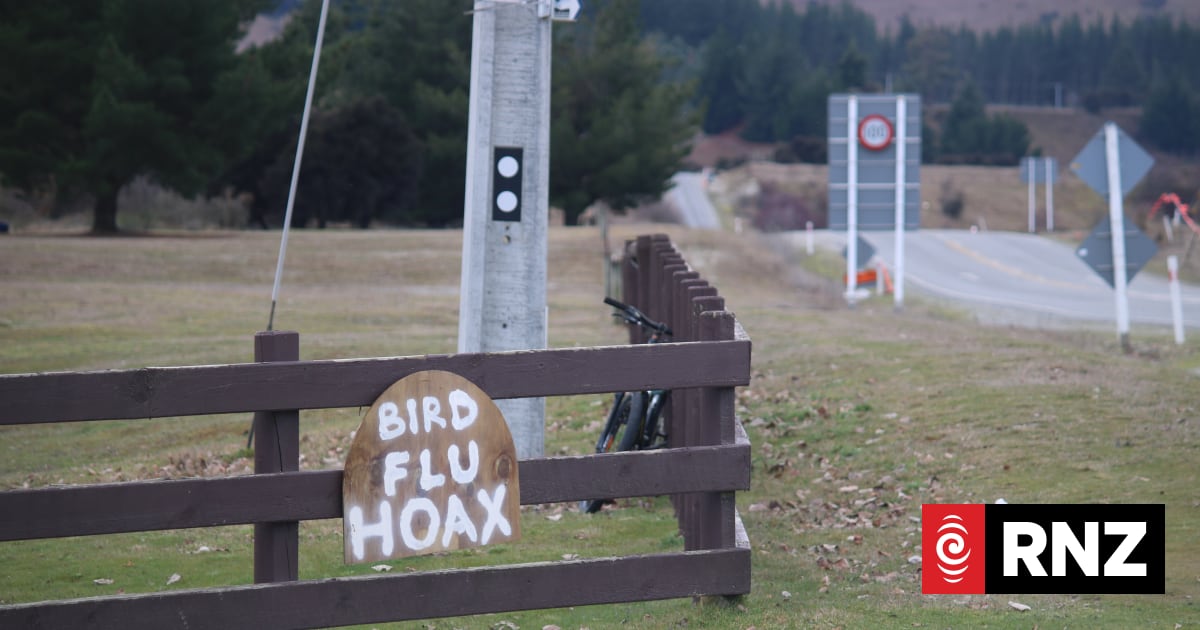
As biosecurity and conservation groups work to shield the country's wildlife from any spread of bird flu, researchers say some New Zealanders are embracing false narratives about the virus on social media.Following three detections of the deadly avian influenza, the Ministry for Primary Industries (MPI) is encouraging people to report any sightings of three or more sick or dead wild birds, but hundreds of people online are claiming the virus is a hoax.MPI has been monitoring the spread of the highly contagious viral disease overseas for more than 20 years and the H5N1 strain for the past six, with response and surveillance work underway to protect poultry production and wildlife.The Department of Conservation has been vaccinating critically endangered species to help curtail any further spread, while a wildlife hospital has set up an off-site triage centre to assess wild birds for symptoms.Within days of the first case being confirmed in July, disinformation researcher Dr Sanjana Hattotuwa said reality was overtaken online by a script incorrectly casting bird flu as a sequel to the Covid-19 pandemic.He tracked thousands of social media comments on RNZ and NZ Herald articles, finding that most falsely dismissed bird flu as a hoax or "plandemic"."By 16 July commenters had converted a biosecurity event into a further episode in an established political story about Covid deception, vaccine injury, captured media, corrupt science, globalist control and the destruction of food sovereignty," he said.Dr Sanjana Hattotuwa.Supplied"Disinformation researchers, contrary to what is popularly believed, love to be proved wrong and here in this instance, I was really worried that the first confirmed case of bird flu in Aotearoa would result in exactly the kind of discourse that I ended up studying."Hattotuwa said commenters were creating a "self-sealing account", where any evidence of H5N1 proved orchestration, uncertainty proved incompetence, absence of confirmed spread proved scaremongering and any official response proved that a planned operation had begun.When MPI reported no further H5 detections on 24 July, commenters misconstrued that as evidence of fakery, he said."They called field staff crisis actors, described systematic surveillance as staged theatre, treated the absence of protective equipment as proof that no virus existed and attacked expenditure on monitoring," he said.Hattotuwa said inaccurate descriptions of bird flu as "Covid 2.0" or "plandemic take 2" placed the new risk inside an already settled story."This framing matters because it removes the need to assess the present evidence," he said."Stories and storytelling are what the disinformation community and the conspiratorial community are very, very good at. When you have a community that subscribes to conspiracy, there is actually no space within that discourse for science."Hattotuwa found on social media, users repeatedly "crowded out" constructive or scientific discussions, manufacturing the appearance of an emphatic popular consensus on comment threads.New Zealanders are embracing false narratives about bird flu on social media.123RF'Evil plot'Conspiracy theory researcher M Dentith said they had also observed unfounded concerns that bird flu was a hoax or at times "some kind of evil plot by people in power"."There's a slight libertarian streak within our society. There are certain people who just don't like the idea that governments or people in positions of authority are going to tell people what to do," they said.Dentith, an associate professor of philosophy at Beijing Normal University, said the scale of the disinformation was very hard to know and could appear exaggerated on social media.The lack of visible consequences from bird flu appeared to be contributing to doubts, they said."This a bad analogy here but we're not seeing chickens on buses snuffling and coughing, we're not really seeing birds being sick in public and thus people going, 'Well, I'm not seeing any evidence of a bird flu, so it can't really be real, right?'"New Zealand had great early success in eliminating Covid-19.RNZ / Nate McKinnonThe country's successful containment of Covid-19 had inadvertently paved the way for future scepticism, Dentith said."Because we were able to control and contain the virus within our policy quite successfully, we didn't see the kind of large scale tragedy that actually may have left an imprint on people's minds. If Covid wasn't a big deal because we didn't see those bad outcomes, then surely when the government is making a big deal out of bird flu, there must be something really suspicious going on there as well."For people dealing with friends or family members who were bird flu sceptics, Dentith suggested finding common ground and appealing to shared values."Many people go, 'Well, just report the facts. Just tell them that, you know, bird flu is real' but telling people insistently that what they believe is wrong doesn't really work. What you need to be able to do is find some degree of commonality and then kind of expand on that to try and get them to consider your particular perspective."Massey University distinguished professor of infectious disease epidemiology and public health Nigel French said disinformation had become an inevitable reality in modern science communication."In almost every aspect of work that I've done on infectious diseases there's disinformation. I think we just have to make sure that the correct information is disseminated as effectively and as widely as possible to counter the disinformation," he said.New Zealand was well-positioned to respond to bird flu and many people were working hard to minimise the impacts, French said."We've had more time than any country really to prepare for this because it's been travelling around the world for some time. We know what the impacts have been elsewhere and that gives us an indication of what it could be like here," he said.Reporting urgedThe Poultry Industry Association was monitoring bird flu developments in Australia and helping New Zealand farmers prepare for a possible incursion, while the New Zealand Veterinary Association was distributing information to help people keep their pets safe.University of Otago professor of virology Jemma Geoghegan said public monitoring was essential for catching early cases."It's usually going to be members of the public that stumble across these animals first and it's really important that they know what to do and what not to do," she said.Geoghegan urged people to report any unusual bird deaths or illnesses to the MPI hotline, recommending that they take photos or videos from a safe distance while avoiding touching or getting too close to the animals.Public vigilance and newly established laboratory and genomic sequencing pipelines to trace the virus were the country's best defence against bird flu, she said.
Bird flu 'hoax' claims spread online
Full Article
Original Source
Read the full article at Rnz →KhanList aggregates and links to publicly available news content. We do not host full articles from third-party sources. Always verify important information with original sources.