
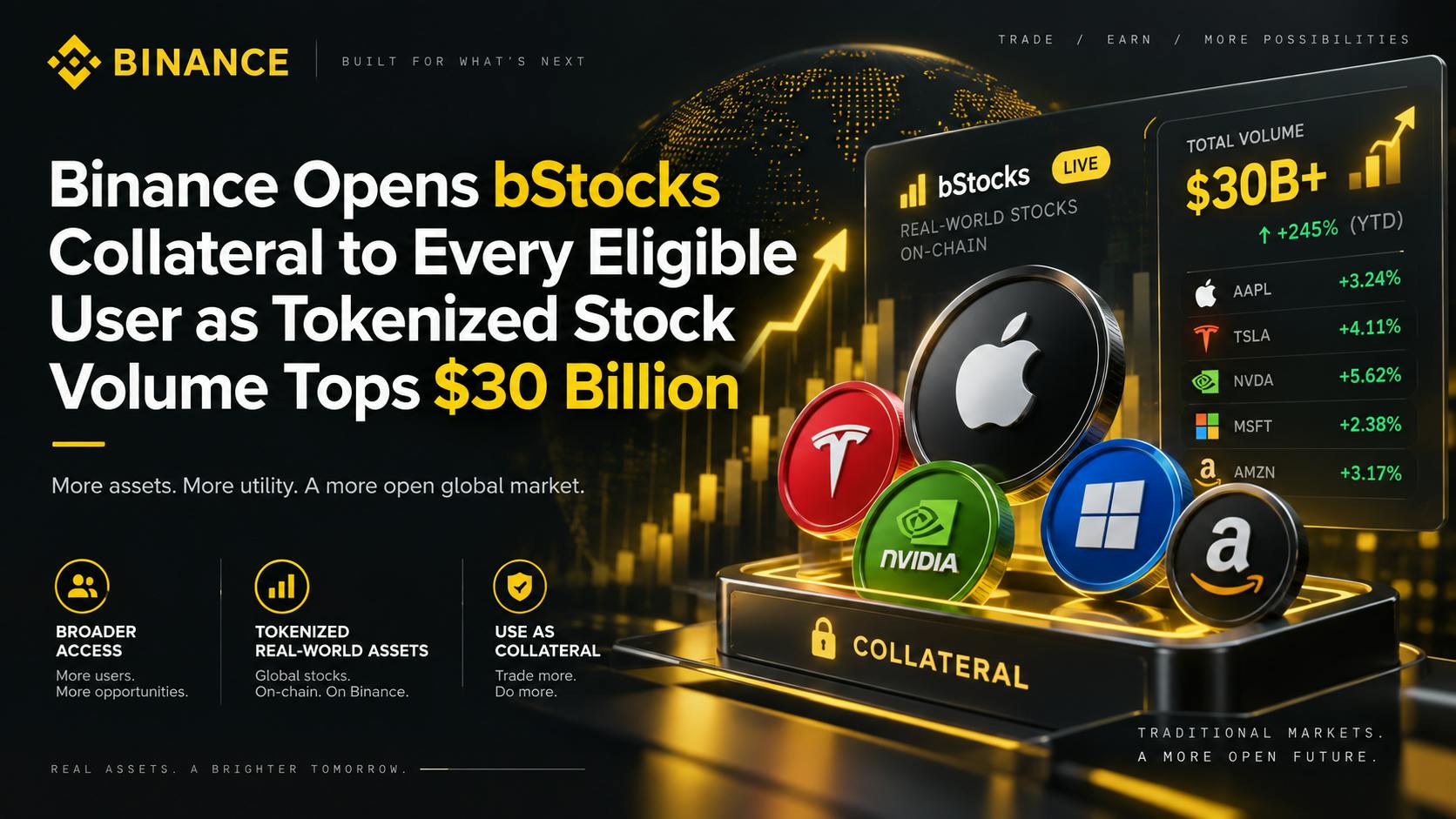
A share of Tesla sitting in a brokerage account does one thing: it goes up or down with Tesla. From today, an eligible Binance user holding the tokenized version, TSLAB, can do three. They can borrow USDT against it. They can open a TSLAUSDT futures short against it to hedge the downside. They can do both at once from the same Portfolio Margin account without posting a single extra dollar of collateral. Binance is extending bStocks collateral, which since late August had been available only to VIP 3 accounts and above, to every eligible user on the exchange. bStocks went live on 12 June with five tickers, crossed $30 billion in cumulative trading volume in under 90 days and doubled in outstanding value between mid-July and early September to $678 million, a whisker behind Kraken's xStocks. A product that took three months to become one of the two largest tokenized-stock issuers in the world is now being wired into the part of Binance where most of its volume lives.What changes today The expansion turns bStocks from something users hold into something they can use. Supported bStocks can be posted as collateral for eligible margin and futures trading across Cross Margin and Portfolio Margin accounts; the release lays out three concrete workflows. The first is leveraged acquisition: a user borrows a quote asset such as USDT inside a Cross Margin or Portfolio Margin account and uses it to buy bStocks, taking exposure of up to 5x on the position. The second is conversion: an existing stockholder converts shares into bStocks, which keeps them eligible for dividend distributions while making the asset usable across the crypto side of the platform. The third one, which matters most to anyone who has run a book, is dual use. In a Portfolio Margin account a bStock can act as collateral and as the hedge at the same time, so a Tesla holder can borrow against TSLAB while short TSLAUSDT futures, locking in a hedged position with no incremental margin. Shunyet Jan, Binance's head of exchange and trading, describes the goal as removing the mental wall between a user's equity exposure and their crypto positions, so that a sector or ETF-linked bStock can stay in the portfolio while doing the work of collateral for whatever else the user wants to do.How fast bStocks got here The product is fourteen weeks old. Binance opened zero-commission trading in more than 7,000 US stocks on 1 June, then launched bStocks on 12 June with Circle, Micron, NVIDIA, Sandisk and Tesla as BEP-20 tokens on BNB Chain, each backed one-to-one by a share held with a regulated custodian and issued by BTech Holdings, a Binance affiliate approved by the ADGM's Financial Services Regulatory Authority. By 16 July bStocks held $334 million of outstanding value, third behind Ondo at $955 million and Kraken's xStocks at $507 million. By 6 September the figure was $678 million, more than double, while Ondo was flat at $947 million and xStocks had grown to $693 million. Binance's product added more value in seven weeks than xStocks did; BNB Chain became the largest venue for tokenized stocks at roughly $1 billion, a third of the market. The $30 billion cumulative volume figure is the one that tells you why collateral is the next step: a token that trades that much is a token people are already moving in and out of positions; collateral status lets them keep it in place while they do.Outstanding tokenized stock value by issuer, 16 July versus 6 September 2026, US$ millions.The category grew tenfold in a year bStocks arrived in a market that was already accelerating. Tokenized stocks and ETFs held $344 million of outstanding value in August 2025. They started 2026 below $1 billion, reached a then-record $2.3 billion on 16 July and stood at $3.1 billion on 6 September, with tokenized ETFs such as SPY, QQQ and IVV making up $644 million of that. Stocks remain a small slice of the $34 billion tokenized real-world asset market, where Treasuries dominate at $15 billion, but they are the fastest-growing slice; their share of the whole has climbed past 15 percent. The demand is not hard to explain. A tokenized share trades around the clock, settles in minutes, sits in a self-custodied wallet and, from today on Binance, backs a leveraged position. A share in a brokerage account does none of those things.Outstanding value of tokenized equities and ETFs, US$ billions, August 2025 to September 2026.The tokens are being used, not parked The most telling numbers are not the market-cap ones. In the thirty days to 29 August, rwa.xyz recorded outstanding tokenized-stock value up just 1.45 percent, to $2.54 billion. Over the same thirty days the number of holder addresses rose 167 percent to 2.36 million, monthly active addresses rose 209 percent to about 1.3 million and transfer volume rose 415 percent to $29.5 billion. Value held barely moved while the number of people holding it, using it and moving it tripled or better. That is the signature of an asset being deployed rather than accumulated, which is the exact behaviour a collateral product is built to serve. Binance's $30 billion in cumulative bStocks volume in under 90 days sits on the same curve. Users are not buying TSLAB to hold it for a decade; they are trading it, hedging with it and now borrowing against it.Tokenized stocks, 30-day change in value versus holders, activity and volume, to 29 August 2026.Where Binance sits in the collateral race Binance is not the first exchange to accept tokenized stocks as collateral, but it is now the one doing it at the largest scale with the fewest gates. Kraken enabled ten xStocks as collateral for futures and margin on 3 July, with haircuts of 10 percent on broad-market ETFs, 20 percent on large single names and 30 percent on volatile ones such as HOODx, MSTRx and CRCLx, plus per-asset limits from $100,000 to $1 million. Bybit followed on 31 July with six xStocks accepted across its unified trading account and loan products. Binance began with DJTB for VIP 3 and above on 26 August, added BNCB on 14 September and today removes the VIP gate entirely. The differences are structural. Kraken and Bybit accept tokens issued by a third party, Backed's xStocks; Binance accepts tokens its own affiliate issues, backs and custodies, which lets it manage the collateral, the margin engine and the underlying asset inside one regulated perimeter. It also means the world's largest derivatives venue by volume now takes equities as margin for crypto futures, which is a bigger statement about where tokenized stocks are heading than any market-cap figure.Tokenized-stock collateral milestones across Binance, Kraken and Bybit, June to September 2026.What to watch Three things over the next quarter. The first is the eligible list. Five tickers at launch have grown to include names like DJTB and BNCB; the collateral list is published separately from the trading list, so the gap between what can be traded and what can be posted is the number to track. The second is the haircut schedule. Kraken published its numbers; Binance points users to a live page. How conservative those ratios are on volatile single names will decide how much leverage this really unlocks for a retail account. The third is the hedge trade. The dual-use case, long the token and short the future from one account, is the workflow that turns bStocks from a retail product into a tool a prop desk would use. The open interest on bStock-linked futures pairs will show whether that desk has arrived. Binance took ninety days to build one of the two largest tokenized-stock franchises in the world and another twenty to make it work as margin for everyone. The tokenization argument has always been that a share on a blockchain can do more than a share in a brokerage account. From today, on the biggest exchange in the industry, that is no longer an argument. It is a menu.Don’t forget to like and share the story!Vested Interest Disclosure: HackerNoon has reviewed the report for quality, but the claims herein belong to the author. #DYOR.
Binance Opens bStocks Collateral to Every Eligible User as Tokenized Stock Volume Tops $30 Billion
Full Article
Original Source
Read the full article at Hackernoon →KhanList aggregates and links to publicly available news content. We do not host full articles from third-party sources. Always verify important information with original sources.