
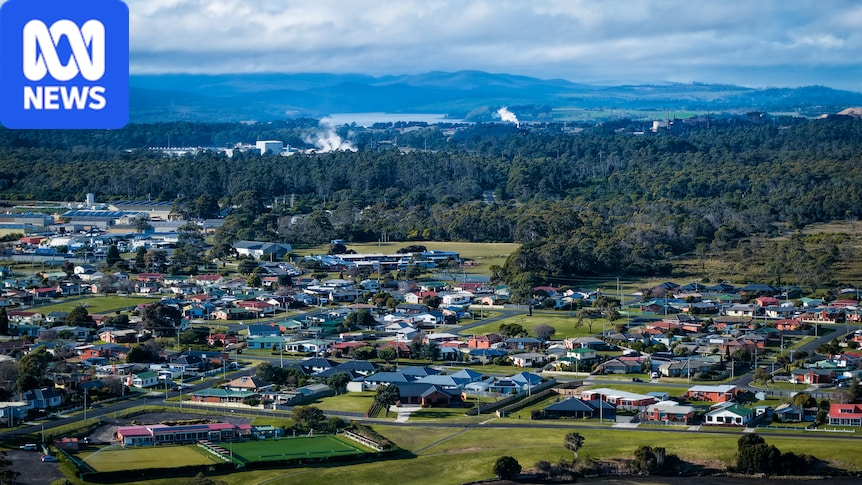
George Town was meant to be reliant on manganese and aluminium smelting jobs for decades to come.Houses have been built and businesses have banked on people continuing to flock to the northern Tasmanian town.But after the liquidation of the nearby manganese smelter there are fears the area's economy will collapse if the Bell Bay aluminium smelter follows suit.The Rio Tinto-owned aluminium smelter is teetering on the brink. Its power deal with state-owned power producer Hydro Tasmania expires at the end of the year.Community members are also angry that the same federal government bailouts offered to Rio Tinto's aluminium smelters in New South Wales and Queensland aren't yet on the table in Tasmania.The closure of Bell Bay Aluminium would have a knock-on effect across the wider community. (ABC News: Mitchell Woolnough)There's an air of alarm in the town as unions and local industry groups mount a desperate fight to keep it operating.Andy Reece, who worked at both the manganese and aluminium smelters, is blunt in his assessment of George Town's future if Bell Bay Aluminium closes."You might as well turn the lights off. What's this town going to survive on?" Mr Reece said."It's a lot of jobs to lose in a small town."$600 million gap in power negotiationsRio Tinto is in negotiations with energy provider Hydro Tasmania to keep the smelter running. (ABC News: Mitchell Woolnough)Rio Tinto and Hydro Tasmania have been negotiating for a new 10-year power agreement for the Bell Bay facility for more than two years.The two parties were previously so far apart that they only agreed to a one-year bridging deal last November, following state government intervention.Nine months later they are still locked in the same stalemate, with Tasmanian Energy Minister Nick Duigan telling state parliament that Hydro and Rio Tinto are about $60 million a year apart, a cost of $600 million over the ten-year life of the contract.Susie Bower from industry group Bell Bay Advanced Manufacturing Zone says a deal must be struck by the end of the month to give certainty to workers and the community.There are concerns for the many businesses in the aluminium smelter's supply chain which would be impacted by the closure. (ABC News: Mitchell Woolnough)"We've taken a major hit with Liberty Bell Bay closing. I don't think we can survive and take another hit with someone as big as Bell Bay Aluminium collapsing as well," she said."I was in the room when those 217 people were told they no longer have a job. I don't want to be doing that for another 550 in another three months' time."Ms Bower says a collapse would have a seismic impact on the many businesses in the aluminium smelter's supply chain, illustrated by a local engineering firm's recent claim that it would have to sack more than half of its 80 workers immediately if it were to close."That's just one example of one business. Bell Bay Aluminium have over 200 in their supply chain, so start doing the multiplier effect of that," she said.Susie Bower represents local industry and businesses and is spearheading the fight to keep Bell Bay Aluminium open. (ABC News: Mitchell Woolnough)"It is absolutely catastrophic for our state."The Tasmanian government has repeatedly pushed for the smelter to receive funding from the federal government's $2 billion green aluminium credit scheme, set to start in two years' time.It has only recently started talks with federal Industry Minister Tim Ayres to bail out the smelter, after it was told it was not eligible for the funding.Mr Ayres has not ruled out federal intervention, like the billion-dollar-plus bailouts afforded to Rio Tinto's aluminium smelters in NSW and Queensland."We are engaged with Rio Tinto and with the government of Tasmania," Mr Ayres said."We'll keep talking about these issues and there's not a lot of time, so we feel a sense of urgency about this, but right now the fair dinkum issue is resolving that power purchasing agreement," he said.UNSW economics professor Roy Green says it is often in the public interest for smelters to be bailed out.Roy Green is an economics professor at UNSW. (ABC News: Craig Hansen)"We can't just let key parts of our manufacturing base disappear as we have in the past," Professor Green told 7.30."We're now in a very different world where sovereign manufacturing capability counts in order that we don't become too vulnerable to those external geopolitical shifts".But while labelling Bell Bay "absolutely critical" to the Australian and Tasmanian economy, he said it was hard to gauge whether federal intervention would be a good use of taxpayers' money.'Angry': Ayres lashes GuptaThere are talks between the Tasmanian and federal governments about the future of the aluminium smelter. (ABC News: Mitchell Woolnough)Mr Ayres declined to comment on the negotiations but said he was focused on securing a deal.He said the closure of the Sanjeev Gupta-owned manganese smelter had been a "pretty tough knock" for Tasmania's north."I'm beyond angry and disappointed with that result," Mr Ayres said."That facility, it was undercapitalised and not run responsibly by its previous owner, and Tasmanians have paid the price for that."Federal Industry Minister Tim Ayres alongside Premier Jeremy Rockliff. (ABC News: Jake Grant)A report from administrator and now liquidator EY found Liberty Bell Bay may have been operating while insolvent as far back as May 2025, when production was paused due to ore supply issues.The smelter never restarted operations and was formally placed into liquidation in August after talks with potential buyers fell over.The EY report also found Mr Gupta loaned $191 million of Liberty Bell Bay's money to his other GFG Alliance businesses, leaving the smelter "very limited cash resources to withstand supply chain difficulties and commodity price fluctuations which have impacted profitability".Former Liberty Bell Bay worker Dean GIbbons, who worked at the smelter for 40 years, directs much of the blame for the closure towards Mr Gupta.Sanjeev Gupta's global empire has been struggling to stay afloat since the collapse of a key lender in 2021. (ABC News: Che Chorley)He says a lack of capital investment in the facility was evident to the staff for many years."A lot of capital needed to be spent because it was an aging site. And we kept hearing, 'Oh no, there's no money for that,'" he said."Even the canteen was closed and they had a tarp over the roof of it. It's sort of like what you see in the movies, run down plants.Since the smelter closed, Mr Gibbons has had to pick up numerous odd jobs to stay afloat. (ABC News: Mitchell Woolnough)"And that was the downfall in the end because if the previous owner had have spent more or some capital, he could have still been making money out of the site, so it was frustrating to see."After finding himself on the job market for the first time in decades, Mr Gibbons will start permanent work in a warehouse.He says the closure has taken a toll on him and his colleagues.Mr Gibbons started working at Liberty Bell Bay when he was 18. (ABC News: Mitchell Woolnough)"In my work group, there's been three marriage break-ups," he said."We had a lot of banter which was good for our own mental health, but it certainly hasn't been pleasant that's for sure."Like most in Tasmania's north, Mr Gibbons hopes the state and federal government can do a deal to save the aluminium smelter from closing.Mr Gibbons wants the state and federal governments to work out a deal to save Bell Bay Aluminium. (ABC News: Mitchell Woolnough)"If there was money for New South Wales and not Tasmania, it's just unforgivable, I believe," he said."People are outraged enough, I think, with Liberty Bell Bay not being saved."So if Bell Bay Aluminum went under there would almost be a public riot."Watch 7.30, Mondays to Thursdays 7:30pm on ABC iview and ABC TV
Billionaire's Tasmanian trainwreck has broken workers and marriages
Full Article
Original Source
Read the full article at Abc →KhanList aggregates and links to publicly available news content. We do not host full articles from third-party sources. Always verify important information with original sources.