
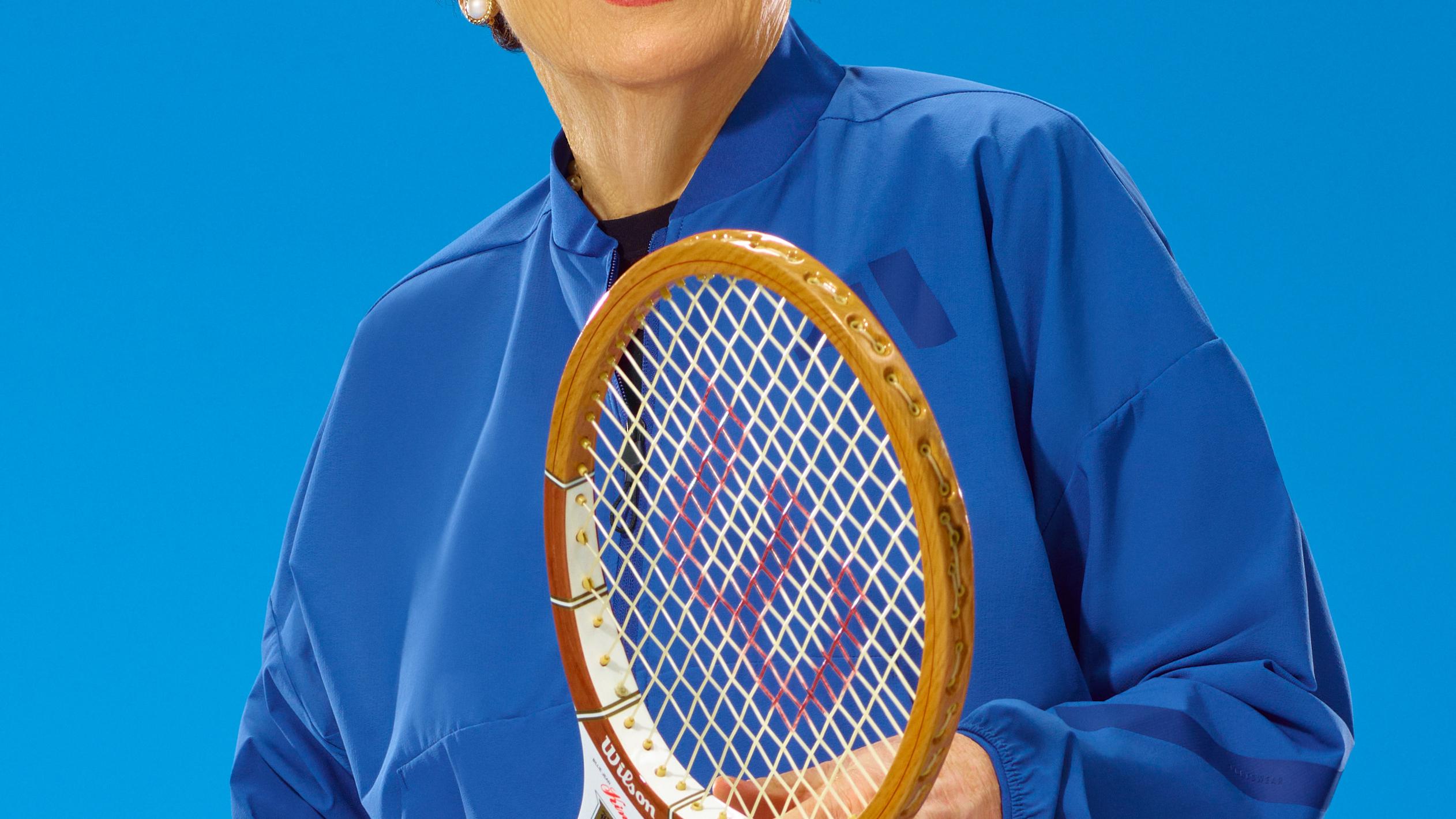
How did Arnold Palmer order an Arnold Palmer? You know, the half-lemonade, half-iced-tea concoction named in his honor? Steve Politi, sports columnist at NJ.com, unearthed the answer years ago, at Augusta National Golf Club, where a waitress who served Palmer his drink told him: "He leaned over and said, 'I'll have a Mr. Palmer.' Then he winked.” Along the same lines, during the U.S. Open, how does Billie Jean King tell a driver that she’s going to her own complex: the USTA Billie Jean King National Tennis Center in Flushing, N.Y., where this year more than 1.2 million fans, a new record, attended the final Grand Slam tennis tournament of the season? “Bring me to Ms. King’s,” perhaps? “No, I never do that,” says iconic tennis Hall of Famer and activist, 82, who is the subject of a new ESPN documentary, Give Me the Ball!, out on Nov. 22. Though “when they get me out there, they kind of start going, ‘Is this yours?’” So few humans experience the feeling of walking into a sprawling sports facility named in their honor. So what’s that like for King? “I never get used to it,” she says. “It's weird. To see your own name up there, I'm like, squeeze me.”In early November, King joined TIME via video to talk about why Give Me the Ball! gets real, the nature of progress for women’s sports, her glasses collection, and why she’s not done fighting for equality. (This interview has been edited and condensed for length and clarity) You’ve been featured in prior films, wrote a best-selling memoir, All In, and were the subject of a biopic, Battle of the Sexes, starring Emma Stone as you. What will viewers learn about you in Give Me the Ball! that they don’t already know? A lot. Personally, I don’t think most people really understand how we got the [women’s tennis] tour started. I don’t expect people to know. They’ve got their own lives. This slows things down, and they really do get a sense of what I went through trying to change things, develop things, trying to always be the first. And then the sexuality part. I had an eating disorder. I talk about that, which I think is important for people to hear because I think a lot of people have eating disorders plus other things. I think sometimes people are afraid to go to therapy. And I told [the filmmakers] how great it’s been for me.Can you recall a moment when the women’s tour got going in the early 1970s that maybe wasn’t much fun at the time, but you look back now and think, “I can’t believe how far we’ve come”?I wanted the men and women to be together. The men just turned me down all the time. They started their own ATP [Association of Tennis Professionals] in '72, so I knew we had to go on our own. We tried to convince the women. The women showed up. Everybody voted for it. We elected officers. During that meeting, I said five continents have to be represented on the board, and that really helped because a lot of the non-Americans thought it was just an American thing. And I kept saying, “No, no, it's a world vision. It's a global vision.” And I don't think they believed me until that moment. There were about 60 of us, and I can remember everybody relaxing. The non-Americans, you could just see them exhale. And I thought, “OK, this is good.”What was at stake in the Battle of the Sexes, your iconic 1973 match against Bobby Riggs? It was about changing the hearts and minds of people. We got 90 million people to watch. The Super Bowl had 53 million that year. Women got self-confidence. Most of them came up to me and said, “I didn’t believe I had a life, and after you beat him, that changed everything.” Men, on the other hand, were very reflective. When I met President Obama, he said to me, “You know, I was 12 years old when I saw your match. And I've got two girls now. It's really helped me raise them.”Billie Jean King waves to crowds at the Astrodome in Houston as four men carry her on a throne for her match with Bobby Riggs on Sept. 20, 1973. Associated PressYou talk about your eating disorder in the film, and how it helped you medicate while coming to terms with your sexual identity. How did binging help you? Like an alcoholic, it helps numb you, and then you can just let go and go to sleep. I'm not bulimic, so I don't throw up. It helps me just totally get numb and go to sleep and not feel anything.In 1972, Ms. magazine published a “We Have Had Abortions" petition for reproductive freedom: your ex-husband, Larry King, signed your name to it without your knowledge. What did you learn from that whole experience? Talked to my mom. I knew she'd have trouble because—oh my God, she doesn't understand. Anyway, [my parents] were great, though. They went when I talked to the media. They were there. They're very loyal. Even though they're homophobic. Working through that took a long time, and Renfrew [Center for Eating Disorders] really helped. I was there for six weeks. I lived there, and I had a therapist, and I had three sessions a week. And then you have couples twice a week. You have family once a week. You're in therapy all the time. But it makes you think and feel. It’s just not fun. It’s not easy. But boy, coming out the other side is fantastic. You also discuss your ordeal with Marilyn Barnett, with whom you had an affair while married in the 1970s. Her 1981 lawsuit publicly outed you. Was it difficult reliving that era? Very. Those very painful times. And I’m living through it again with this doc. But it’s necessary. I didn’t want it to be all pabulum and goody two-shoes. Nobody has that easy a life. So the way a lot of these athletes and others do [documentaries], they’re acting like it’s just la-di-da la-di-da, boom, boom. “The tough part is being a jock and working out hard and injuries.” And I’m like, “Oh, come on.” That is a lot of it, but that’s not your whole life. I’m not going to bring up names, but when you see their docs I’m like, “Uh-huh, and?” I didn’t want that to happen with mine.How has your friendship with Elton John helped you through various challenges? We could talk about our feelings to each other. I couldn’t talk to very many people in those days. He was one of the good ones. He and I could talk about drugs, sexuality. Food was my drug. We knew that the world wouldn’t hear everything we had to say. We could keep things private. We just hit it off when we first met. It was pretty funny. We just sat for hours talking and listening to music. He's hysterical.The WNBA played Game 6 of its finals, between the Atlanta Dream and Golden State Valkyries, at 12:30 p.m. E.T. on a Thursday, as the Atlanta Hawks, the primary tenant of State Farm Arena, had a game scheduled that evening. What did you make of that? It was great they could get an arena that allowed more people to come and watch because they were getting the crowds. That was major. Was it convenient? No. Was it harder? Yes. But it’s not a perfect world. And women’s sports is still very young.Give Me the Ball! gives us a glimpse of your everyday life, like when you chose, among a suitcase full of glasses, which color to wear to match an outfit. Do you take that everywhere with you? Yes. It holds 16 glasses. People go, “Oh, did you get those from Elton?” I go, “No.” I looked at his stuff. He’s got thousands. He goes overboard a lot. I go a little bit. But not like him. He’s got a lot more money.What role do you think you played in the ascendance of women’s sports? I’m not finished. Girls are taught not to ask for what they want and need. That’s one of the things I want sports to help change. Ilana [Kloss, King’s wife] and I are really good at relationships. Relationships are everything. If you ever need to get to anybody, just tell us. We want to make a bigger, better impact and help generations that are going to follow. I’m still going full blast.If you or someone you know is struggling with an eating disorder, you can call the National Eating Disorders Helpline at 1-800-931-2237; in case of a crisis or emergency, text “NEDA” to 741741 for 24/7 support.
Billie Jean King Had Seen Other Sports Documentaries. She Wanted Hers to Be Different
Full Article
Original Source
Read the full article at Time →KhanList aggregates and links to publicly available news content. We do not host full articles from third-party sources. Always verify important information with original sources.