
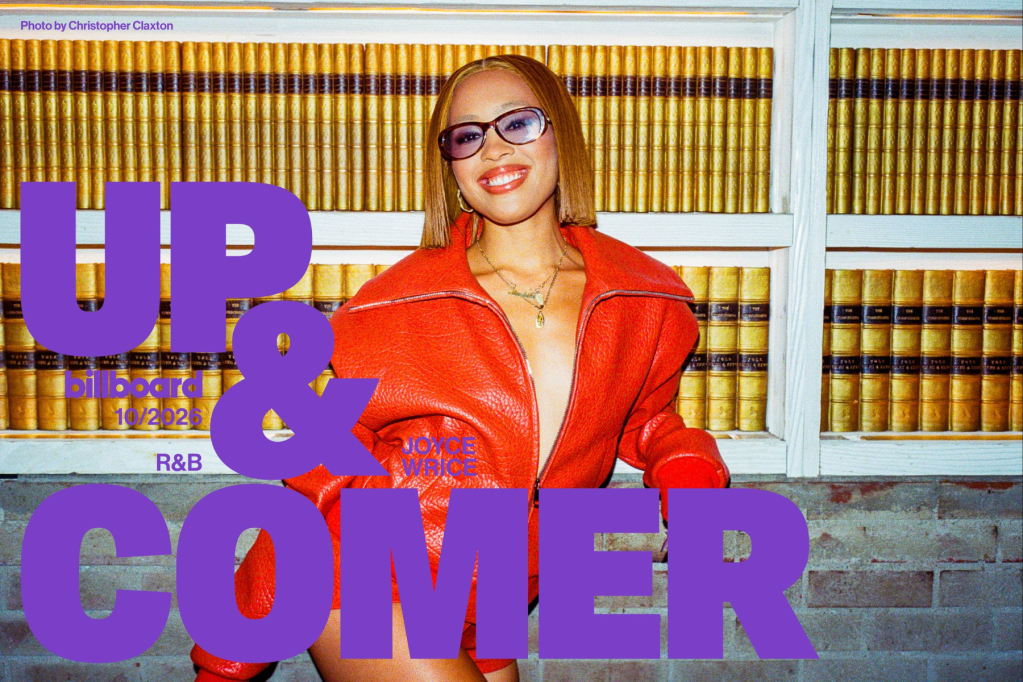
Trending on Billboard Joyce Wrice is a city girl, but not in the way you might think. The Los Angeles-based R&B singer, born in Chula Vista, California, to a Japanese mother and a Black father, is entering a new chapter with MACHIKO, her long-awaited sophomore album and a project that reflects how much she’s grown since releasing her 2021 debut, Overgrown, before seemingly going ghost. Named after her middle name, which translates to “city girl,” the album finds Wrice embracing more of herself, both personally and creatively. Explore See latest videos, charts and news When I met Wrice, I went into our conversation having already heard the unreleased album, but I wasn’t just interested in discussing the music. I wanted to understand the story behind her three-and-a-half-year absence. Where had she been? Why hadn’t she posted to YouTube since 2022? And what did it take to bring her sophomore album MACHIKO to life? What I didn’t expect was to meet an artist who seemed more sure of herself than ever. There’s a newfound ease in the way she talks about her music, her relationships and the woman she’s becoming. After the success of Overgrown, a collaboration with Kaytranada, a Grammy credit for “Falling in Love” with Lucky Daye, and a memorable Tiny Desk performance, she had plenty of reasons to keep pushing forward. Instead, she took time to reflect on what she’d already accomplished and figure out what she wanted to say next.I realized I was looking for the wrong answers. This wasn’t just a story about an artist taking time away to make another album. It was about what happens when you give yourself the space to figure out who you are, what you want and what you have to say, especially as a young women growing up in the spotlight. That process took three and a half years and more than 100 songs. But the journey to MACHIKO wasn’t just about finding the right music. Through songwriting, Wrice began confronting her avoidant tendencies in relationships, learning to ease up on her own self-criticism and finding the confidence to let herself be seen in ways she hadn’t before. She’s no longer approaching love from the same place of heartbreak, and she’s more comfortable embracing the parts of herself that make her who she is. “I would say just growing into myself more and letting go, loosening up and not being too hard on myself,” she tells Billboard when asked what has changed since she began making the album. “It’s about having a better understanding of who I am, what I want, what I need and how I want to uplift others and make an impact in regard to my purpose, to be an artist for peace and inspiration.” That clarity is at the heart of MACHIKO. As Wrice puts it, she’s gaining a better understanding of her role in this lifetime. And with the album’s more confident perspective, including the flirtatious “Break Me In,” she’s making room for a version of herself that’s less guarded, more playful and ready to embrace what comes next. In the conversation below, Billboard’s October R&B Up-and-Comer opens up about the three-and-a-half-year journey behind MACHIKO, the personal revelations that shaped the album and what it means to finally feel at home in herself. What do you want your impact to be? I really think about how the music and artists I loved growing up healed me and brought so much joy to my parents, who are also big music lovers, and my family. For me, impact is about staying true to who I am and really serving my community and the world. I feel like we all have a story to tell that’s unique to us, so it’s about digging deep, expressing that story and sharing it with others. From the outside, it can look like you disappeared for three years. What was actually happening in your life during that time? I was reflecting and soaking in all the greatness of Overgrown and “Iced Tea” with Kaytranada, my Grammy certificate with Lucky Daye for “Falling in Love” and Tiny Desk. There was just so much success and so many opportunities that, for me as an independent underground artist at the time, it was quite the experience. So there was a lot of soaking that in and intentionally thinking, “Okay, what’s next? What do I have to say next? What can I bring to the table next?” I love having quiet time alone to journal and fill my cup with new art and inspiration… There was a lot reflecting on, “Okay, you’re not heartbroken this time. You’re stepping into womanhood. How can you dig deeper and show other sides of yourself that people haven’t heard or experienced before?” You created more than 100 songs during the making of this album. What were you trying to figure out about yourself through all of that writing? I was trying to figure out what story I have to tell and what I’m trying to say. I think writing music and creating is really therapeutic and healing for me. I’m the most tapped in with my emotions when I’m writing and creating. This album brought me clarity about some of my negative tendencies when it comes to love, relationships and dating. Through the writing process, I realized I have avoidant attachment style tendencies. I love to have fun, have my cake and eat it, too. When things get too serious, I’m like, “I don’t know about all this. Let’s pull back.” There were a lot of things I realized just by freestyling melodies. A lyric like “I guess I like the chase better than the man” started to come up. Or I’d realize, “Oh my God, ‘The way your eyes got me looking right now got me thinking I could fly.'” Through that whole line, I realized that maybe this is someone who genuinely, truly loves me. I can actually have that genuine experience with someone, as opposed to sometimes feeling like people don’t want to go all the way there with me in terms of getting serious… So it was a lot of understanding and clarity that I think, for the first time, I truly gained through this process, as opposed to just going to therapy and journaling. Your album is named after your middle name, Machiko, which your mother gave you. What does that name mean to you now that you’ve grown into the woman she imagined when she gave it to you? Machiko means “city girl.” “Machi” means town, city, the streets. “Ko” means girl or child. I grew up not really bringing attention to my middle name. My family in Japan doesn’t even call me Machiko. But this album felt so autobiographical that I was like, “Can it be self-titled?” But it didn’t feel self-titled. Then I was like, “Oh my God, what about my middle name? Machiko.” When I took it apart, I realized it means “city girl.” I moved from Chula Vista, San Diego, to L.A. L.A. isn’t like New York or Tokyo, but it’s a city. So, I realized, “Wow, I subconsciously embodied what my name means.” To me, that felt really beautiful and special. My mom wanted me to be a city girl, which is why she named me this. It was more about validation and clarity that I’m on the right path. And it’s bigger than me. It’s for my family and the legacy of my roots and where I come from. It’s time to fully embody what I was brought on this earth to be. You’ve said, “I’m not heartbroken and jaded anymore.” What does Joyce Wrice sound like when she’s no longer creating from that place? It sounds like someone who’s stepping into their bravery and focusing on themselves. How can I become more of who I’m meant to be and who I want to be? Because that will attract who’s meant to be around me and who deserves to be my partner. So it’s really redirected the focus for me right now, and I think that’s very liberating, especially for women. I feel excited and proud, but I’m also like, “Okay, yeah, it takes a lot of courage and bravery to look inward.” There are so many parts where I’m like, “Ah.” And then there are so many things where I’m like, “Oh, girl, see, you got it down.” “Crack the Code” is about wanting to let someone in while still fighting the instinct to protect yourself. Do you think the Joyce on that song would’ve existed three years ago? I think lyrically, for sure, thematically, that’s a pretty common theme throughout my life. Vocally, in terms of aura and emotion, it feels like a more grown version. It feels more sultry, with more grit and feeling behind it. Whereas before, I was a bit younger, and I don’t know if I could tap into the same emotion as that song because I’ve experienced more life now. You’ve described this era as living fully, confidently and fearlessly. What did you have to unlearn to become that version of yourself? I had to unlearn being so self-critical and always trying to find something I could be better at or do better. Like, “Girl, you got it. Sometimes maybe you don’t, but you’re self-aware enough, and no one’s perfect… You have everything you need. Everything that you are and everything that you have makes you who you are, and that’s what people love. That’s what’s special.” So, I think that’s the biggest thing: unlearning that. Learning to surrender, let loose and have fun. Don’t take everything so seriously. Everything doesn’t have to be so complex and difficult. Sometimes, when things go smoothly, that’s just how it’s supposed to go. You don’t have to be in the trenches all the time… So get out of your own way and just let it flow. You were raised by a Japanese mother and an African-American father. How has living between those cultures shaped the way you see yourself and, ultimately, the music you make? I was really, really blessed to have a mother from Japan who raised me to be culturally tapped in… I went to Japan once a year from the time I was a baby, and she made sure I learned Japanese and knew all the food. My dad also made sure we visited Flint, Michigan, his hometown, once a year. My parents introduced me to all the greats in music, from the ’50s through the ’90s and 2000s. I was so fortunate to be exposed to so much. I think that’s allowed me to have such a potent palette to pull from. I’d say that’s truly the gift of my background: being exposed to a variety of things and people. Not everyone can travel to Japan and Michigan once a year. But my parents worked really hard to make sure I was well-versed in my roots. I’d say that’s the best part. Is there anything about your Japanese identity that you feel you’re finally expressing more openly on MACHIKO? In the intro, I’m speaking Japanese and sharing sounds from my mom’s hometown. Culturally, I’d say Japanese people are raised to be very considerate of others, which can sometimes make you not want to be a burden on anyone and encourage you to be humble. But the dangerous part is that it can turn you into someone who puts others before themselves, and you can sometimes lose your individuality. You can also become too apologetic and hold back. The album brings together artists like JID, Ty Dolla $ign, Rio Da Yung OG, Eem Triplin, Odeal, Salimata and Mack Keane. What did you want those different voices to add to your world? I thrive off collaboration. How boring would it be for just me to be on the album? I’m not saying that it’s boring, but when you think about movies, there are multiple characters. Obviously, I’m the main character, but I want life to be felt in this album. I’m known for my features. Overgrown had so many incredible features, both predictable and unpredictable, and I love that. I wanted everyone to bring their own sauce. I’m a fan of them and, thankfully, they’re fans of me. I wanted to slay, and I wanted my fans to get hip to who they are. Hopefully, their fans can learn who I am as well. I’m a huge fan of that. I love Missy Elliott, who had an intro by Busta Rhymes on her Supa Dupa Fly album. I love Mariah Carey and her collaborations with Mobb Deep, Snoop Dogg and everyone. I want that… But I will say, in the beginning, this felt like an album without too many features, but I still wanted to see what I could make work because I know people want that from me. I feel like we did a good job. I wanted more women on the album, but the timing didn’t work out. I asked so many women, and it just wasn’t the right time for them. So, deluxe. Cross your fingers. “Catch Me If You Can” with JID is such an unexpected but exciting pairing. What made you hear him on that record? JID isa storyteller, and his voice is so unique. He can sing, rap, harmonize with you or just talk. He has this voice and this way of storytelling that felt so fitting for that song. The song has a pretty particular style. It’s sample-heavy and raw. It’s quite musical but still pretty simple, a little bare. So, I wanted to make sure whoever was on it could really hold their own and feel it. With JID, you never have to question that. I actually sent it to a few other people. One of them was like, “I just don’t know what to do on it.” Another one passed, but that’s fine. If Overgrown introduced people to Joyce Wrice, what do you hope MACHIKO teaches them about you? MACHIKO gives everyone a deeper insight into who I am. I think it also shows people who I’ve become. I think it’s very relatable. There are a lot of people who can relate to this album and this side of me that they just haven’t heard before… I think “Break Me In” is fun and playful, a little dirty. “Catch Me If You Can” is kind of like the villain — not quite the villain, but it’s a bit more inside my head. Overall, I feel like this album is a raw, unfiltered version of me.
Billboard’s R&B Up-And-Comer Joyce Wrice Learns to Get Out of Her Own Way on ‘MACHIKO’: ‘You Don’t Have to Be in the Trenches All the Time’
Full Article
Original Source
Read the full article at Billboard →KhanList aggregates and links to publicly available news content. We do not host full articles from third-party sources. Always verify important information with original sources.