
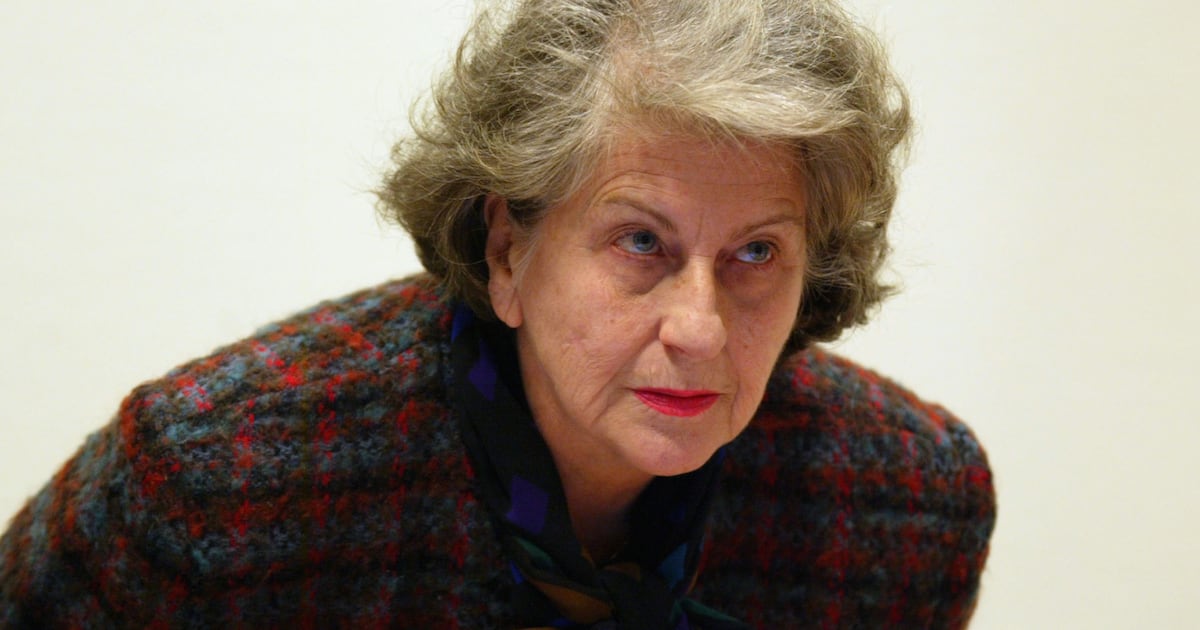
Biljana Plavsic, a Bosnian Serb biologist and ultra-nationalist political leader during the Balkan wars of the 1990s, has died in Serbia’s capital, Belgrade, aged 96. She pleaded guilty to one count of crimes against humanity and expressed remorse, but later recanted, saying she “would do the same again”.Her death was announced on Thursday by Serbian state media. No other details were provided.Plavsic, a former professor at Sarajevo University who studied in Zagreb, Croatia, New York, London and Prague, and wrote more than 100 scientific papers, became notorious in the 1990s for applying biology to politics when the multi-ethnic state of Yugoslavia disintegrated. She declared Bosnia’s Muslim population “deformed genetic material” and railed against mixed marriages, common before the war, as leading to “the degeneration of Serb nationality”.Often coldly indifferent to the suffering of non-Serbs, she was known as the Iron Lady of the Balkans, a nickname inspired by Soviet descriptions of Britain’s Margaret Thatcher. But the name Plavsic relished most was a tribute that Serb fighters daubed on the side of their tanks: Empress.READ MORE“She was educated, a professor but a real hard-line nationalist,” recalled Laura Silber, co-author of The Death of Yugoslavia, who interviewed Plavsic several times during the 1992-95 war in Bosnia. “She was prim and proper – school marmish in demeanour – so it was especially shocking to hear the ugly nationalist rhetoric coming out of her mouth.”Olivera Simic, an Australian scholar from Bosnia who interviewed Plavsic for hundreds of hours in her later years, remembered her as highly intelligent but often blind to the suffering of non-Serbs. “She was not a monster and would express from time to time that she felt sorry for everyone – and then quickly start talking about Serb victims and cry over them,” Simic said in a telephone interview.For nearly four years, Plavsic served as vice president of Republika Srpska, a Serb enclave in Bosnia that declared itself a separate state in 1992 and began a programme aimed at driving out Muslims, Croats and other non-Serb residents. In that role, she worked closely with Radovan Karadzic, the self-declared state’s president, who in 2016 was convicted of genocide, war crimes and crimes against humanity by a United Nations tribunal.She rejected the term “ethnic cleansing” in her interviews with Simic, a law professor at Griffith University in Australia, describing the separation of different peoples as a “natural process.” According to Simic, Plavsic believed that “everyone should live with their own tribe” and, as a result, “willingly turned a blind eye” to the suffering this caused when ethnic groups were separated at gunpoint “because she was only interested in protecting her own tribe.”Testifying as a witness at The Hague trial of Serbia’s wartime leader Slobodan Milosevic, Vojislav Seselj, the founder of a far-right Serb political party who was also charged with war crimes, said that Plavsic “held very extremist positions during the war, insufferably extremist, even for me, and they bothered even me as a declared Serb nationalist.”After the war ended, Plavsic muted her anti-Muslim fervour, broke with Karadzic, accusing him of corruption, and in 1996 took over as president of Republika Srpska with support from the West, which viewed her as a partner for peace.She was for a time hailed as a symbol of reconciliation after she expressed remorse during a 2002 sentencing hearing in The Hague. “I have now come to the belief and accept the fact that many thousands of innocent people were the victims of an organised, systematic effort to remove Muslims and Croats from the territory claimed by Serbs,” she said.Serbs, driven by “an obsession to never become victims,” had “allowed ourselves to become victimisers,” she told the court.Plavsic was the only woman among more than 150 people indicted by the international court for war crimes in former Yugoslavia. In 2003, she received an 11-year sentence for persecution, a crime against humanity, as part of a plea bargain that allowed her to avoid a trial on charges of complicity in genocide.In contrast with Karadzic, who went into hiding for more than a decade and, after his arrest, boycotted parts of his trial in The Hague, Plavsic surrendered voluntarily and cooperated with the tribunal.After initially pleading not guilty, she later pleaded guilty on one count, acknowledging that Serb forces had committed crimes and her own responsibility for these. “The knowledge that I am responsible for such human suffering and for soiling the character of my people will always be with me,” she told the court.The judge said that Plavsic had not conceived or planned the violent Serbian campaign of ethnic separation that killed tens of thousands of Muslims and Croats and expelled many more from their lands with “great brutality,” but that she had embraced, supported and contributed to it. “This is a crime of utmost gravity,” he said.Victims of the war and some human rights groups criticised her sentence as too lenient. But others said the major issue in Plavsic’s confession and guilty plea was that they would make denials by other Serbian leaders more difficult.“In a region where denial and revisionism are central and where the tribunal is seen with scepticism, Ms. Plavsic’s gesture is striking,” Alex Boraine, a member of South Africa’s Truth and Reconciliation Commission, told the court.Fellow Serb nationalists, appalled by the confession in The Hague, denounced her as a traitor for deviating from the narrative that Serbs were innocent victims. They embraced her as a hero when she later recanted and declared herself and Serbs blameless.The grip that the narrative of innocence still holds on many Serbs was on ghoulish display in September when thousands, including Serbian government ministers and the son of President Aleksandar Vucic, turned out in Belgrade for the funeral of Ratko Mladic, a Bosnian Serb general convicted of genocide and known as the Butcher of Bosnia.Plavsic’s contrition, if ever more than a ploy to avoid a lengthy trial and escape genocide charges, did not last long. Released early from prison in 2009 for good behaviour, she settled in Belgrade and quickly retreated from what Simic, author of the 2025 book “Madam War Criminal,” concluded was “fake remorse” in The Hague.Divorced with no children, she lived alone in a modest Belgrade apartment decorated with Orthodox Christian icons and a wooden cross made for her by a fellow inmate convicted of genocide for his role in the 1995 Srebrenica massacre.“She believes she sacrificed herself for ‘her people’ and did not show any ability to critically reflect on her actions but persistently justified and rationalised her behaviour, which she always perceived as highly ethical, moral and legitimate,” Simic wrote in her book. “She told me on many occasions during our conversations that if the circumstances would arise again she would most likely respond the same way.”The debate rages in former Yugoslavia, where the 1995 massacre of Bosniaks at Srebrenica has been legally recognised as genocide but atrocities committed by Serb forces against Croats in Vukovar in 1991 and by Croats against Bosniaks in Mostar during a 1993-94 siege have been classified as war crimes and crimes against humanity.Biljana Plavsic was born on July 7th, 1930, in Tuzla, then part of the Kingdom of Yugoslavia. She grew up in Sarajevo, to which her affluent family moved when she was four. Her father was a prominent scientist who had been educated in Vienna, and she was raised on books and stories celebrating an infamous relative — Gavrilo Princip, a Serb nationalist who precipitated the first World War in 1914 by assassinating Archduke Franz Ferdinand, the heir to the Austro-Hungarian throne, in Sarajevo.Eleven years old when Nazi Germany invaded Bosnia in 1941, she witnessed Serbs being executed in the street and lost dozens of relatives to brutal ethnic purges carried out by the Ustashe, a Croatian fascist group that led the Independent State of Croatia, a puppet state of Germany formed during the second World War.After the defeat of the Nazis, Bosnia became one of six republics in the newly declared Socialist Federal Republic of Yugoslavia. Despite her family’s hostility to communism, Plavsic, who never joined the party, embarked on a highly successful academic career focused on plant virology. This included two years of botany research in the 1970s at Cornell University.A popular biology professor in Sarajevo, she had a reputation as an exacting but fair-minded scholar who held all students, no matter their ethnicity, to the same high standards. Elected dean of Sarajevo University’s faculty of natural sciences and mathematics in 1987, she turned to politics in 1990 when she became the Serb member of a collective, multiethnic presidency of Bosnia and Herzegovina, then still part of Yugoslavia.When Slovenia and Croatia, two other Yugoslav republics, broke away to declare independence in 1991, Bosniaks began demanding their own state, too — a prospect that terrified Plavsic and many other Serbs.In interviews with Simic, the Australia-based scholar, before her death, Plavsic often referred to 1991 as “the continuation of 1941,” a replay of the World War II conflict between Nazi-aligned Croats and anti-fascist Serbs that, she believed, “never finished.”She told Simic years later in Belgrade that everything she did was motivated by a desire to avoid “the extinction of the Serb people.” Bosniaks, Serbs and Croats all suffered and, Simic said, Plavsic’s obsession with crimes against her own people was part of a bigger problem across former Yugoslavia.“Everyone talks about their own victims, never their own perpetrators — no one,” Simic said. “This is the problem. Everyone wants to talk about their victimhood, never their perpetrators. They think nobody acknowledges crimes done against them, no matter how big or small.” - This article originally appeared in The New York Times.
Biljana Plavsic, the only woman charged with war crimes in the Balkan wars, dies aged 96
Full Article
Original Source
Read the full article at Irishtimes →KhanList aggregates and links to publicly available news content. We do not host full articles from third-party sources. Always verify important information with original sources.