
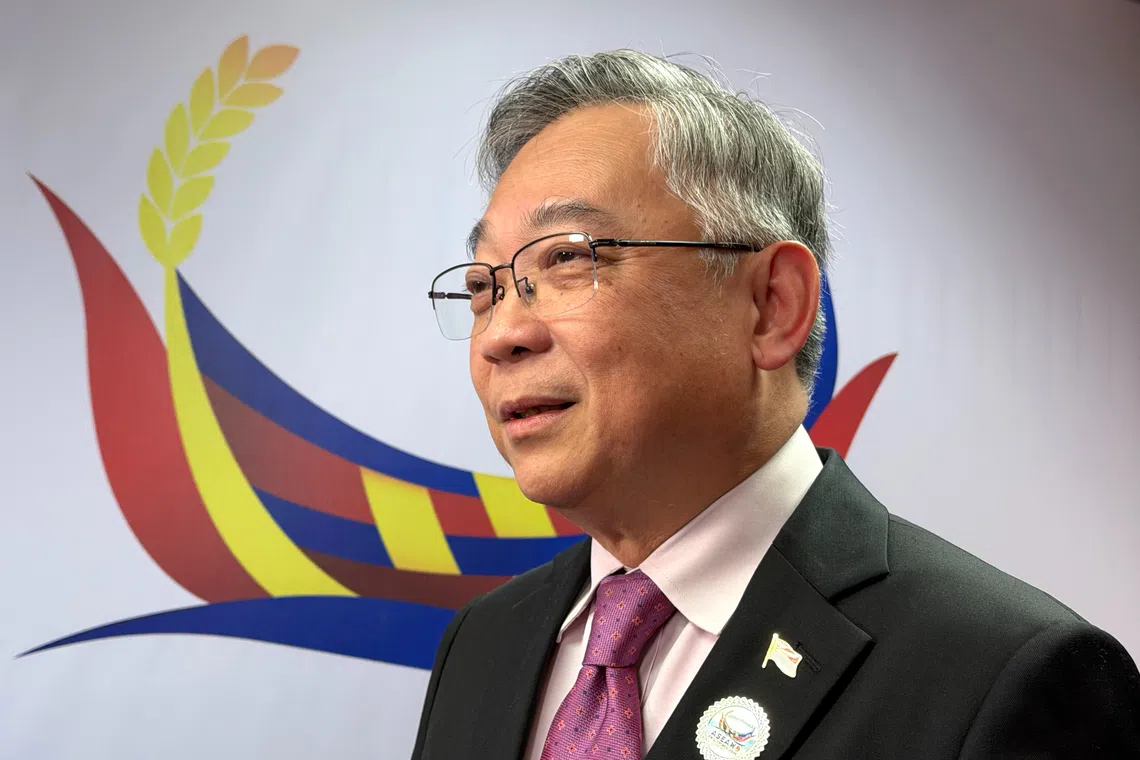
MANILA – Bilateral trade deals between the European Union (EU) and individual South-east Asian countries could help pave the way for an eventual ASEAN-EU free trade agreement (FTA), Singapore Deputy Prime Minister Gan Kim Yong said on Sept 22.The remarks coincided with the EU and the Philippines announcing the finalisation of their own free trade deal the same day, adding to a growing network of bilateral pacts between the European bloc and ASEAN member-states.“They build on each other. I think with bilateral negotiations between EU and individual countries will also set the stage for further integration at the ASEAN level,” said Gan.Gan, who is also Singapore’s Minister for Trade and Industry, spoke to reporters on the sidelines of the ASEAN Economic Ministers’ Meeting and Related Meetings held in Manila.The EU already has FTAs in force with Singapore and Vietnam, while a deal with Indonesia was finalised in 2025. Negotiations with Thailand and Malaysia are also under way.Gan said these bilateral negotiations could help individual ASEAN countries and the EU better understand each other’s needs and challenges, making it easier to eventually pursue an agreement involving the entire region.“The FTA may be a longer-term objective, but we can take a modular approach,” he said, adding that the two sides could move step by step in areas where progress can be made more quickly.Businesses push for ASEAN-EU frameworkEchoing the ministerial push, European businesses on Sept 22 urged ASEAN and the EU to establish a region-to-region economic framework in 2027, when the two groupings mark 50 years of relations.In a statement, the EU-ASEAN Business Council (EU-ABC) proposed a modular framework that would allow both sides to deepen economic ties gradually without waiting for every element of a comprehensive FTA to be finalised.The council’s latest business sentiment survey found that 74 per cent of European businesses polled believe an ASEAN-wide FTA would bring greater benefits than separate bilateral agreements, while 49 per cent want negotiations for such a deal to be launched in 2027.“Bilateral deals should not be the end point, but the foundation for a more ambitious, longer-term goal to establish a region-to-region FTA,” said EU-ABC chairman Jens Ruebbert.The council also proposed making a region-to-region digital trade agreement the first priority, followed by an investment protection agreement and other sectoral deals.Gan similarly pointed to the digital economy as an area where ASEAN and the EU could move more quickly.The two sides are discussing digital trade principles, with Gan saying they hope to complete negotiations in 2027 before exploring further cooperation.He said one possibility is to make digital payments more seamless between ASEAN and its trading partners.Rather than maintaining multiple bilateral payment links, Gan said a multilateral system would be “much easier, more efficient”, allowing countries to connect to a wider network through a single arrangement.Upgrading digital and goods pactsThe push for stronger external partnerships comes as ASEAN is also seeking to deepen economic integration within the region amid growing uncertainty in the global economy due to the Middle East crisis.Gan said the economic ministers’ decision to bring forward the implementation of the ASEAN Trade in Goods Agreement (ATIGA) reflected a sense of urgency among member-states.The upgraded pact, which aims to reduce barriers and simplify trade within ASEAN, was originally scheduled to come into force in 2027. Economic ministers are now pushing for this to happen by the end of 2026.“This will also signify that, despite a very challenging external environment, despite the world becoming a lot more volatile, unpredictable and beginning to be fragmented, we are able to further strengthen ASEAN’s integration,” Gan said.He added that moving up the timeline demonstrates member states’ shared commitment to making the trade agreement benefit businesses as soon as possible, despite an increasingly unstable and fragmented global environment.ASEAN is also preparing to implement its Digital Economy Framework Agreement (DEFA), which is expected to be signed by the region’s leaders during the summit in November.Gan said Singapore wants DEFA to remain a “living document” that can evolve as technology changes rapidly.He said potential projects may include interoperable digital payments, an upgraded ASEAN Single Window to simplify trade documentation, and a centralised registration system that would allow businesses to be uniquely identified across ASEAN economies.Gan said ASEAN is also laying the groundwork for a green economy framework, with Singapore hoping negotiations can begin in 2027 when it assumes the ASEAN chairmanship after the Philippines.He said the framework could cover areas including renewable energy, carbon markets, and greener products and production processes.“We hope that we can build on the achievements that the Philippines have done this year, and continue to build on the momentum,” he said.
Bilateral EU free trade deals can pave way for broader ASEAN-EU pact: DPM Gan
Full Article
Original Source
Read the full article at Straitstimes →KhanList aggregates and links to publicly available news content. We do not host full articles from third-party sources. Always verify important information with original sources.