
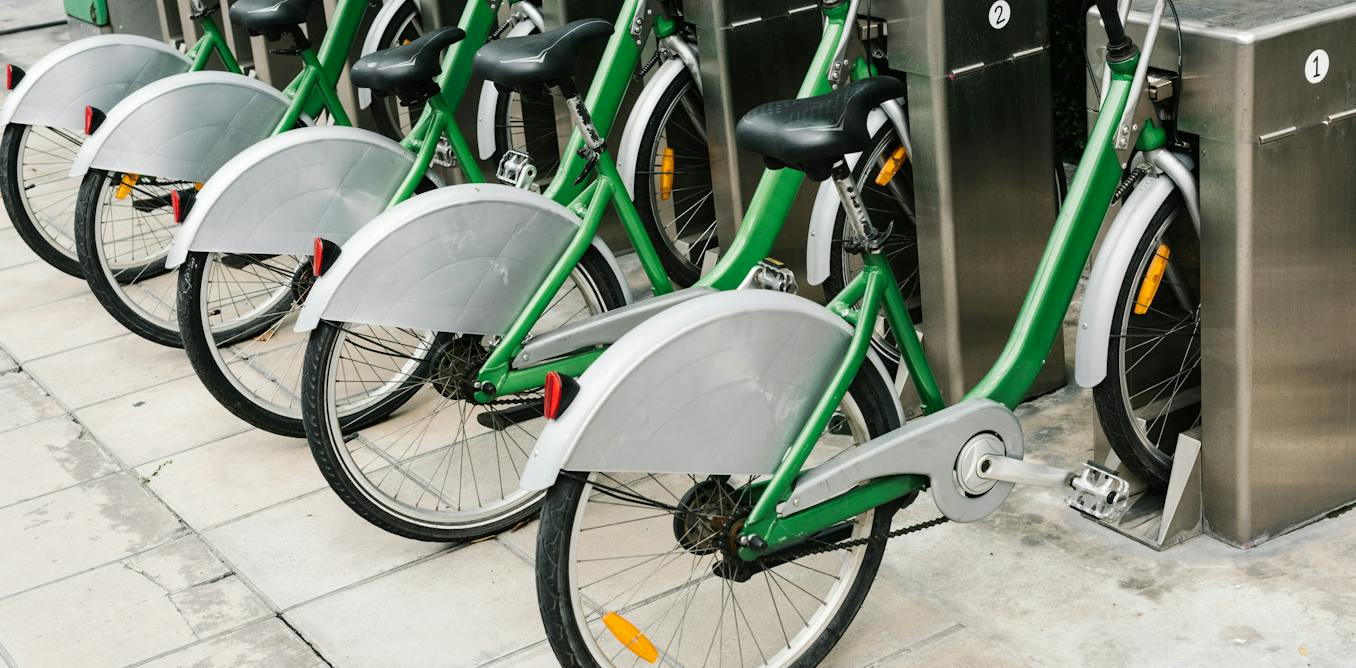
Transportation accounts for almost one-quarter of greenhouse gas emissions in a Canada. In Metro Vancouver, around 40 per cent of emission are from transportation. In Canadian cities, there is more to transportation than greenhouse gases: urban air pollution, exposure of roadside population to toxic pollutants, traffic, congestion and road safety hazards. In 2015, transportation related air pollution was associated with over 1,200 premature deaths in Canada. As Canada aims to reduce emissions, what can cities do to create a transportation system that is greener, more sustainable, comprehensive and equitable? Shared micromobility systems, such as bike and scooter rental programs, offer an interesting transportation solution. Users do not need to own a vehicle, and they do not have to worry about parking, storage, security or maintenance. These programs are easily accessible and they are particularly well-suited for short trips in dense urban areas. How much can shared micromobility reduce emissions, and what is its broader potential as an urban transportation option? To answer these questions, we recently looked into Vancouver’s bike-share program. We used a trip diary survey by the city’s transit operator, TransLink, to understand the mode choice behaviour. Using data from actual bike-share trips and combining it with several transportation and emissions models, we arrived at some interesting results. What we found Researchers studied Vancouver’s bike-sharing program to understand how micromobility can help reduce emissions. (Mobi By Rogers), Author provided (no reuse) Our analysis shows that about 29 per cent of daily trips in Vancouver are made by car drivers, while roughly seven per cent are made by personal bicycles or bike-share systems. Most of the short commuting trips in our study had an average distance of about two km. Much longer leisure trips had an average distance of around 10 km. E-bike trips tended to be slightly longer in both groups. Of particular interest were trips with the potential to replace car journeys. Importantly, according to a City of Vancouver survey, around 11 per cent of all daily trips are classified as bikeable but not walkable, meaning that they are too long to be attractive for walking but still within a practical cycling distance. These trips represent a particularly promising pool for potential substitution by bike sharing. The best way to understand the environmental benefit of bike sharing is to compare it with using a conventional fossil fuel car. Our analysis shows how many shared bikes, at their current level of use, are needed to achieve the same annual reduction in exhaust emissions as removing one fossil-fuel vehicle. We found that roughly 18 shared bikes are needed to match the carbon dioxide or toxic exhaust particles benefit of removing one car. But the real opportunity comes from using the bike-share system more intensively. As each shared bike replaces more car trips, far fewer bikes are needed to achieve the same benefit. Under our high-utilization scenario, for example, only about five shared bikes could provide the same greenhouse gas reduction as removing one conventional car. In other words, the environmental value of bike sharing depends not only on how many bikes are available, but on how often they are used to replace trips that would otherwise have been made by car. EVs not a complete solution EVs may reduce some emissions but they do not solve all the problems caused by cars. THE CANADIAN PRESS/Jonathan Hayward The federal government is aiming for 75 per cent of car sales being electric vehicles (EVs) by 2035. Whether Canada is moving fast enough toward vehicle electrification and whether the targets set by the federal government are achievable remains an open question. But there is another important question: would a switch to EVs actually solve all the problems associated with urban transportation? EVs occupy the same road space as conventional cars, so electrification alone does little to address traffic and congestion. EVs are also generally heavier than their fossil-fuel counterparts, placing additional pressure on road infrastructure. Nor are they entirely carbon-free: vehicle and battery production can be carbon-intensive, and electricity generation in some Canadian provinces still relies partly on fossil fuels. EVs also generate non-exhaust particulate emissions from tire, brake and road wear, meaning that traffic-related air pollution does not completely disappear with electrification. It is likely that Canadians with EVs will drive more. Nevertheless, moving toward electrification is an essential part of decarbonizing transportation. The question is not whether we should electrify, but whether electrification alone is enough. Reducing car use The good news is that there are already many options available and they do not necessarily involve driving a personal car. Public transit, shared mobility services, active transportation such as walking and cycling, shared micromobility such as e-bikes and e-scooter, and combinations of these modes can provide alternatives to private vehicle use. Each has its own advantages and limitations, but they share one important feature: they can reduce our dependence on personal cars and the number of kilometres we travel by car. Our study did not examine in detail how bike-sharing could be increased, although this is the focus of our subsequent work. Possible strategies include lower user costs and better connections between bike-share stations and transit hubs. Companies could also co-ordinate with transit operators to make it easier to make seamless multi-modal trips and integrate fares so people can use their transit card to pay for bike sharing. Whatever combination of solutions proves most effective, our research points to a clear opportunity: bike sharing has considerable untapped potential to help decarbonize urban transportation. Unlike many other low-carbon strategies, it can do so by replacing car trips altogether rather than simply replacing one type of car with another.
Bike-sharing programs can help cities reduce emissions and congestion
Full Article
Original Source
Read the full article at Theconversation →KhanList aggregates and links to publicly available news content. We do not host full articles from third-party sources. Always verify important information with original sources.