
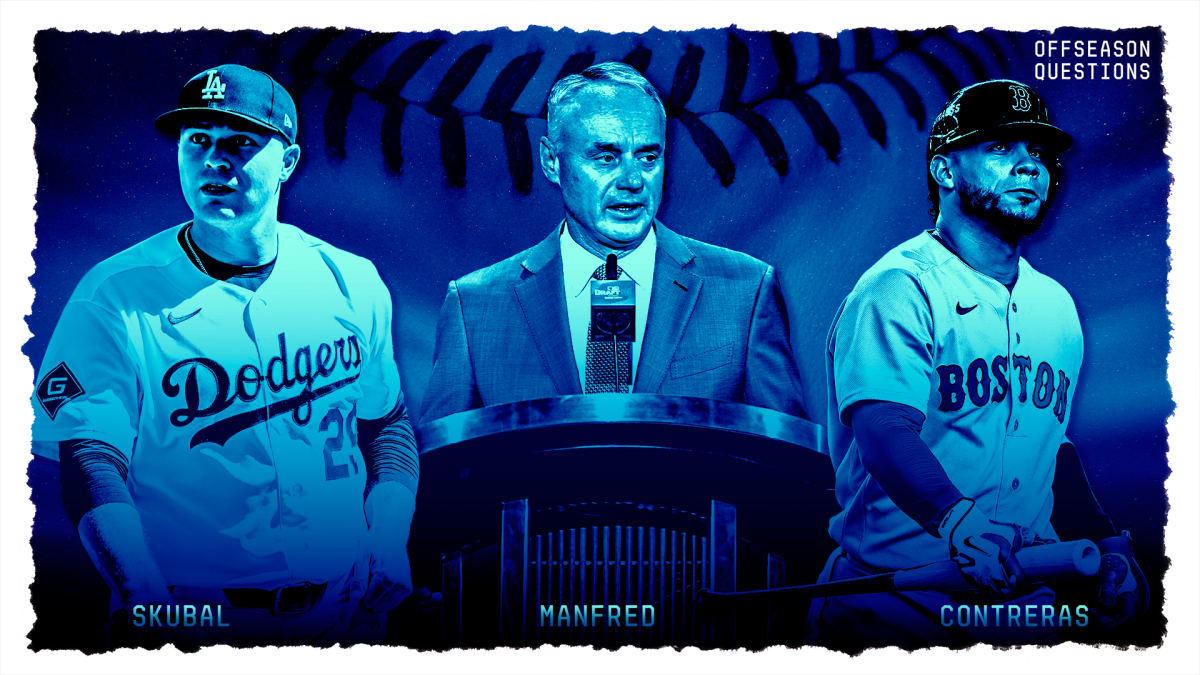
The 2026 World Series is in the rearview and it's time for the winter to get underway -- until a likely lockout gets in the way Nov 5, 2026 at 8:47 am ET • 9 min read Not so long ago, the Milwaukee Brewers were crowned World Series champions, and at the moment of the last out, the 2026-27 Major League offseason began. So let's talk about that. The winter ahead is one shot through with uncertainty, as labor strife figures to roil the sport and perhaps even compromise the 2027 season. Those matters, vital as they are, won't be the only story, and we'll still have the familiar presences of free agency and trade talk to sustain us. To set the scene for all that's ahead in advance of the 2027 campaign – good, ill, or somewhere in the middle – we're here to take a look at the five questions that will inform an offseason that's going to be quite unusual and – for good, ill, or somewhere in the middle – probably unforgettable. Let's explore those five queries right now … 1. How long will the lockout last?The current collective bargaining agreement – or CBA, the accord that governs the working relationship between clubs/owners and players – is set to expire at 11:59 p.m. ET on Dec. 1 of this year. At that time, MLB owners are all but certain to lock out the players. That's a labor stoppage, and that means the offseason will be brought to a sudden halt. The lockout, the purpose of which is to preempt a players' strike, will last until a new CBA is agreed to. Agreeing to a new CBA will be no simple matter, and owners and their hireling, commissioner Rob Manfred, are pushing for a cap on team payrolls. The players, as represented by their union, the MLBPA, have never shown any willingness to agree to a cap-and-floor system. There are a lot of other issues to iron out, as the CBA is an all-encompassing document, but the fight over a cap will be what drags out the lockout. MLB CBA negotiations timeline: League proposes delaying salary cap for 'smoother transition' Dayn Perry The heart of the matter is whether the lockout will last long enough to push back, abbreviate, or – perish the thought – cancel entirely the 2027 season. The latter is the worst-case scenario and is highly unlikely, but it's a possibility, however remote. More of a threat is a 2027 season that doesn't span the usual 162 games. We have a recent precedent to guide us. The last time the CBA was up for negotiation during the offseason of 2021-22, owners locked out the players for 99 days. That meant a shortened spring training by about two and a half weeks and forced the regular season calendar to be compressed, albeit while still preserving the 162-game docket. As such, we can say that if the lockout lasts beyond the middle of March 2027, then we'll likely lose regular-season games. For further context, here's a brief history of modern labor stoppages in the sport: MLB work stoppageDates1972 strikeApril 1-13, 19721973 lockoutFeb. 8-25, 1973 1976 lockoutMarch 1-17, 19761980 strikeApril 1-8, 19801981 strikeJune 12 - July 31, 19811985 strikeAug. 6-7, 19851990 lockoutFeb. 15 - March 18, 19901994-95 strikeAug. 12, 1994 - March 31, 19952021-22 lockoutDec. 2, 2021 - March 10, 2022Just two, the 1981 and 1994-95 player strikes, significantly compromised seasons. The 1994-95 stoppage cost us the 1994 World Series, and it took years for the sport to recover from the resulting fan disaffection. As for the 2027 season, the worst-case scenario may not be the loss of the entire season but rather the loss of 60 games off the regular-season slate. Here's the explanation from our recent Lockout 101 piece: "… [I]f the lockout extends into late May or so and costs at least 60 games, then most of the league's national broadcast and streaming contracts would be extended for another year, through 2029. That matters because Manfred and the league hope to bundle and centralize team streaming rights and share those revenues equally, and the current timeline would theoretically allow that to happen at the same time the national contracts are up for renegotiation in 2028. Tacking on another year to those national contracts would push back the significant windfall that owners and the league are expecting from that new media rights structure. This amounts to a major incentive, at least on the league side, to agree to a new CBA before June arrives."Obviously, the hope is that the lockout doesn't even affect the spring training calendar, let alone cost us a major chunk of the regular season. Why MLB could see an early free agency frenzy before the potential Dec. 1 lockout Mike Axisa 2. What will the next CBA look like?As noted, the big fight is over whether or not MLB will have a cap-and-floor structure moving forward, as is the case in the NFL, NBA, and NHL. Owners have tied every single proposal wrinkle to date to the players' acceptance of a cap. However, it remains highly unlikely, at least until further notice, that the union would ever agree to such a thing. The other major issue is a likely restructuring of the revenue-sharing system. Specifically, the next CBA is highly likely to revise the system so that local broadcast revenues are shared much more evenly. Fortunately, there's already some common ground on this issue, and a reordering of that system would directly address the revenue disparities within MLB that are such a reliable source of consternation – and misinformation – without the grievous labor war that a continued cap push would force upon us. Otherwise, some other key wrinkles and changes may come out of the wash. That list potentially includes: Further expansion of the postseason, possibly from 12 to 14 teams;A roadmap for league expansion before the end of the decade, likely from 30 to 32 franchises;The reduction of the regular season from 162 games to 154 games;The implementation of an international draft;Changes to the Competitive Balance Tax, or "Luxury Tax," as it's informally and more accurately known, in the event a cap isn't agreed to;Structural changes to the MLB Draft;Structural changes to free agency and salary arbitration.This doesn't get into evergreen matters like an increase in the minimum salary, draft bonus pools, the qualifying offer system, active roster sizes, and so forth. There's a lot to sort out, to say the least. The expectation is that the next CBA is going to lead to sweeping changes to the sport starting in 2027 and, perhaps by design, growing over time. Even if there's no cap and floor, the economic structure of MLB is almost certain to look very different after this winter. 3. Where -- and when -- will Tarik Skubal and other major free agents sign?Overall, this is one of the weakest free agent classes in living memory, but there is elite superstar value to be found at the tip-top with back-to-back (for the moment) American League Cy Young winner Tarik Skubal. Skubal, who turns 30 on Nov. 20, remains foremost in the discussion for best pitcher in baseball, and he's going to be paid like it. The expectation is that he'll wind up signing the largest pitcher contract in MLB history and perhaps also fetch the highest-ever annual salary for a pitcher. It's not out of the question that Skubal's next contract could approach or even surpass $400 million in total value. At those rates, the incumbent Los Angeles Dodgers and the free-spending New York Mets are the consensus favorites. The Chicago Cubs are also reportedly heavily interested in Skubal, and surprise bidders are always possible. Other notable free agent names include Freddy Peralta, Michael King, Jazz Chisholm Jr., Trevor Rogers, Adrian Morejon, and Teruaki Sato. Our ranking of the top 50 2026-27 free agents has you covered. Ranking the top 50 MLB free agents for the 2026-27 offseason, plus landing spots for every player Mike Axisa The "when" of all this is more complicated thanks to the upcoming lockout detailed above. Will premium free agents and their representatives rush to find some stability in advance of the stoppage, during which no major-league transactions will be permitted, or will they decide that the long game will be better for their markets? It's possible that the biggest spenders on the team side will look to make moves early, as the barrel of the next CBA figures to be leveled directly at them and their abundant revenues. Or maybe the unknown will have a chilling effect on spending before we arrive at the lockout. The past is not always prelude, but let's note that we saw a flurry of spending leading up to the lockout of 2021-22. Indeed, in November 2021, MLB teams committed more than $1.7 billion to free agents prior to the lockout. The Texas Rangers alone guaranteed $500 million to a new middle infield – Corey Seager and Marcus Semien – before the lockout put an end to such things. In all, teams put ink to paper on five nine-figure contracts prior to the 2021-22 lockout. The comparisons may not entirely hold since this upcoming CBA should bring about a much more drastic re-ordering of the sport than the current expiring CBA did. As such, teams may proceed cautiously given all the uncertainties. Or, as just mentioned, they may seek to get business done before the ways of doing business change entirely. We'll see soon enough. If we do see the dollars start flying before the lockout, then the upcoming Nov. 10-12 general managers meetings in Las Vegas may occasion the groundwork for all those deals. 4. Any blockbuster trades on the way?Will a lackluster free agent class mean more headline-grabbing trades? That may indeed be answered in the affirmative this winter. Yes, the CBA uncertainty will have a bearing on trades, especially those that involve the assumption of major salary obligations, but big trades still figure to be a prominent part of this offseason. It's of course impossible to know who's going to be dealt ahead of time, but some big names perhaps on the move this winter include Francisco Lindor, Mason Miller, Spencer Strider, Hunter Greene, Otto Lopez, Jeremy Peña, Ketel Marte, Jacob deGrom, and of course others. Paul Skenes? Almost certainly not, but you'll just as certainly hear his name bandied about. Top 25 MLB trade candidates for 2026-27 offseason: Paul Skenes, Jeremy Peña and more who could move Dayn Perry Turning back to last lockout, it was mostly minor trades before the sport shut down. Yes, we'll see big ones this time around, but they may not happen until we have a new CBA in place and the lockout is over. 5. Who will get the No. 1 overall draft pick? Let's make time for the losers, shall we? The teams that didn't make the postseason in 2026 and otherwise qualify will take part in the draft lottery, which is presently scheduled for Dec. 8. That lottery will determine which teams get the top six picks in the 2027 MLB Draft. This year, 16 of the 18 non-playoff teams will be in the lottery. Non-playoff teams can be barred from the lottery if they've had lottery picks in two consecutive seasons. If a team is a revenue-sharing payor, then it can't be in the lottery in consecutive years. Those wrinkles this year mean that the San Francisco Giants and Pittsburgh Pirates will not be in the lottery and can't pick higher than 10th in the 2027 Draft. Here's how the preliminary lottery odds look for those 16 teams in the mix, based on how they finished the 2026 season: TeamOdds of getting No. 1 overall pickOdds of getting lottery pick (top six)Rockies19.1%87.6%Angels19.1%87.6%Athletics19.1%87.6%Royals11.57%73.0%Mets8.68%62.6%Reds6.37%51.1%Tigers4.51%39.2%Mariners3.13%28.7%Nationals2.08%19.9%Twins1.62%15.7%Cardinals1.27%12.5%Blue Jays1.04%10.3%Orioles0.93%9.3%Marlins0.69%6.9%Rangers0.58%5.8%Diamondbacks0.23%2.3%It's too soon to know which players will be in the mix for that top pick since the amateur seasons haven't begun yet. However, two early favorites to go No. 1 are University of Florida shortstop Brendan Lawson and Mississippi State left-hander Tomas Valinicius.
Biggest MLB offseason questions: How long will lockout last? Will we see a free agency frenzy?
Full Article
Original Source
Read the full article at Cbssports →KhanList aggregates and links to publicly available news content. We do not host full articles from third-party sources. Always verify important information with original sources.