
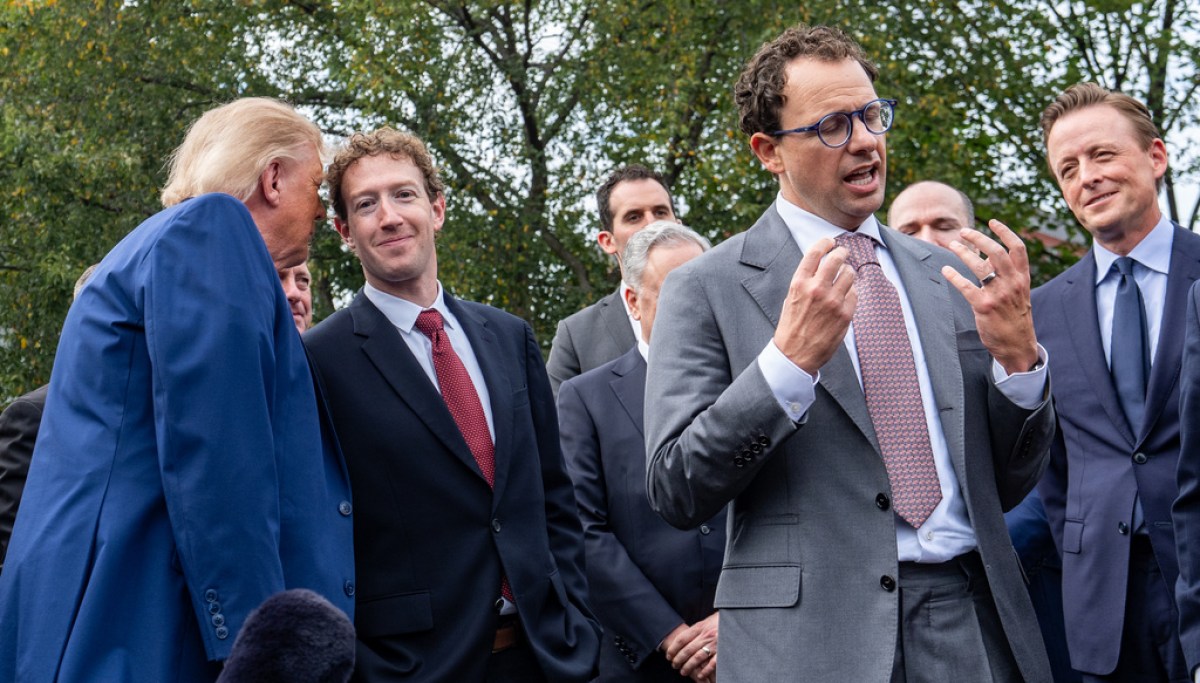
The recent spike in warnings about artificial intelligence from industry leaders has triggered questions about whether their calls for “AI safety” reflect genuine fear for humanity or disguise an orchestrated push for more power.In September, an Anthropic employee resigned, releasing a public statement condemning his employer and OpenAI, where he formerly worked, citing allegations that “the people building AI earnestly believe that it could kill us all by the end of the decade.” That resignation seemingly sparked a renewed commitment from Anthropic, along with OpenAI, and a host of other tech leaders to enact “guardrails” ensuring AI safety.What exactly those reforms could mean, and who the guardrails protect, however, has become increasingly disputed. As panic spreads across the country, Congress is reaching a bipartisan consensus that change is needed. But critics, from Wall Street expert Michael Burry and former Meta chief AI scientist Yann LeCun to President Donald Trump’s top AI adviser, see a trap in which enacting certain changes could allow a select group of tech leaders to gain antitrust waivers and squelch competition, allowing them to consolidate power. For example, LeCun believes the push is designed to sideline U.S. companies that favor more open-source AI models. Anthropic and OpenAI are among industry leaders that have developed closed AI models, in contrast to Meta, Nvidia, and other companies that favor open-weight models. Open models are typically free and allow users more control over the model’s core inputs, as they can download and customize them to individual or business preferences. In recent years, they have been gaining steam in the United States, where closed models have enjoyed dominance.When pressed on whether LeCun’s fears are true, Kevin Frazier, a professor at the University of Texas at Austin School of Law, told the Washington Examiner it is difficult to determine which guardrails would strike the balance between preserving robust competition and ensuring AI safety.“There’s a tension between policies that restrict access to the core inputs of AI or heighten the thresholds for releasing AI models and a more competitive ecosystem,” the AI innovation and law fellow said. “That said, competition for the sake of competition is not good policy. The aim should be to have as many reliable, useful AI models as possible available to meet a variety of users’ interests, needs, and values. Given the current state of the science of AI, which is highly uncertain, it’s difficult to know which policies adequately strike that balance.”One by one, technology leaders, from Anthropic’s Dario Amodeo to SpaceXAI CEO Elon Musk, have backed industry-wide coordination on AI, in a call recently supported by Trump. They have framed collaboration on the world’s most powerful technology as needed to implement safety controls. Frazier agreed that coordination is necessary, but argued that concentrating power long-term in the hands of a few people is “troubling.”“Under the status quo — one in which AI labs have lured academics and experts from the Ivory Tower to the Silicon Tower and those same labs have near-exclusive access to the latest tools, forming a sort of tokenocracy — there’s a need for collaboration on the science of AI because they are the entities with the talent and the resources,” he said. “However, this troubling concentration of power should only be justified in the short term and under very specific constraints. We need to invest more in universities and research entities that can offer independent expertise and provide external bases of knowledge and guidance.”Business goals versus addressing the problem Vahid Behzadan, a professor at the University of New Haven’s Department of Computer Engineering and Computer Science, said he believes industry-wide talks of coordination tend to “coincide with their business goals rather than actually addressing the problem.” He said the AI safety debate over the years has often “somehow ended up promoting products and services rather than advancing actual implementation of safety guidelines or controls.”President Donald Trump, left, speaks with Meta CEO Mark Zuckerberg as Dario Amodei, CEO and co-founder of Anthropic, as he speaks with reporters on Tuesday, Sept. 29, 2026, outside the West Wing of the White House in Washington. (AP Photo/Alex Brandon) Behzadan stood by his belief that collaboration is generally beneficial and that “some level of federal regulation is going to be required to ensure at least the basic degrees of safety” for AI. However, he conceded that more guardrails on the industry would likely spell trouble for smaller start-up labs and those developing and using open models. New licensing requirements, or mandating permissions to develop or lease models, “could become a costly barrier,” restrictions on downloadable models “could become an issue,” and smaller developers might avoid releasing “useful models because their exposure is unpredictable,” he said.“This is not a new argument. Every time regulations are proposed by the bigger names in AI, this argument comes up,” Behzadan noted during an interview. “The bigger names have significantly more resources, both in funding and access to talent and manpower to implement changes in their workflow, mandatory or otherwise, and making those changes mandatory would essentially equal the cost on a smaller developer or a smaller research lab.”“Essentially, smaller labs with either budgets may be constrained or may be budgeted out of the competition because of the more stringent regulations and compliance requirements,” he added.Industry calls for reforms have included warnings that independent oversight of models is needed through third-party auditors. But some critics have raised concerns that such calls do not mark a genuine demand for enhancing AI safety. They have speculated that Anthropic’s suggestion that the prominent third-party evaluator METR could help make AI safer may be a ploy for a “regulatory capture machine” because of concerns that METR is financially tied to the company.OpenAI CEO Sam Altman speaks at the OpenAI DevDay 2026 conference on Tuesday, Sept. 29, 2026, in San Francisco. (AP Photo/Jeff Chiu) Frazier said that there are valid concerns that third-party reviewers “have a concerning level of personal and financial connection to many labs.” He suggested fixing the issue by randomizing selections of auditors, mandating that auditors only remain at one place for a finite period of time “to avoid them acclimating to the culture and becoming too close to employees,” and making them subject to periodic review by a government authority to ensure they have the requisite expertise to do the work in question.China plays catch-up … fast Concerns remain that scaling back AI development could give the reins of the technology to China, allowing it to surpass the U.S. as the world’s dominant superpower. Such accusations have been prominently voiced in the Trump administration, including by David Sacks, the president’s AI adviser. Sen. Ted Cruz (R-TX) and Rep. Brett Guthrie (R-KY) are among those in Congress who have raised fears that China is helping to orchestrate the latest wave of panic about AI safety in the U.S. so it can win the technology race, echoing allegations raised in investigations by the Bitcoin Policy Institute and OpenAI.Specifically, China could be weaponizing the open-closed model debate in the U.S. to push its own agenda. Some experts have raised concerns that Beijing is flooding the market with free open models to undermine the U.S.’s advantage and make users reliant on software linked to China. Xie Feng, the Chinese ambassador to the U.S., jabbed Washington last week in remarks that noted the edge his country holds on open models, pointing out that when Hugging Face was hacked over the summer, it was a Chinese open model the U.S. startup used to thwart the attack.Though they are more expensive, closed models have historically been dominant in the U.S. due to their superior capabilities, though open models are fast closing the gap. Open models are typically free systems that are easy for users to download and customize for their individual and business preferences. They are also typically more nimble than their closed counterparts, which is vital in cases of data breaches.“How can you compete with something that’s free when American tech is very, very expensive?” Leah Siskind, an AI research fellow at the Foundation for Defense of Democracies, recently told Fox News Digital. “How can we ensure that a Chinese open-source model would be truly clean, that it’d be truly free of CCP censorship? We can’t be — we just wouldn’t know. And that’s by design. We wouldn’t know what sort of trick backdoors might be implanted and how that could rear its head later on.”Humans First, a major group that has led nationwide protests against data centers, told the Washington Examiner it does not believe China is behind the momentum against AI in the U.S. Humans First Chairwoman Amy Kremer said that in the group’s tour across the states, she’s seen more and more grassroots antagonism toward AI from people angered that it “seems to be infiltrating our lives in every single way possible.” She suggested that if the Trump administration was truly concerned about beating China, it would stop allowing companies such as Nvidia from selling powerful AI chips to China, and crack down on companies such as OpenAI and Google that a Financial Times report found are selling their frontier AI systems to Chinese subsidiaries through Singapore that are blacklisted by the Pentagon.Kremer also denounced allegations that the deluge of calls for “AI safety” from leaders in the U.S. is little more than a political ploy designed to give their companies more power, as Sacks has suggested.AI LEADERS SUGGEST ‘OPTIONAL’ WORK ON HORIZON: IS IT A PIPE DREAM?“I think David Sacks has a vested interest in seeing that these companies have free rein to do whatever the hell they want, and it’s about adding zeros to his bank account,” Kremer said.“I think that America will lead the world — we can lead the world in innovation, ingenuity, and also have safety at the same time,” she added. “It’s not just the data centers that we’re hearing about. It’s AI that we’re hearing about, too. That the American people are not happy with how this technology is being imposed in their lives in every way, and they — nobody voted for this.”
Big Tech is leading the ‘AI safety’ guardrails push: For protection or profit?
Full Article
Original Source
Read the full article at Washingtonexaminer →KhanList aggregates and links to publicly available news content. We do not host full articles from third-party sources. Always verify important information with original sources.