
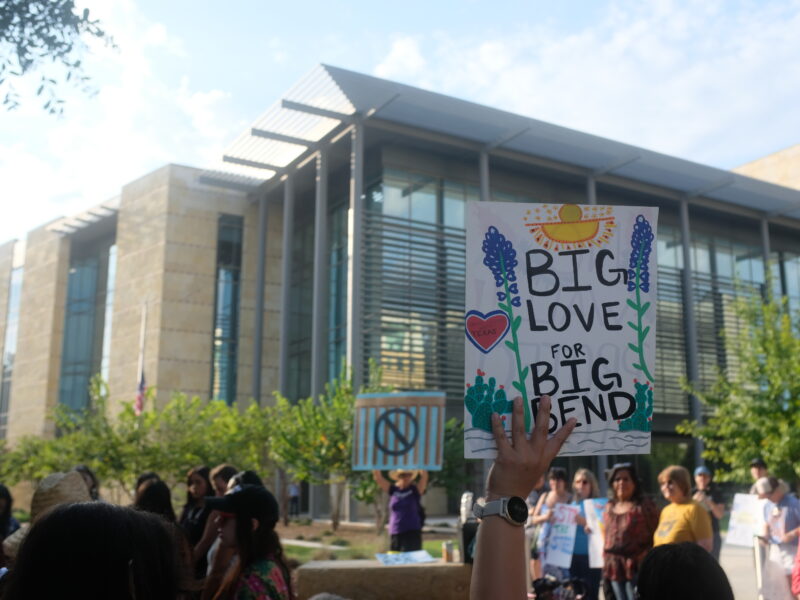
Despite asking for an injunction, the plaintiffs in a lawsuit against the Department of Homeland Security left a federal courthouse Friday with an agreement and assurance that no wall will be built in Big Bend National Park.SAN ANTONIO (CN) – Attorneys for the Trump administration reached an agreement Friday with a business and nonprofit from far West Texas to extend a pause on border security construction in Big Bend National Park, giving the groups more time to raise their concerns.News earlier this month that bulldozers were plowing through pristine habitat in Big Bend National Park sparked outcry and a lawsuit by Far Flung Outdoor Center, a Terlingua adventure guide business, and People of La Junta for Preservation, a nonprofit associated with the Lipan Apache Tribe. They seek to stop the Department of Homeland Security and Customs and Border Protection from damaging land they say is vital to their livelihoods and religious practices, respectively.Customs and Border Protection Commissioner Rodney Scott had ordered construction halted through the end of August, but after an emergency hearing Friday, the pause was extended to Sept. 15.U.S. District Court Judge Orlando Garcia, a Bill Clinton appointee, announced the agreement at the end of the hearing, saying it would give both sides time to work through the issue.“It sounds like the government can do what it wants to do, but that does not mean it should,” Orlando said.Throughout the year, the Department of Homeland Security has sought to expand border security infrastructure along the Texas-Mexico border, including in Big Bend National Park and Big Bend Ranch State Park. On June 9, DHS Secretary Markwayne Mullin waived several federal environmental and historic preservation statutes “to ensure the expeditious construction of barriers and roads in the vicinity of the international land border in the state of Texas.”However, U.S. Attorney Pamala Amaechi told the court during Friday’s hearing that no wall is planned for the park.“No pedestrian barrier will be built in Big Bend National Park,” Amaechi said. “The only barrier being built will be a vehicle barrier.”While the plaintiffs agree the administration can waive federal laws to build border barriers, they say such projects cannot violate their rights under the Religious Freedom Restoration Act, or RFRA.Christina Hernandez, founder and director of People of La Junta for Preservation and a plaintiff in the case, appeared as a witness during Friday’s hearing. She testified that losing access to sacred sites in the park would interfere with her ability to practice her Indigenous faith. Under RFRA, the government cannot substantially burden religious exercise without a compelling reason.“That land in the national park and in the state park, that is your synagogue, mosque or chapel, correct?” Roland Gutierrez, an attorney and Democratic state senator representing the plaintiffs in the case, asked.“That is right,” Hernandez replied.“Disconnecting me from the river would impede my religious practices,” Hernandez said later on during her questioning.Gutierrez argued that even if the DHS secretary issued another determination waiving RFRA, the government still could not proceed because it has not shown a compelling reason for barriers in the park. He noted that the Big Bend Sector covers 25% of the southern border but has the fewest apprehensions for illegal crossings.The plaintiffs also called Terrell County Sheriff Thaddeus C. Cleveland as a witness. Cleveland, a former Border Patrol agent of 26 years, testified that the area’s rough terrain and lack of roads make it undesirable for people seeking to cross the border.Amaechi rejected the plaintiffs’ arguments, saying DHS is responsible for securing operational control of the border, meaning zero crossings of people or illicit materials.“The number of crossings does not matter here,” Amaechi said. “The discretion is vested with the Department of Homeland Security and Customs and Border Protection. There is no need for judicial oversight here.”In response to Amaechi’s comment, Gutierrez pressed that there should be oversight of the government’s actions to protect the plaintiffs.“The government does not get to say, ‘we get to do whatever we want just because it is our land,’” Gutierrez said. “This isn’t the White House.”In addition to Hernandez and Cleveland, the court heard from Far Flung Outdoor Center owner Billy Bartko and archaeologist David Keller, who has researched the Big Bend region. Gutierrez also argued DHS lacks authority to build border infrastructure within the national park, though much of the hearing focused on the plaintiffs’ RFRA claims.With an extended pause having been agreed to, the parties are expected to continue talks with officials at DHS and CBP to work through concerns raised in the plaintiff’s lawsuit.Outside the courthouse, Houston-area attorney Dick DeGuerin, who is also representing the plaintiffs in the case, told reporters that the fight for Big Bend is not over.“We have an absolute commitment that there will be no wall, but the rest of the area is still in our fight,” DeGuerin said.Subscribe to our free newslettersOur weekly newsletter Closing Arguments offers the latest about ongoing trials, major litigation and rulings in courthouses around the U.S. and the world, while the monthly Under the Lights dishes the legal dirt from Hollywood, sports, Big Tech and the arts.Additional Reads
Big Bend National Park border construction paused under agreement with locals
Full Article
Original Source
Read the full article at Courthousenews →KhanList aggregates and links to publicly available news content. We do not host full articles from third-party sources. Always verify important information with original sources.