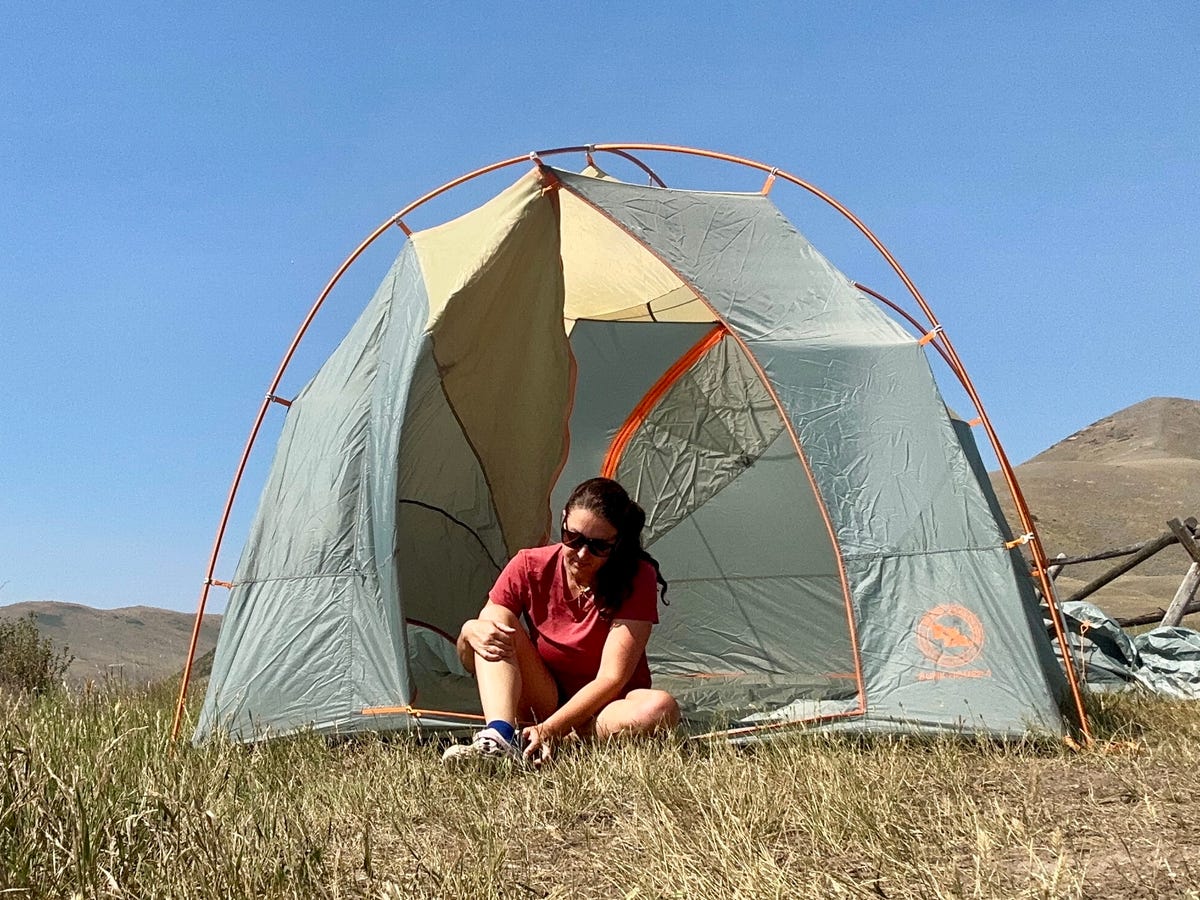
6 min readMost of my experience with Big Agnes is with its backpacking tents, and they’re my all-time favorite shelters for their excellent space-to-weight ratio. The Bunk House 6 is my first experience with the brand’s family tents, and I’m pleased to report Big Agnes carried its excellent design ethos into more accessible car-camping tents.The Bunk House is roomy and wastes no space or weight. It features a smart pole structure that keeps the pitch as simple as possible without compromising stability. The interior has plenty of pockets along the corners and sidewalls, and you can pitch the fly and poles in “shelter mode” if all you want is some portable shade.With an 80-inch peak height and more than 80 square feet of interior space, this is a well-designed, durable tent. And while it’s tough to set up solo and the doors are a bit hard to get in and out of, it still works well for outdoorsy families looking to hit the frontcountry.ProsVestibule is large enough to stash wet gearProVersatile “shelter mode” is helpful for shade when you don’t need the full tent80-inch peak height is tall enough for most campers to standConsA bear to pitch soloDoors can be hard to get in and out ofKey SpecsCapacity6 (also comes in a four-person)Weight18 lb 4 ozInterior Space83 sq ftVestibule Space56 sq ftPeak Height80 in.How I Tested I took this tent out during the summer season here in Montana. It’s mostly hot and dry, with the occasional afternoon thunderstorm. The main thing I look for during summer testing is ventilation and sun protection. A lot of our frontcountry campsites are exposed, and the sun at 5,000 feet is hot.I was impressed with the Bunk House’s ample mesh and airflow, and it has plenty of options for tying back the doors for additional air movement. I usually camped near water at both lakes and rivers, and made sure to note the condensation each morning, and whether or not the tent was saturated.Maggie SlepianThe tent is well designed overall, but the doors are a bit tough to get in and out of.Roomy With Ample HeadroomThis tent has more than 80 square feet of interior space for the six-person, and the four-person has 58 square feet. This is pretty on par for this capacity, though there are a few tents out there with several more square feet. For comparison, The North Face Wawona 6 has 81 square feet of interior space, and the REI Base Camp 6 has 84 square feet.Maggie SlepianThe interior space is roomy, and the peak height will make tall folks happy.Where the Bunk House shines is in headroom. The tent is 80 inches tall at its peak, and thanks to Big Agnes’s smart pole design, you get a lot of head and shoulder room. This is in contrast to other tents that pitch steeply down from the high point, and many other six-person tents top out around 74 or 76 inches tall.The most people I had in this tent was four, and that felt like a good amount of space, especially since we’re all adults. I would hesitate to put six full-size humans in here, though you can easily get away with a few adults, a few kids, and a dog or two. My friends and I were all able to sit up and move around, and there was little cramping even as we got dressed in the morning.It’s Easier to Pitch With Two (or More) People This should come as no surprise to anyone who has pitched a family-sized tent before, but it’s a bear with just one person. Big Agnes does a good job keeping its systems streamlined, but I still had to take this out a few times on my own and fight with the material to get the whole thing upright.It’s not any more challenging than a six-person Coleman and did come together faster than the REI Base Camp 6—but it’s still a lot of pole sections and material to manage on your own. The structure uses a straightforward spreader pole at the peak to boost shoulder room, with the four sides securely anchored at the corners and tiebacks for the large door.Maggie SlepianThe tent takes about 10 minutes to pitch, but it’s tough to do solo.I had to reach pretty high up to clip the horizontal spreader pole into place and had some trouble securing the fly over top of the extended front section, but it was easier to pitch than some of the more needlessly complex large-capacity tents I’ve used.Overall, this reminded me of a larger and slightly more involved Copper Spur, which is one of my favorite Big Agnes backpacking tents. I have a lot of experience with its backcountry shelters, which might have made the Bunk House 6 less of a learning curve.Made to Last, With Excellent Ventilation and ProtectionBig Agnes is first and foremost a backcountry brand, known for its durable, weatherproof, and intentionally designed gear for everything from backpacking to ice climbing. Its frontcountry, family-friendly products are no exception, and the Bunk House is built to last many seasons while packing down reasonably small and without being too much of a burden to fit in the car and lug to the tent pad.The tent body is a durable 75-denier polyester taffeta with a 1,500mm waterproof polyurethane coating, plus a PFAS-free durable water repellent for added assurance. The mesh is ample, allowing excellent ventilation, and is made from tough yet light nylon that shows no signs of wear or holes. The pole system is made from DAC’s DA17 aluminum poles, which I’ve found to be an excellent balance of toughness and flexibility.Since this tent is oriented toward families, I was also happy to see the guylines are reinforced at their attachment points (I can picture kids pulling on them and tripping over them). And the stakes are robust enough to hold down the substantial tent body in higher winds.I tested this tent during the summer in Montana, so I didn’t encounter too much nasty weather like I do during spring testing. I camped through a few bursts of thunderstorms but nothing sustained. That said, I was impressed at how well condensation evaporated, and any dew from my riverside campsites stayed beaded up on the surface of the fly, never penetrating inside the tent. I had some moderate winds during a few outings, and the guylines helped keep everything in place.The Fast-Fly Shelter Is Great, but Tough to PitchMost often seen on smaller, lightweight tents, the “fast fly” is another option for pitching that allows you to just throw the fly on top of the tent poles. Big Agnes calls this “shelter mode,” and it creates an open-sided shelter (held back with ties) similar to a pop-up tent at a tailgate, or an additional shelter at a sunny campsite.All that said, this is really tough to pitch on your own. I spent some time testing this solo and found myself wrestling with the pole system and the fly material more than I’d like. I actually found the shelter mode easiest to set up with three people, and if you have that many friends willing to help, the result is an excellent shade option for picnic sites or sunny areas where you want added shade and shelter during the day.Final ThoughtsOverall, what surprised and pleased me most—and is the feature that I think makes this tent a standout—is the option of using it as a fly-and-pole sun shelter. I can see that aspect working well even for tailgates and backyard shade, and it’s a great base-camp option even if you don’t want to set up the interior.I found it took about the same effort to pitch as REI’s Base Camp 6 (which I reviewed here), though it costs almost $100 more. For that $100, you save a few pounds of weight and inches of packed size, plus you get more headroom and more vestibule space. Ultimately, it comes down to whether the headroom and pitching versatility are worth the extra money to you. But with Big Agnes’s reputation and my experience with this tent, I’d say it is.Shop the Big Agnes Bunk House 6 Other Family Tents We RecommendColeman Skydome 4 TentThe North Face Wawona 6 TentAlso Great for Large GroupsKelty Wireless Freestanding 8 TentMaggie Slepian is a full-time freelance writer in the outdoor industry and has tested gear professionally for almost ten years—she is an avid backpacker, trail runner, bikepacker, and horseback rider and has thru-hiked thousands of miles on the Appalachian, Colorado, and Ouachita trails, along with backcountry travel on terrain including coastal trails, the desert, and high alpine peaks. Maggie has written for New York Magazine, Huffington Post, REI, and Outside. She is a columnist with Backpacker Magazine and is the co-founder of BackpackingRoutes.com. Contact her at MaggieSlepian.com.Rachel is the Deputy Editor of Reviews for Hearst's Enthusiast and Wellness Group where she supports Popular Mechanics, Runner's World, and Best Products. Her background is in service journalism and earlier in her career she worked as a daily newspaper reporter and book editor. She spent more than a decade as a staff editor and writer at TripAdvisor and Penguin Random House and her byline has appeared in Time Out New York, the New York Daily News, and New York Magazine. Outside of work, Rachel can be found planning her next trip, visiting museums and galleries, and walking her wirehaired dachshund in Central Park.
Big Agnes’s Bunk House 6 Is a Roomy, Ventilated, and Versatile Car-Camping Tent With Backcountry DNA
Full Article
Original Source
Read the full article at Popularmechanics →KhanList aggregates and links to publicly available news content. We do not host full articles from third-party sources. Always verify important information with original sources.