
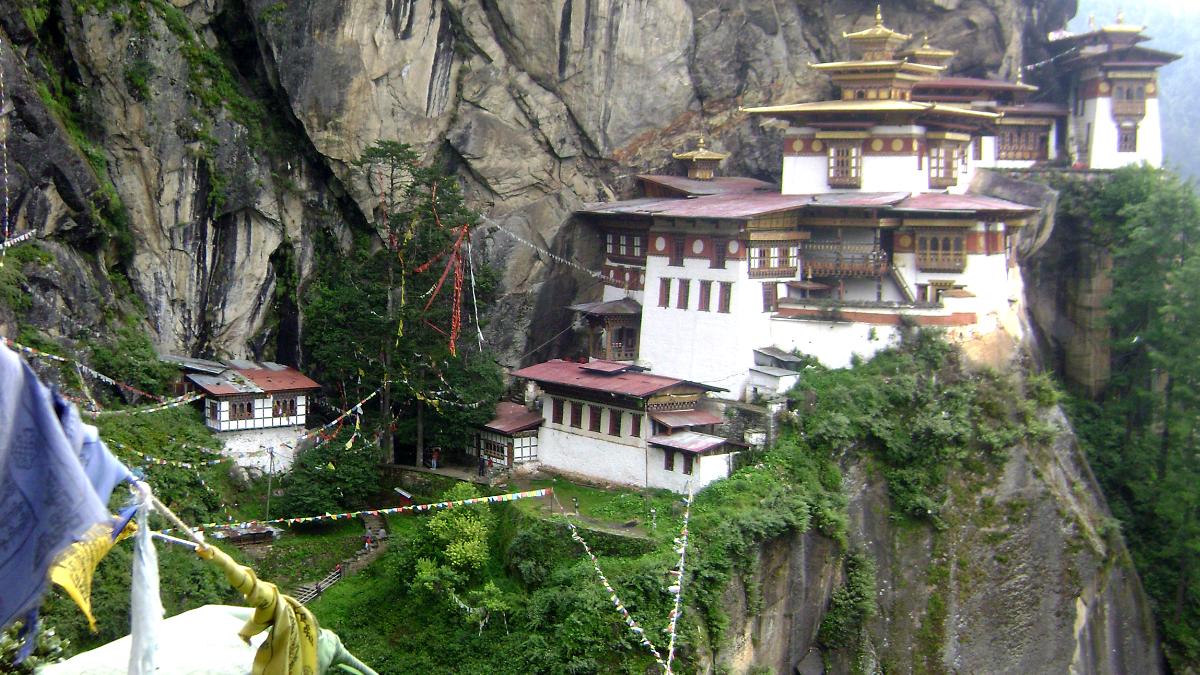
This is a blog post fromAmong the first impressions of the majestic Paro airport is the sight of the Royal King and his Queen greeting guests at Bhutan’s doorstep. With an airport that is perhaps the most scenic in the world, Bhutan represents everything unique from the conventional world. The Bhutanese have long been living a life which is considered to be holistic if perhaps isolated from the rest of the world. Driven by the vision of the former Majesty of Bhutan, it has been pursuing the idea of Gross National Happiness (GNH) in all its governance mechanisms since the early 1970s. While I was leading a research team that was about to asses this with the Government of Bhutan, my images of the sparkling country drew multiple parallels. Through this piece, I try to pin together various elements of the Bhutanese experience beyond the reams of research which i still have not made up my mind on. The single-most striking thing about the royal kingdom is its ability to hold onto itself amidst the globalisation-led clamour for uniformity of cultures. It essentially represents the version of urban India in the 1960s and 70s — an addictive innocence to the nostalgic era of royalty, an overarching emphasis on being under control and of working less and being content with life. There are three major figures that you get to see all across Bhutan — the King, the Queen and the King’s father (the 4th King), who had recently given the throne to his son after a voluntary retirement. Despite almost eight years of democracy, the royalty commands a great degree of goodwill. In my interactions with policymakers and common people alike across Bhutan, not one person had anything negative to say about the King. To a Western educated mind, this seems an implausible ask and we are often critical of this demigod-like status accorded to any individual. However, you ask any Bhutanese and their answer would be the antidote — the austerity and simplicity of the royalty and their relentless service to Bhutan makes them deserving of the demigod-like status, they say.As one western-educated Bhutanese told me, “the royalty has garnered enough goodwill to be supreme”. Bhutan’s philosophy has largely been the brainchild of the visionary 4th King, who pioneered the concept of GNH. He announced the concept of GNH to the world, coincidentally, on a trip with the Indian Prime Minister in the early 1970s. The 4th King’s vision provided the foundations of GNH and built resistance to any form of development that harmed the happiness of the people. The higher ideal of happiness was kept as the prime goal even at the cost of world isolation. And as the 20th century unfolds, the King, according to the people, seem vindicated, considering the socioeconomic direction the world is moving in. As such, the imprint of the royal family spans across all of Bhutan; and democracy seems to have further bolstered their standing and respect among the country’s people. The streets of Bhutan are endowed with colour; there are no traffic-lights. And I could see hardly any anger anywhere in the country. At the core of the Bhutanese GNH ethic has been the overarching emphasis on culture and the restraint that Vajrayana Buddhism brings to the people of Bhutan. Everywhere you see in the country, there is a stamp of culture that is distinct to the Himalayan kingdom. Whether it be the numerous Dzong s (large monasteries in Bhutan), the preservation of the local Bhutanese language Dzongkha, the numerous festivals, the traditional attire, or even the innumerable sites of worship — all of it is related to the preservation and presence of the Bhutanese culture. The royalty as well as the democratic setup have been unanimous in maintaining and strengthening traditions. You hear whispers of the ill-effects of modernisation every so often. One senior officer told me: “We have to protect GNH from these negative forces”. Any economic initiative that is seen to be causing harm to the cultural fabric of the country is given a re-jig. Most Buddhist teachers are held in high regard and the monasteries are even given representation in the governance mechanisms to ensure that their views are heard. The royalty is known to be religious and evidenced by the elaborate ceremonies held during the royal wedding. The country’s culture is thus safeguarded in the formal governance mechanisms instilled in both the constitution as well as the filtering tools such as GNH. Besides the cultural emphasis, the emphasis on the environment too has been a priority for a very long time in the country’s history.The Himalayan environment is as pristine as it gets. As enshrined in their constitution, Bhutan is expected to protect at least 60 percent of its forest cover at all times. Today, it holds a healthy 72 percent, according to some estimates. This emphasis on protecting the environment has been intrinsic to the Bhutanese version of sustainable development. Any major economic policy that comes through the system needs to pass the strict rigours associated with the protection of the environment.As such, you’d be hard-pressed to find any projects in Bhutan that harm the environment. Take, for example, Bhutan’s hydro-energy partnership with India. Even though this has become the largest revenue-seeking project in Bhutan, it took time for the government to vet it in light of environmental issues in order to get it to pass the GNH muster. Even though this project has ensured virtually 24 x 7 electricity in Bhutan (no mean feat for a nation that is in the UN’s list of least-developed countries) and made it economically prosperous, it took many measures and discussions to ensure the environment wasn’t affected. Even then, some activists contend that the project harms the environment. Many projects proposed by foreign governments have been given a pass purely because it violates the environmental interest. At the same time, there have been other projects, such as the road expansion through the entire national highway, that have cleared the GNH paradigm. The erstwhile King ensured that protection of the environment was enshrined in the constitution when he advocated democracy to the country.So, is Bhutan the cinderella of the world, facing no challenges? Of course not. The advent of democracy along with the rapid development in mobile technology has opened up the world — especially for Bhutanese youth. Their society has metamorphosed from an age of global isolation to one of hyper-connectivity within a short period of time and the social impact of this is telling. “We want more jobs to fulfill our aspirations” is the general refrain amongst the young. The need, therefore, for employment opportunities is a big deal for the government as on date. The streets of Thimphu, which were, decades ago, dormant, today bustle with pubs and restless youth who pursue the trappings of a materialistic lifestyle, I realise, as a Manchester-United fan proudly displays his red scarf to me.Furthermore, the aspirational gen is also causing rapid rural-urban migration within Bhutan with almost half the population expected to move to urban areas by the next decade, according to some estimates. The rapid urbanisation is also providing a challenge for the government to protect their heritage and pass it to on to the younger generation. While there is barely any dissent against the establishment today, it wouldn’t surprise me if urbanisation and greater education were to trigger such a movement in the future, unless their aspirations are met by the state.It is interesting to also note that Bhutan, as a society, despite its strong Buddhist influence, is not too ritualistic or socially conservative at the ground level. An example would be the acceptance of polygamy (male and female, both ways) and the rule for the husband to stay with the wife’s family after marriage. Drinking is common even in the interiors of Bhutan and has been for a long time. In contrast, therefore, to Bhutan’s image as a conservative Buddhist — thanks perhaps to the GNH model — society, the Bhutanese are, as such, a fairly easy-going people. I think its a very interesting time to be in Bhutan. On the one hand, the world is looking up to it, seeking inspiration from its sustainable GNH model to chart an alternative global path. On the other, Bhutan itself is increasingly seeking growth, as a result of rapid migration and advances in technology, to satisfy the growing aspirations of its youth. Striking a balance between these two contrasts is the biggest challenge for both the government and the royalty. It remains to be seen the evolution of Bhutan over the next 20 years. I so wish that they preserve their heritage and indeed provide a sustainable growth model for the world to follow. I sincerely hope they don’t follow India’s rapid transition to urbanisation — from a social standpoint — with its urban millennial generation that is largely a prototype of the West with limited knowledge about their roots beyond cricket and cinema.Bhutan’s beauty is its uniqueness and its cultural heritage. There can be no better inspiration than the Tiger’s nest, a 8th-century wonder 25 miles on top of a hill — a spectacle built by sheer perseverance and a sense of holistic well-being that stands tall amidst changing times. The sooner Bhutan recognises the value of its uniqueness in contemporary society and looks to carve a distinctive identity for itself in the world stage, the more it will thrive. Else, like the likes of Nepal and other countries, it could be consumed among the swaths of globalisation-hit cultures and drowned by the plethora of issues that come with it. It’s time for Bhutan to take a strong stand and look to preserve its character (through the young minds of Bhutan), and promote jobs as well as ensure that their USP — culture and environment, both of which intertwine to form Bhutan’s beauty — are protected like never before.
Bhutan, a tiger's nest on a precipice
Full Article
Original Source
Read the full article at Thehindu →KhanList aggregates and links to publicly available news content. We do not host full articles from third-party sources. Always verify important information with original sources.