
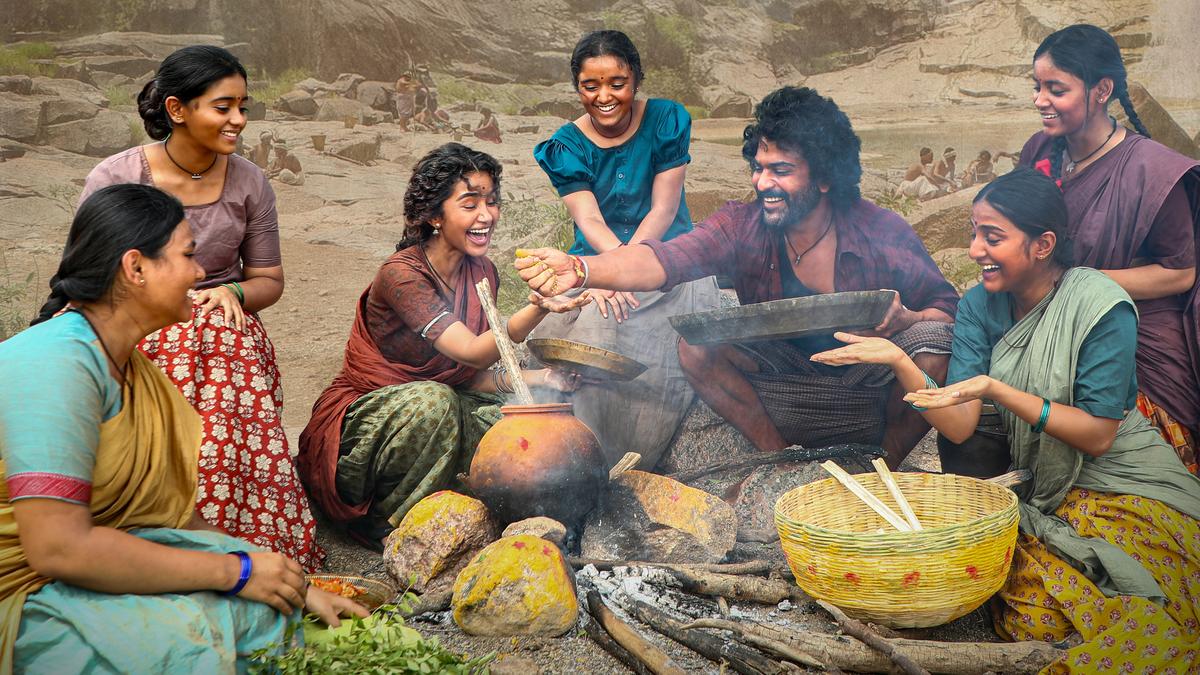
Anupama Parameswaran and Sharwanand with co-stars in ‘Bhogi’ | Photo Credit: Special Arrangement As the end credits of the Telugu film Bhogi roll, newspaper clippings of real-life incidents that inspired the story appear on screen. The film draws on a social evil rooted in extreme superstitious beliefs that continues to haunt pockets of the country. But that does little to justify a story that seems more interested in exploiting such incidents for an action drama that is, at best, crude.In a sequence leading up to the interval, lead actor Sharwanand plays the archetypal brother confronted with a harsh reality that sets him on a path of revenge, not just for himself but for an entire community. It is easy to see why an actor would choose a story that allows him to showcase a range of emotions and his machismo, while further establishing himself as an action hero. The problem is that Indian cinema has seen too many films with similar settings and plots in recent years. The excessive graphic violence has also become tiresome.Bhogi is set in the coal-rich interiors of Telangana a few decades ago. Yet, judging by the way the story unfolds, the setting could easily be medieval. Its proximity to Maharashtra adds a faint layer of context to a few characters, but does little to enrich the narrative.Bhogi (Telugu)Director: Sampath NandiCast: Sharwanand, Anupama Parameswaran, Dimple HayathiRuntime: 154 minutesStoryline: Never mindThe feudal landlord who controls the fictional Boggulagutta village and its surrounding forests is known as Patel (Sharath Lohitashwa). Villagers are forbidden from looking him in the eye; everyone must crouch in his presence. This aspect of the story is reminiscent of director Sukumar’s 2018 blockbuster, Rangasthalam. The key difference is the subplot revolving around a superstitious practice.The portrayal of a dust- and coal-laden village, where people make do with the bare minimum and dare not question those in power, has been done to death. Sampath Nandi attempts to bring something different to the narrative through the bond between siblings.Ganga (Sharwanand) is the sole guardian of his five sisters. A blacksmith by profession, he is supported by his uncle and childhood sweetheart, Sulochana (Anupama Parameswaran). The film spends considerable time establishing the siblings’ bond, but it is easy to anticipate where the story is headed.Two other pivotal characters are a spiritual leader who is always by Patel’s side and a police officer portrayed as the embodiment of evil.More than its predictability, it is the film’s brutal depiction of violence that derails an already stale story. Heads and limbs are severed, and bloodshed is relentless. But audiences have become increasingly immune to such on-screen excess.Sharwanand gets ample scope to perform, while Anupama has her share of mass moments. Neither, however, can salvage the film. Bhogi is yet another film that exploits its female characters to evoke shock and sympathy. It is 2026, and filmmakers can do better. Dimple Hayathi plays a sex worker who gets a few philosophical lines, but even these are lost in the film’s exploitative treatment of women.There are a few thoughtful touches, such as Ganga putting his skill with metals and knowledge of herbs to use, but they do little to lift the narrative.By the time Ganga completes his revenge and the villagers confront a larger truth, the film has become a test of endurance. Kishore Kumar’s cinematography attempts to capture the film’s terrain, while Bheems Ceciroleo’s music swings between softer, emotional passages and excessively loud beats. Neither makes the experience any more engaging.It may sound harsh, but writers and directors would do well to consign such stories to the proverbial bhogi fire and make room for fresher ideas. Published - November 27, 2026 02:15 pm IST
‘Bhogi’ movie review: Sharwanand’s revenge drama is all blood and no fresh ideas
Full Article
Original Source
Read the full article at Thehindu →KhanList aggregates and links to publicly available news content. We do not host full articles from third-party sources. Always verify important information with original sources.