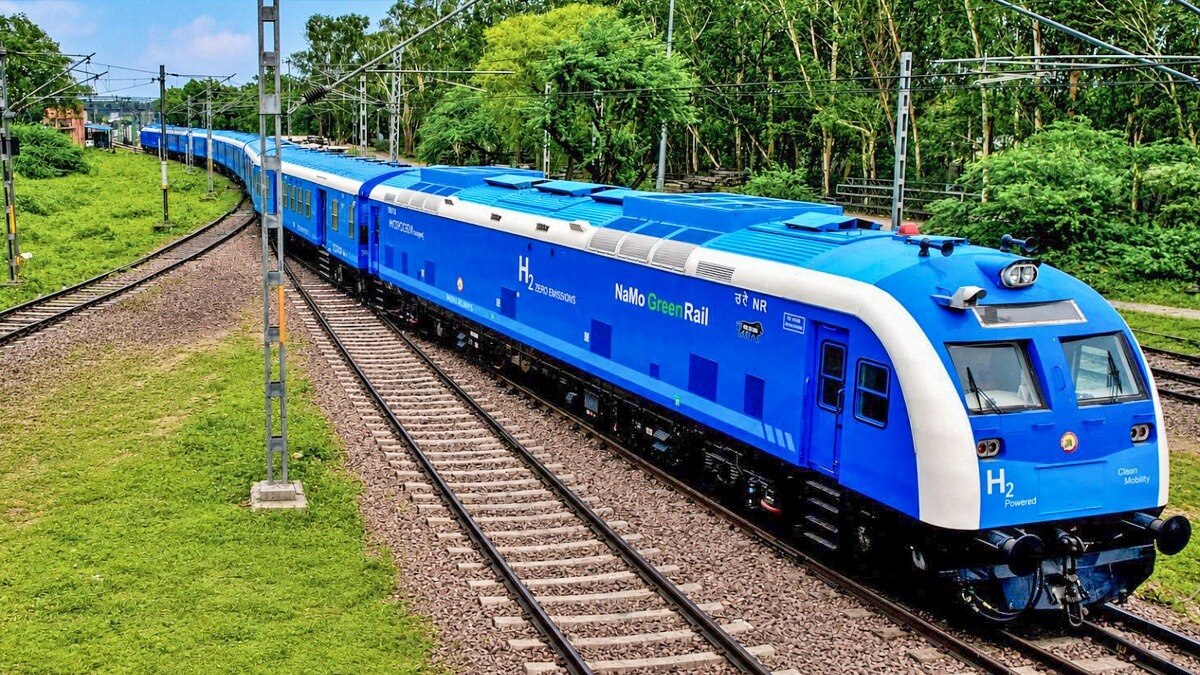
India's first hydrogen-powered train has moved the rail decarbonisation effort from policy to operations. Experts say wider rollout will depend on cheaper green hydrogen and route-based infrastructure.India's first hydrogen-powered train, developed by Indian Railways, during trials ahead of its rollout. (Photo: PTI)When Prime Minister Narendra Modi flagged off India's first hydrogen-powered train, it was more than the inauguration of a new locomotive, it was the beginning of an ambitious experiment that could redefine how some parts of the country's railway network are powered.The train, operating under Indian Railways' "Hydrogen for Heritage" initiative, has demonstrated that green hydrogen is no longer confined to laboratories and policy papers. It is now running on Indian tracks.The first train is operating on the 89-km Jind-Sonipat route under Northern Railway, connecting Jind Junction, Gohana Junction and Sonipat while stopping at several stations and halts along the corridor.Yet, for all the excitement surrounding the country's first hydrogen train, the bigger question remains unanswered: Can India realistically scale the technology from a single pilot to hundreds of trains across one of the world's largest railway networks? The answer, experts say, is yes, but only if India treats hydrogen not as a replacement for its electrified railway network, but as part of an entirely new energy ecosystem that has to be built from the ground up.WHAT IS A HYDROGEN TRAIN?Hydrogen trains are fundamentally different from diesel or electric locomotives. Instead of drawing electricity from overhead wires, they use hydrogen stored in onboard tanks. The hydrogen passes through a fuel cell, where it reacts with oxygen to produce electricity, emitting only water vapour.The technology promises zero tailpipe emissions while eliminating the need for expensive overhead electrification on difficult routes. Prime Minister Narendra Modi along with Union Minister Ashwani Vaishnaw during the flag off ceremony of India's first hydrogen-powered train. Haryana. (PTI Photo) However, unlike electric trains that can simply plug into an existing power network, hydrogen trains require a completely new supply chain, from producing green hydrogen and compressing it to transporting, storing and refuelling it safely."The biggest challenge isn't any one part of the value chain in isolation," said Vipul Kumar, Partner and Managing Director (India) at Xynteo. "It's bringing together green hydrogen production, storage, transportation, refuelling infrastructure and safety systems into an integrated ecosystem that can operate reliably at scale."India currently has no dedicated hydrogen pipeline network. That means every railway corridor operating hydrogen trains would initially need its own hydrogen production facility or dependable supply chain, along with compression systems, storage tanks, dispensing stations and trained personnel."The pilot has demonstrated that the train can run," Vipul said. "The next challenge is proving that everything around it can be deployed consistently across multiple locations." Prime Minister Narendra Modi flags off India's first hydrogen-powered train, between Jind and Sonipat. (Photo: PTI) WHY HYDROGEN WON'T REPLACE ELECTRIC TRAINSThe launch has prompted speculation over whether hydrogen could eventually replace conventional electric locomotives.Experts believe that is unlikely.India has already electrified nearly 99% of its broad-gauge railway network, making it one of the world's largest electrified rail systems. Direct electrification remains significantly more energy-efficient because electricity flows straight from the grid to the traction motors without multiple conversion losses."Conventional electric trains remain the most efficient and cost-effective option wherever electrification already exists," Kumar explained.Hydrogen, by contrast, involves converting electricity into hydrogen through electrolysis and then converting that hydrogen back into electricity inside a fuel cell, making the process inherently less efficient.Instead of competing with electric trains, hydrogen is expected to complement them.Former DRDO scientist and Chancellor of Amity University Chhattisgarh, Dr W Selvamurthy, believes hydrogen trains are ideally suited for routes where electrification is either technically challenging or economically unjustifiable.These include heritage railway lines, mountainous terrain, remote border regions, low-density passenger corridors and strategically important routes through Ladakh and the Northeast."Hydrogen trains will find application in low-density sectors, heritage tourism and border areas where laying extensive electrification may not always be practical," he said.Such routes, experts argue, would allow Indian Railways to gain operational experience while avoiding the enormous costs of deploying hydrogen across already-electrified corridors. A hydrogen-powered train undergoes a high-speed trial, in New Delhi, Friday, June 26, 2026. (PTI Photo) THE ECONOMICS STILL NEED TO WORKThe biggest hurdle remains cost.Green hydrogen today is still substantially more expensive than diesel or electricity.Current green hydrogen prices in India are generally between $5 and $10 per kilogram, while commercial competitiveness across transport applications is expected only when prices fall closer to $1 per kilogram.More importantly, railways must account for the delivered cost, which includes compression, storage and dispensing, not merely hydrogen production.Dr Selvamurthy believes technological advances could dramatically reduce costs over the next five years.Scientists and engineers across India are currently researching lower-cost hydrogen production using photocatalysis, photoelectrochemical processes, wastewater-based electrolysis and advanced catalysts. A decorated hydrogen-powered train is seen ahead of its flagging off by Prime Minister Narendra Modi in Jind. (Photo: PTI) Another aspect that critically needs attention, for the hydrogen ecosystem to boost, is the development of safer storage materials and technologies to transport compressed hydrogen more efficiently.The former DRDO scientist believes that green hydrogen production costs could fall from around $10 per kilogram today to nearly $2 per kilogram as laboratory technologies are scaled up for industrial deployment.BUILDING AN ECOSYSTEM, NOT JUST TRAINSFor hydrogen rail to succeed, experts say India's biggest investment will not be in trains themselves.It will be in the surrounding infrastructure.Dr Selvamurthy says hydrogen refuelling stations, electrolysers and maintenance depots must be developed first."You need hydrogen fuelling stations, maintenance support systems and electrolysers. Just as electric vehicles require charging stations, hydrogen trains will require dedicated refuelling infrastructure planned according to route length and train endurance," he said.Kumar agrees but argues infrastructure should be developed route by route rather than asset by asset.He recommends creating integrated hydrogen hubs where renewable power generation, water treatment, electrolysers, hydrogen compression, storage and refuelling facilities are all built together.Otherwise, expensive infrastructure could remain underutilised if only a handful of trains use each station.WHY HYDROGEN TRAIN NEEDS TO BE 100% RENEWABLEProducing hydrogen is only environmentally beneficial if the electricity used for electrolysis comes from renewable sources.India's National Green Hydrogen Mission aims to produce 5 million tonnes of green hydrogen annually, a target Kumar says would require roughly 125 GW of dedicated renewable energy capacity.However, he points out that railway demand would represent only a small fraction of India's planned hydrogen production.The immediate challenge is ensuring renewable power generation, hydrogen production, storage and refuelling infrastructure expand together. Hydrogen trains are fundamentally different from diesel or electric locomotives. (Photo: PTI) Without coordinated planning, hydrogen production could place additional stress on already constrained power systems during periods of high electricity demand.A PHASED ROLLOUTExperts envision hydrogen trains expanding gradually rather than rapidly.The next phase should focus on a few additional hydrogen clusters serving heritage railways, hilly regions and remote corridors before larger deployments are considered.Moving to hundreds of trains is more likely after 2030, once hydrogen becomes cheaper, fuel-cell durability improves, and shared infrastructure achieves consistently high utilisation.Indian Railways' immediate programme focuses on deploying 35 "Hydrogen for Heritage" trainsets, making the pilot only the beginning of a much longer journey.However, hydrogen trains are only one piece of a much larger clean-energy transition. Could hydrogen power the cars of the future? Work is underway to make the technology cheap across the world. (Photo: Generative AI by India Today) THE SPILLOVER EFFECTAs technology improves, Hydrogen could eventually power trucks, ships, aircraft, drones and even energy-intensive industries such as steel and cement manufacturing.Combined with India's growing investments in renewable energy, fuel cells and hydrogen production technologies, the railway project could become a catalyst for an entirely new industrial ecosystem.The first hydrogen train may have already left the station, but experts say the real journey lies ahead.Its success will depend not on a single locomotive, but on India's ability to build an integrated hydrogen economy, one that connects renewable energy, manufacturing, infrastructure and transport into a seamless network.If that ecosystem comes together, hydrogen could power not the entirety of Indian Railways, but the parts of it where electrification cannot easily reach, making the country's clean mobility transition both practical and sustainable.- EndsPublished By: Sibu Kumar TripathiPublished On: Aug 9, 2026 10:00 IST
Beyond the pilot: Can India build a nationwide hydrogen train network?
Full Article
Original Source
Read the full article at Indiatoday →KhanList aggregates and links to publicly available news content. We do not host full articles from third-party sources. Always verify important information with original sources.