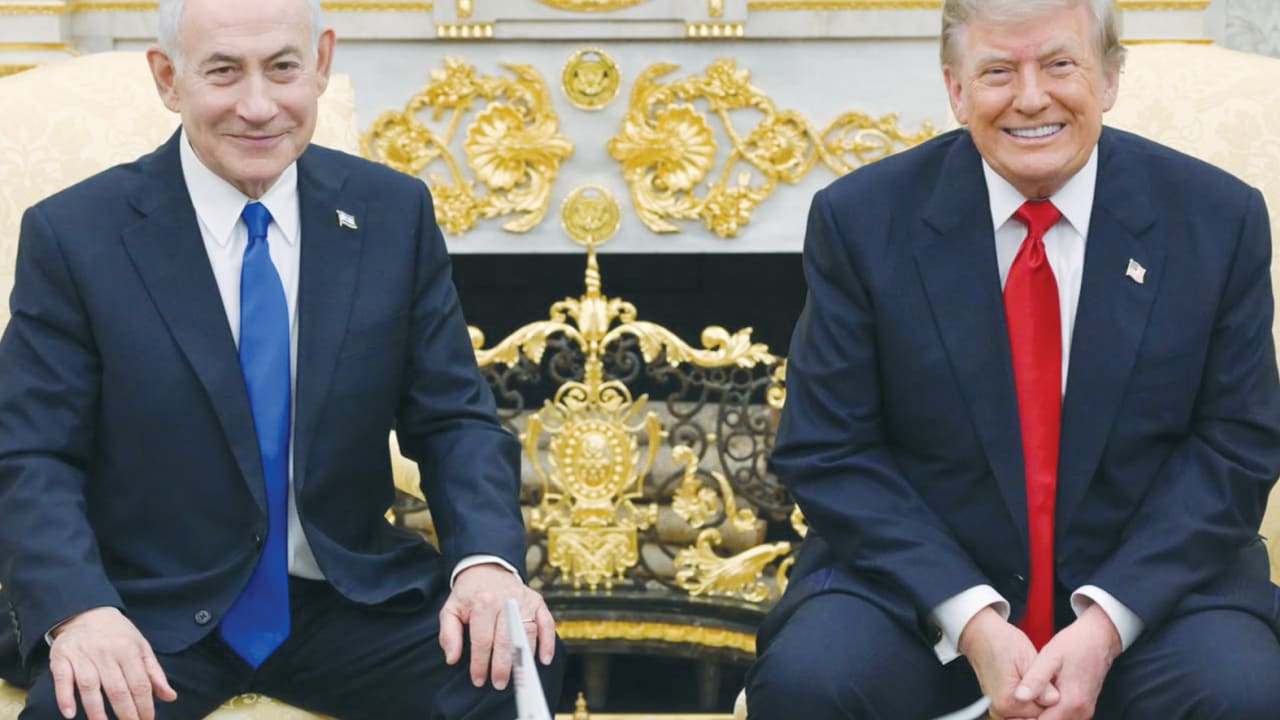
ByHERB KEINONJULY 31, 2026 13:04The choreography surrounding the Netanyahu-Trump meeting has fueled speculation about a widening rift, but the more important question is whether Israel and the US remain coordinated on IranOn Tuesday night, just hours after Prime Minister Benjamin Netanyahu met US President Donald Trump in the White House, Iran launched five ballistic missiles directly at a major US airbase in Jordan.The missiles were intercepted, causing no infrastructure damage or harm to US personnel.America’s response was not long in coming. Just hours after the attack, the US and Saudi Arabia conducted joint airstrikes in Iraq against Iran-aligned militias, killing at least 20. And then on Wednesday night, as Trump had pledged earlier in the day, the US carried out a wave of strikes in Iran, targeting dozens of sites, including command and control centers and missile and drone facilities.US President Donald Trump (R) and Israeli Prime Minister Benjamin Netanyahu (L) walk inside after Netanyahu arrived at Trump's Mar-a-Lago residence in Palm Beach, Florida; December, 2025. (credit: Jim WATSON / AFP via Getty Images)What the Iranians did with what was termed a “surprise attack” on the US base was hand Netanyahu an unexpected reprieve.Because for days preceding his visit, and during interviews while in the US, the narrative being advanced was that the prime minister had come to the US, just as he had a couple of weeks before the joint Israel-US attack in February, to press Trump to take up military action against the Islamic Republic.The second question in an ABC interview with Linsey Davis on Wednesday dealt exactly with that narrative: “When you met with President Trump at the White House, did you try to persuade him to resume attacks on Iran?”Netanyahu’s response: “Actually, no. That is a caricature – a cartoon picture. It is not true.”The Iranians proved his point. Trump did not need Netanyahu to convince him to resume attacks on Iran; the Iranians did that themselves by resuming attacks on US troops.Nevertheless, that framing is gaining traction: that the wily Israeli prime minister lured what critics portray as a feckless US president into a disastrous war with Iran. Versions of it can be heard from the Democratic Socialist Left to the Tucker Carlson Right.Much of what is being portrayed as a sharp rift between Netanyahu and Trump, or between the US and Israel, needs to be viewed, therefore, through the prism of countering that narrative.It is politically damaging to both leaders. To Trump, because it is bad optics for him to be seen as doing Israel’s bidding, and to Netanyahu, because it is politically damaging for him to be portrayed as being in Trump’s pocket, unable to make decisions affecting Israel’s national security based solely on Israel’s interests. Or, as opposition head Yair Lapid often says, “turning Israel into a vassal state.”Why the Netanyahu-Trump rift narrative benefits both leaders“Earlier this month, President Trump said in an interview that, in his relationship with you, you know who the boss is, meaning that he is the one calling the shots,” ABC’s Davis asked Netanyahu. “Do you see it that way?”Netanyahu replied by noting the irony that while in America the critics say Trump does everything Netanyahu tells him to do, in Israel the reverse is true: “They often say that I do everything he tells me to do.”And the truth, he said, “is that we are partners. We are allies.”Then he added a comment that was obviously important for his host: “He is the senior partner. It is the United States of America – let us not forget that – and I am the junior partner.”Netanyahu, it turns out, has learned on the job. Thirty years ago this month, he held his first meeting with then-US president Bill Clinton in the Oval Office, a tense meeting dealing with the Oslo Accords that did not go well.How do we know? Because afterward, according to accounts of the meeting, Clinton fumed in a private conversation, “Who the f**k does he think he is? Who’s the f***ing superpower here?”Netanyahu was clearly determined not to repeat that mistake, at least not with this president. In the ABC interview, Netanyahu showed that he knew how to read the room. He was careful to leave no doubt about who, in his view, was the senior partner.Trump has been just as careful in crafting his own public message.His repeated public put-downs of Netanyahu over the last few months fit that pattern. He has called him “f***ing crazy,” said he had no “f***ing judgment,” declared that he, Trump, is the boss, and, on the eve of their meeting, told reporters that he neither needed Netanyahu to come to Washington to provide intel about the nuclear facility at Pickaxe Mountain nor would be told by him whether the US could sell F-35s to Turkey.Taken together, those remarks can best be understood as an effort to puncture a narrative that is politically damaging to Trump: that he is allowing the Israeli prime minister to dictate American policy – not exactly America First – and is a classic case of the tail wagging the dog.Yet, Netanyahu, acutely aware of how this plays at home, then quickly added in the interview, “But I am the prime minister of Israel. When I have to stand up for the interests and security of my country, I do so.”That, in many ways, is the balancing act both leaders are now performing. Trump needs to demonstrate to Americans that no foreign leader dictates US policy.Netanyahu needs to reassure Israelis that, however close the alliance with Washington, Israel’s security decisions are ultimately made in Jerusalem.That balancing act was reflected not only in what was said, but also in how the visit itself was carefully choreographed.The White House deliberately kept the meeting low-key. Netanyahu was not greeted by Trump on the North Portico, where presidents generally welcome visiting foreign leaders.There was no Oval Office photo opportunity with reporters firing questions, nor was there the extended public display of warmth that characterized some of their previous meetings.Netanyahu entered through a side entrance, and the meeting, which included other officials rather than being one-on-one, lasted less than 90 minutes, details that drew considerable attention in the Israeli media.None of that was accidental. At a moment when Trump wants to deflate the notion that Netanyahu is somehow leading him, there was little political upside for the White House in turning the visit into a made-for-television embrace.On the other hand, perspective here is needed. This was Netanyahu’s seventh summit with Trump since he returned to the White House – eighth if one includes their meeting after the election but before the inauguration.Does every visit require a red-carpet welcome and an Oval Office media spectacle? Probably not. Routine meetings between leaders who see each other this often – and who talk as often as they do on the telephone – eventually become just that: routine.Which raises the obvious question: If so much of the public messaging is aimed at domestic audiences, how much of the reported rift is real?CENTCOM's Adm. Brad Cooper meets with IDF Chief of Staff Lt. Gen. Eyal Zamir on January 24, 2026. (credit: IDF SPOKESPERSON'S UNIT)Where Netanyahu and Trump really differ on IranHere, it is important to distinguish between a rift and a rupture. A rift is a disagreement within a relationship. A rupture is the relationship itself breaking down.There are, to be sure, real policy differences between Netanyahu and the Trump administration regarding Iran. Both sides want to ensure that Iran can never develop nuclear weapons.But whereas Israel would like to prioritize regime change as a goal in the war, the administration’s aims at this time are more limited: opening the Strait of Hormuz and restoring stability to the Gulf.There is also a difference over how to prevent Iran from attaining nuclear capability. Netanyahu made clear in the ABC interview that he has little faith in diplomacy because of what he described as the Iranian regime’s modus operandi.“They always lie, they always cheat, and they always play for time,” he said.Trump, by contrast, has repeatedly left the door open to a negotiated solution if one can be reached.Those are real differences. They are, however, not evidence of a rupture.This distinction is not just a matter of semantics. In Israel’s overheated political environment, turning every disagreement with Washington into proof that the alliance is falling apart reinforces a broader political narrative that Netanyahu has fundamentally damaged relations with Israel’s most important ally.But disagreements between allies are not unusual. The more relevant questions are whether the close coordination on Iran continues and where to go from here. One of the purposes of this meeting was to address both.Whether that happened behind closed doors is difficult to ascertain. Netanyahu emerged from the meeting calling it one of the best he has ever had with Trump – a notable assessment considering how many times the two men have met over the years. Then again, he was hardly likely to emerge from the Oval Office declaring the talks a failure.With so little concrete information about what actually transpired in the room, the safest conclusion is probably also the simplest: when it comes to US-Israel relations, things are rarely as good – or as bad – as the public rhetoric would have one believe.A good rule of thumb is not to judge the health of the alliance by public barbs, carefully choreographed optics, or sound bites surrounding a White House meeting. Those are often aimed as much at domestic audiences as at each other.The real test lies elsewhere: whether Washington and Jerusalem continue to coordinate on the issues that matter most. Despite all the background noise, this week’s meeting suggests that they do.Follow us on Google
Beyond the optics: Is the Netanyahu-Trump rift real, or are they still aligned on Iran?
Full Article
Original Source
Read the full article at Jpost →KhanList aggregates and links to publicly available news content. We do not host full articles from third-party sources. Always verify important information with original sources.