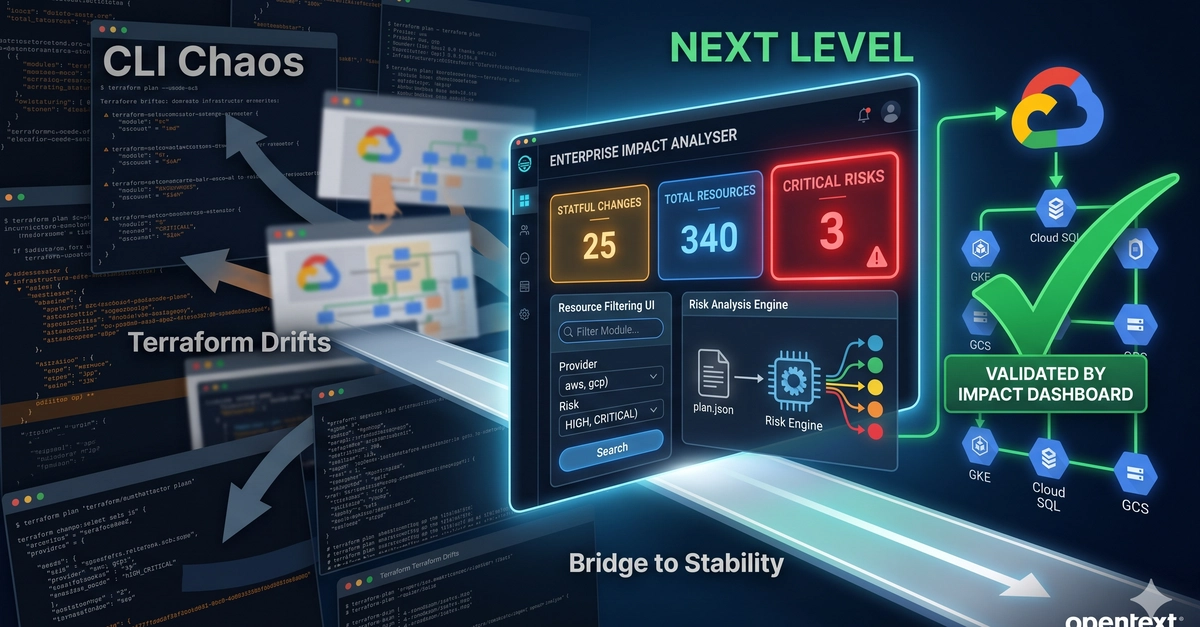
Stop Reading Raw JSON: Build an Enterprise Terraform Impact Dashboard As a Lead DevOps Architect, I often deal with infrastructure plans that touch hundreds of resources. Sifting through a standard terraform plan terminal output to find a single critical "delete" is like looking for a needle in a haystack. When you are managing complex infrastructure—like a technical cutover from Squid Proxy to Google Secure Web Proxy—the cognitive load is high. The risk of missing a "destroy" on a production database is a real threat to stability. The Problem: The "Wall of Text" Standard Terraform output is designed for logs, not for human auditing. In an enterprise environment, we face three main challenges: Risk Blindness: Critical resources (like RDS instances, S3 buckets, or IAM roles) look exactly like a minor tag update in the terminal. Scale Issues: Large plans (500+ changes) are impossible to review manually without missing something important. Stakeholder Gap: It is difficult to share a raw CLI output with a manager or security auditor for quick approval. The Solution: An Automation-First Dashboard I developed a Python-based Impact Analyser that transforms a plan.json into a high-fidelity, interactive HTML dashboard. This isn't just a formatter; it’s a risk-assessment engine. 1. The Workflow The process is simple and integrates directly into any CI/CD pipeline: Generate the Plan: terraform plan -out=main.tfplan Convert to JSON: terraform show -json main.tfplan > plan.json Run the Analyser: python3 tf_impact.py plan.json 2. Enterprise Features Risk-Level Heuristics: The script automatically flags changes as CRITICAL or HIGH if stateful resources (Databases, Storage, KMS Keys) are marked for deletion or replacement. Client-Side Filtering: Built with Tailwind CSS and vanilla JavaScript, the dashboard allows you to search 1,000+ resources instantly by address or module path. Standalone Portability: The output is a single HTML file. No database or server is required, making it perfect for CI/CD artifacts. The Code: Python Risk Logic Here is a snippet of how the risk assessment engine identifies dangerous operations before they hit production: we can always modify the risk engine with more critical type resources class RiskAnalyzer: """Identifies dangerous changes based on resource sensitivity""" CRITICAL_TYPES = { 'aws_db_instance', 'google_sql_database_instance', 'aws_s3_bucket', 'aws_iam_role', 'aws_kms_key' } @staticmethod def assess(resource_type, actions): is_delete = 'delete' in actions is_replace = 'create' in actions and 'delete' in actions if resource_type in RiskAnalyzer.CRITICAL_TYPES: return "CRITICAL" if (is_delete or is_replace) else "HIGH" if is_delete or is_replace: return "HIGH" return "LOW" Enter fullscreen mode Exit fullscreen mode copy the script below #!/usr/bin/env python3 """ Enterprise Terraform Impact Analyser (v2.0) High-performance, filter-enabled change detector for large-scale plans. Provides a dynamic HTML dashboard with client-side filtering. """ import json import argparse import re import logging import sys from typing import Dict, List, Any, Optional from collections import defaultdict from datetime import datetime from dataclasses import dataclass, asdict # Configure logging logging.basicConfig( level=logging.INFO, format='%(asctime)s - %(levelname)s - %(message)s', stream=sys.stderr ) logger = logging.getLogger("TF-Impact") @dataclass class ResourceChange: address: str type: str name: str module: str provider: str actions: List[str] risk_level: str change_summary: str class FilterEngine: """Enterprise filtering logic for large-scale infrastructure""" def __init__(self, include_types=None, exclude_types=None, modules=None, providers=None, address_regex=None): self.include_types = set(include_types) if include_types else None self.exclude_types = set(exclude_types) if exclude_types else None self.modules = set(modules) if modules else None self.providers = set(providers) if providers else None self.address_pattern = re.compile(address_regex) if address_regex else None def should_include(self, resource_addr: str, r_type: str, module: str, provider: str) -> bool: if self.include_types and r_type not in self.include_types: return False if self.exclude_types and r_type in self.exclude_types: return False if self.modules and not any(module.startswith(m) for m in self.modules): return False if self.providers and provider not in self.providers: return False if self.address_pattern and not self.address_pattern.search(resource_addr): return False return True class RiskAnalyzer: """Identifies dangerous changes based on resource sensitivity""" CRITICAL_TYPES = { 'aws_db_instance', 'aws_rds_cluster', 'google_sql_database_instance', 'azurerm_postgresql_server', 'aws_s3_bucket', 'google_storage_bucket', 'aws_iam_role', 'aws_kms_key', 'kubernetes_namespace', 'aws_route53_zone' } @staticmethod def assess(resource_type: str, actions: List[str]) -> str: is_delete = 'delete' in actions is_replace = 'create' in actions and 'delete' in actions if resource_type in RiskAnalyzer.CRITICAL_TYPES: return "CRITICAL" if (is_delete or is_replace) else "HIGH" if is_delete or is_replace: return "HIGH" if 'update' in actions: return "MEDIUM" return "LOW" class EnterpriseTFDetector: def __init__(self, plan_file: str, filter_engine: FilterEngine): self.plan_file = plan_file self.filter_engine = filter_engine self.risk_analyzer = RiskAnalyzer() self.data = self._load_plan(plan_file) def _load_plan(self, filepath: str) -> Dict: try: with open(filepath, 'r') as f: return json.load(f) except Exception as e: logger.error(f"Failed to load plan file: {e}") sys.exit(1) def _detect_provider(self, resource_type: str) -> str: parts = resource_type.split('_', 1) return parts[0] if len(parts) > 1 else 'other' def analyze(self) -> Dict[str, Any]: logger.info(f"Analyzing {self.plan_file}...") results = { 'metadata': { 'timestamp': datetime.now().isoformat(), 'tf_version': self.data.get('terraform_version', 'Unknown'), 'plan_id': self.data.get('format_version', 'N/A') }, 'changes': [], 'stats': defaultdict(int), 'risk_summary': defaultdict(int), 'by_module': defaultdict(lambda: defaultdict(int)) } resource_changes = self.data.get('resource_changes', []) for change in resource_changes: addr = change.get('address') r_type = change.get('type') module = change.get('module_address', 'root') provider = self._detect_provider(r_type) actions = change.get('change', {}).get('actions', []) if 'no-op' in actions or not actions or actions == ['read']: continue if not self.filter_engine.should_include(addr, r_type, module, provider): continue risk = self.risk_analyzer.assess(r_type, actions) primary_action = "replace" if ('create' in actions and 'delete' in actions) else actions[0] res_obj = ResourceChange( address=addr, type=r_type, name=change.get('name'), module=module, provider=provider, actions=actions, risk_level=risk, change_summary=" -> ".join(actions) ) results['changes'].append(asdict(res_obj)) results['stats'][primary_action] += 1 results['risk_summary'][risk] += 1 results['by_module'][module][primary_action] += 1 return results class EnterpriseVisualizer: def __init__(self, analysis_results: Dict): self.results = analysis_results def generate_html(self, output_file: str): """Generates a standalone HTML dashboard with client-side filtering""" json_data = json.dumps(self.results) html_template = f""" TF Impact Dashboard .risk-CRITICAL {{ border-left: 5px solid #ef4444; background: rgba(239, 68, 68, 0.05); }} .risk-HIGH {{ border-left: 5px solid #f97316; background: rgba(249, 115, 22, 0.05); }} .risk-MEDIUM {{ border-left: 5px solid #f59e0b; }} .risk-LOW {{ border-left: 5px solid #10b981; }} Terraform Impact Dashboard Enterprise Infrastructure Change Analysis Report Generated {datetime.now().strftime('%Y-%m-%d %H:%M:%S')} Create {self.results['stats']['create']} Update {self.results['stats']['update']} Replace {self.results['stats']['replace']} Delete {self.results['stats']['delete']} Interactive Filters Search Resources Risk Threshold Show All Risks Critical Only High & Above Filter Action All Actions Create Update Replace Delete const data = {json_data}; const listContainer = document.getElementById('resource-list'); function updateUI() {{ const searchTerm = document.getElementById('searchBox').value.toLowerCase(); const riskLevel = document.getElementById('riskFilter').value; const actionType = document.getElementById('actionFilter').value; const filtered = data.changes.filter(item => {{ const matchesSearch = item.address.toLowerCase().includes(searchTerm) || item.type.toLowerCase().includes(searchTerm); const matchesRisk = riskLevel === 'ALL' || (riskLevel === 'HIGH' ? (item.risk_level === 'HIGH' || item.risk_level === 'CRITICAL') : item.risk_level === riskLevel); const matchesAction = actionType === 'ALL' || item.actions.includes(actionType); return matchesSearch && matchesRisk && matchesAction; }}); if (filtered.length === 0) {{ listContainer.innerHTML = 'No resources match your filters'; return; }} listContainer.innerHTML = filtered.map(item => ` ${{item.type}} ${{item.risk_level}} RISK # ${{item.address}} Module Path: ${{item.module}} ${{item.actions.map(a => ` ${{a}} `).join('')}} Provider: ${{item.provider}} `).join(''); }} document.getElementById('searchBox').addEventListener('input', updateUI); document.getElementById('riskFilter').addEventListener('change', updateUI); document.getElementById('actionFilter').addEventListener('change', updateUI); // Initial render updateUI(); """ with open(output_file, 'w') as f: f.write(html_template) print(f"Dashboard generated: {output_file}") def main(): parser = argparse.ArgumentParser(description='Enterprise TF Impact Dashboard Generator') parser.add_argument('plan', help='Terraform plan JSON file') parser.add_argument('--output', default='tf_report.html', help='Output HTML filename') parser.add_argument('--provider', nargs='+', help='Initial filter by provider') parser.add_argument('--module', nargs='+', help='Initial filter by module prefix') args = parser.parse_args() # Pre-filtering engine (CLI level) engine = FilterEngine(providers=args.provider, modules=args.module) detector = EnterpriseTFDetector(args.plan, engine) results = detector.analyze() visualizer = EnterpriseVisualizer(results) visualizer.generate_html(args.output) print("\nSummary:") print(f" - Total Changes detected: {sum(results['stats'].values())}") print(f" - Critical Risks: {results['risk_summary']['CRITICAL']}") print(f" - High Risks: {results['risk_summary']['HIGH']}") if __name__ == "__main__": main() Enter fullscreen mode Exit fullscreen mode
Beyond the CLI: Building an Enterprise Terraform Impact Dashboard
Full Article
Original Source
Read the full article at Dev →KhanList aggregates and links to publicly available news content. We do not host full articles from third-party sources. Always verify important information with original sources.