
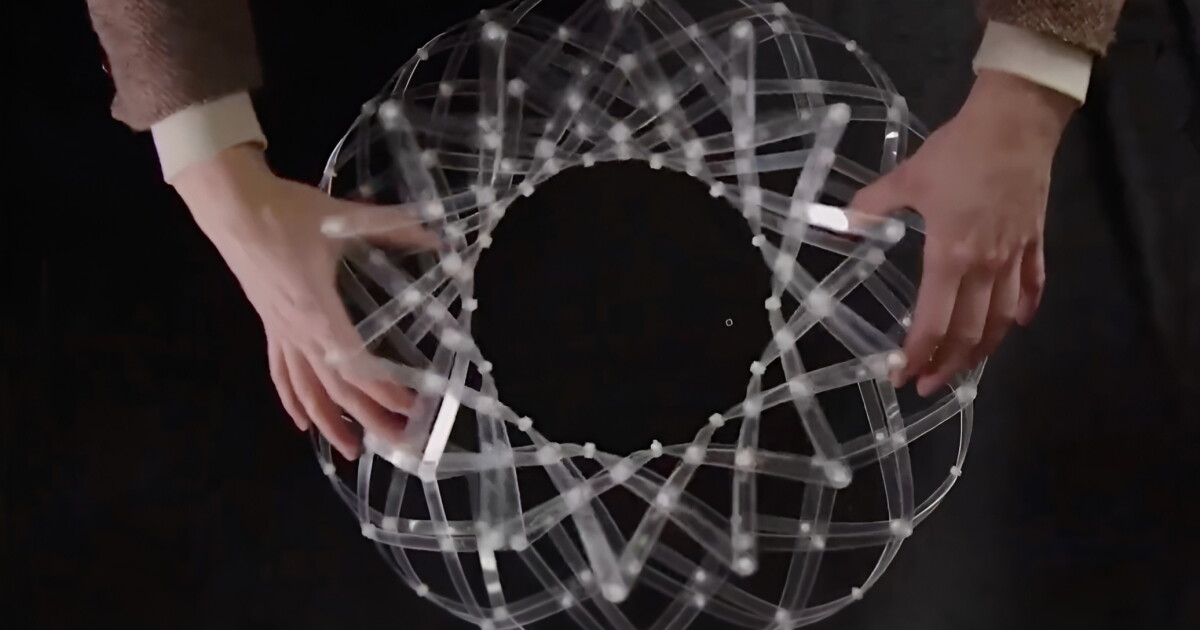
Chances are you’ve seen Hoberman spheres, those kinetic lattices made of joint-connected rods that, with a little manual effort, can contract or expand. Inspired by the ancient Japanese arts of origami (paper-folding) and kirigami (paper-folding-and-cutting), a team from Harvard University in the US and Tokyo University in Japan has developed expandable structures that, like Hoberman spheres, use rods and scissored joints. They’re calling them "collapsible scissored surfaces and pantographic lattices" ... although Hobegami would be much cooler and faster to type.As Physics graduate student Noah Toyonaga writes in a recent Proceedings of the National Academy of Sciences paper, the Harvard/Tokyo University team he led created “an algorithm for growing pantograph structures […] to explore the full space of possible mechanisms,” which they used “to computationally design and physically assemble a series of examples of varying complexity.” The devices were produced using multi-material 3D printers. Torus-shaped pantograph lattice folds into a cylinder According to senior author Lakshminarayanan Mahadevan, “Origami showed how folds can encode shape. Kirigami showed how cuts can unlock motion and functionality. This work asks a complementary question: What can be achieved when the basic building block is not a fold or a cut, but a linkage?" Mahadevan is also the Lola England de Valpine Professor of Applied Mathematics, of Organismic and Evolutionary Biology, and of Physics.When volume, and not just mass, is a performance limit for objects, tools, structures, and vehicles, collapsibility is a valuable design feature. Whether you’re piloting a submarine, a cargo airplane, or a spacecraft to restock a space station, if you can afford more fuel for the extra tonnage, you’re probably better off taking more collapsible furniture, helmets, surgical implants, habitats, cubesats, spacesuits, flying donuts, and flying wings than fewer non-collapsible ones, thus reducing the number of costly and risky trips.To create objects with collapsibility as a core feature, Toyonaga’s team devised an analytic design algorithm allowing incremental construction of complex scissored surfaces. As Toyonaga explains, “Global form can be understood through purely local rules [that] shape an entire structure from a sequence of simple geometric decisions.” This “brick-by-brick” (actually, joint-by-joint) approach works upward, adding new connections individually towards creation of the whole, rather than working downward from the entire form to the discrete joints, and requires only a small set of design parameters.Through this approach, Toyonaga’s team (including Harvard’s Colter J. Decker and Robert J. Wood, and Tokyo University’s Seri Nishimoto and Tomohiro Tachi) designed and built objects of various shapes including helices, toroids, and “eggboxes.”While those dynamic structures objects don’t necessarily rise to the breathtaking hyperbole in the team’s paper, Harvard’s pantographic lattices do provide an additional benefit their paper doesn’t mention at all: beauty. Because of their geometric elegance, the “Hobegami” structures may inspire more designers to include collapsibility in their products. After all, if you could have a useful box, chair, table, tent, or anything else that dynamically shape-shifted like a low-tech Transformer, wouldn’t you choose it over a static one?Source: Harvard John A. Paulson School of Engineering and Applied Sciences
Beyond origami: New algorithm designs expandable 3D lattices
Full Article
Original Source
Read the full article at Newatlas →KhanList aggregates and links to publicly available news content. We do not host full articles from third-party sources. Always verify important information with original sources.