
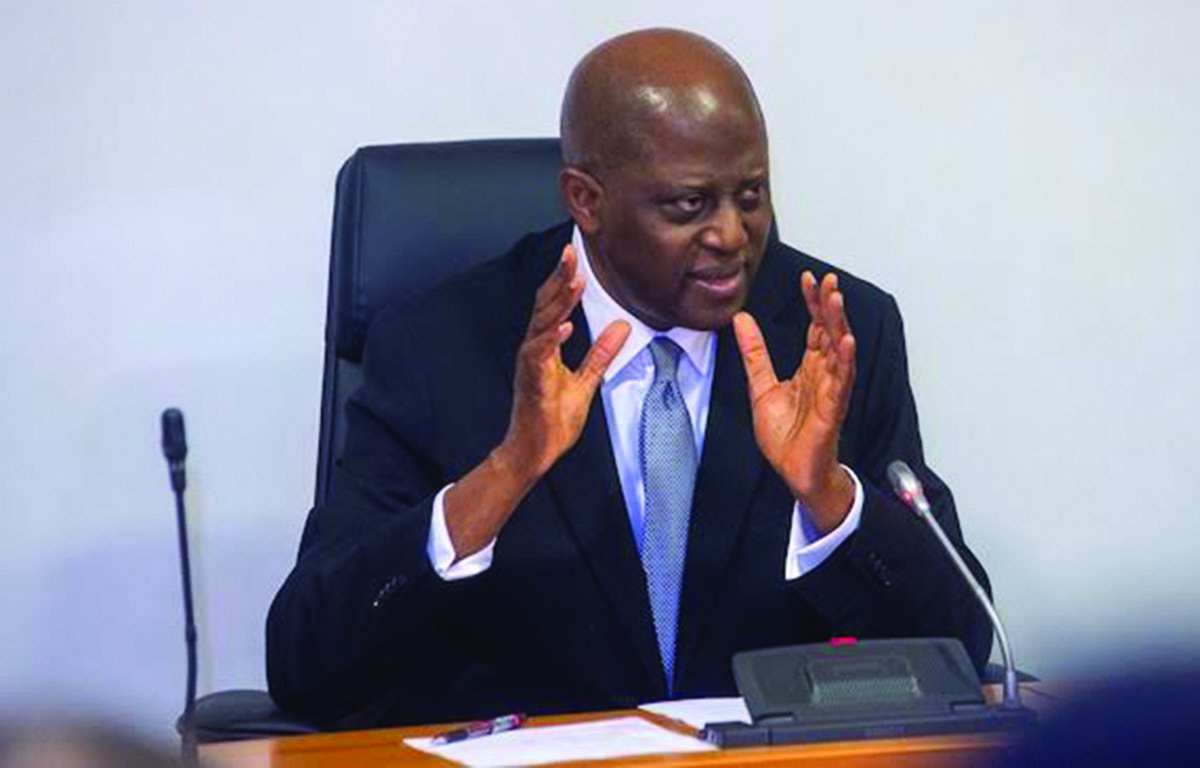
Three years after inheriting a monetary system weakened by excess liquidity, FX distortions and collapsing confidence, CBN Governor, Mr. Olayemi Cardoso, is seeking to turn hard-won stability into cheaper capital and stronger growth without reopening the vulnerabilities he spent time to fix, writes James Emejo There is a subtle but important change in the language coming from the Central Bank of Nigeria (CBN). For much of the past three years, the conversation was about stopping things from getting worse—containing inflation, rebuilding reserves, stabilising the naira, draining excess liquidity and restoring confidence in a monetary authority that Governor Olayemi Cardoso said he inherited in a deeply weakened state. Now, the question is different. With inflation falling, the foreign exchange market more stable, reserves rebuilt and investors returning to Nigerian markets, the central bank is beginning to ask whether the machinery it used to restore stability must itself be recalibrated. That is the deeper meaning of the Monetary Policy Committee’s decision to reset the Monetary Policy Rate (MPR) by 350 basis points to 23 per cent. The size of the reduction attracted the headlines. But Cardoso’s explanation points to something more consequential: the CBN believes the problem has moved from controlling monetary excess to making monetary policy transmit effectively through an economy that is no longer where it was three years ago. The MPC has described the move as a reset rather than a conventional easing cycle, retaining a high Cash Reserve Requirement and stressing that policy would remain restrictive and data-dependent. Fighting inflation to fixing transmission Cardoso insists the latest rate decision should not be mistaken for an abrupt abandonment of the restrictive policy that defined the early years of his administration. The central bank believes tightening has done much of the work for which it was deployed. Inflation, which Cardoso recalled was around 30 per cent when he took office, has fallen to 15.39 per cent. The foreign exchange market is considerably more orderly. Gross external reserves have risen above $55 billion, compared with net reserves of about $3.3 billion at the beginning of his tenure. The balance of payments has moved into surplus, while investor confidence has improved. But another problem has emerged: the policy rate itself had become increasingly detached from the rates at which money was actually trading in the market. If the benchmark rate sends one signal while interbank and other market rates send another, monetary policy becomes less effective. That is why Cardoso’s most revealing description of the 350-basis-point reduction was not “easing”. It was a “reset and recalibration.” The objective, in his explanation, is to close the gap between the policy signal and market reality, strengthen transmission and ensure that the CBN’s decisions actually influence the cost and availability of money across the financial system. This makes the latest move less about abandoning restraint than about changing the mechanism through which restraint is exercised. FX market reform Perhaps the most consequential part of Cardoso’s three-year account is his treatment of the foreign exchange market. The old system, according to him, was not merely inefficient. It created a distortion in which access to foreign exchange could depend on connections and preferential channels. Multiple exchange rates effectively operated as a subsidy. Cardoso put the cost of that distortion at roughly three per cent of GDP—higher than the estimated 2.2 per cent GDP cost of the fuel subsidy at the time. Taken together, the two distortions represented a burden equivalent to about 5.2 per cent of GDP. The significance of the FX reform therefore goes beyond the daily movement of the naira. It removed a major source of uncertainty from monetary management. Businesses can price more rationally. Investors have greater visibility. Foreign exchange can move through a more transparent market. And the CBN has greater capacity to build reserves without constantly defending an artificial exchange-rate structure. That stability has now become one of the foundations for the latest monetary reset. Remittance surprise One of the quieter indicators of that change is sitting outside the traditional monetary-policy statistics. Diaspora remittances. Cardoso said monthly inflows had risen from roughly $200 million to about $600 million and were approaching $1 billion by July. He was careful not to present one month as proof of a permanent trend. His larger point was that policy changes had altered the incentives and infrastructure through which Nigerians abroad send money home. The CBN revamped the BVN framework for Nigerians in the diaspora, imposed greater settlement and reporting requirements on international money transfer operators and stepped up engagement with the diaspora. The result is potentially more important than the headline monthly figure. Nigeria is increasingly able to attract foreign exchange through channels that are less dependent on speculative portfolio flows. That matters now because lower domestic yields could make Nigerian fixed-income assets relatively less attractive to some international investors. Remittances provide a different kind of buffer. Rebuilding banks to encourage lending The monetary reset also rests on a banking sector that has itself undergone reconstruction. The recapitalisation exercise was initially met with scepticism, particularly after the naira adjustment and the government’s ambition of building a $1 trillion economy. But the exercise ultimately mobilised substantial domestic capital. For Cardoso, that is not simply a regulatory achievement. It is evidence that domestic savings and investment capacity exist in Nigeria when confidence and institutional structures are sufficiently strong. The objective is now to have banks capable of absorbing shocks while providing the capital required for a larger economy. That puts the banking industry directly at the centre of the next phase of the CBN’s strategy. A lower MPR can open the door. But banks must walk through it. Real test begins with borrowers This is where the analysts’ reservations become important. For Chairman, Alliance for Economic Research and Ethics, Dele Kelvin Oye, a lower policy rate is an opportunity rather than a guarantee. His warning is straightforward: the reduction must reach businesses and households through actual lending rates. There is a particular danger that banks could reprice deposits faster than loans, allowing their margins to widen without producing the expected relief for productive borrowers. His call for a “Prime Lending Rate Adjustment Tracker” goes to the heart of the transmission problem. Chief Executive Officer of the Centre for the Promotion of Private Enterprise (CPPE), Muda Yusuf, similarly sees the decision as potentially significant for the real sector, where expensive credit has constrained investment, working capital and job creation. Professor Uche Uwaleke of Capital Market Academics of Nigeria believes the macroeconomic conditions now justify the reduction, while NECA’s Adewale-Smatt Oyerinde cautions that businesses will not feel meaningful relief unless banks transmit the change. That distinction is critical. The CBN can reduce the price of the monetary policy signal. It cannot compel every bank to make productive credit cheap. The banking sector’s response will therefore become one of the most important measures of whether Cardoso’s recalibration succeeds. A different kind of fiscal-monetary relationship Another part of Cardoso’s second act is institutional rather than numerical. The new fiscal-monetary coordination agreement between the CBN and the Ministry of Finance is designed to prevent monetary and fiscal policy from working at cross-purposes. Cardoso’s point is that coordination should no longer depend on personalities occupying particular offices. That matters because Nigeria is moving towards an inflation-targeting framework. Monetary policy cannot sustainably carry that burden alone. Government borrowing, liquidity creation, debt issuance and public spending can either reinforce or undermine the central bank’s efforts to control prices. The new framework is therefore intended to institutionalise communication and coordination without compromising the CBN’s independence. Election as next stress test Perhaps the most revealing element of Cardoso’s interaction with journalists was his discussion of the approaching election cycle. Rather than treating election-related liquidity as an unpredictable event, the CBN has modelled scenarios around currency in circulation, banking-system liquidity, monetary aggregates and foreign exchange demand. He said the central bank does not intend to wait for liquidity pressures to become visible before responding. It plans to use its monetary tools proactively. Cash will remain available, Cardoso said, but abuse of the cash system will not be tolerated. The emphasis on electronic payments, transaction trails and enforcement of cash limits is therefore part of a broader effort to prevent election-related liquidity from undoing the stability painstakingly built over the past three years. Global vote of confidence The final piece of the puzzle is Nigeria’s re-entry into major international investment indices. Cardoso described this as a vote of confidence. The importance extends beyond prestige. Some global institutional investors operate under mandates that restrict investment in markets absent from recognised indices. Restoring Nigeria’s place in those benchmarks can therefore broaden the investor base, deepen domestic capital markets and potentially improve foreign exchange liquidity. It also strengthens monetary transmission. Deeper markets provide more reliable price signals, broader sources of funding and greater liquidity through which monetary-policy decisions can work. That is why the CBN’s reforms cannot be reduced to the MPR alone. The rate is only one component of a much larger attempt to rebuild the financial architecture. From survival to the harder task of growth. Three years ago, Cardoso’s immediate challenge was credibility. The central bank had to convince Nigerians and investors that it could control liquidity, restore the integrity of the FX market, rebuild reserves and enforce the rules. Today, the challenge is more demanding. It has to prove that stability can produce something tangible- cheaper productive credit, more investment, deeper capital markets, higher private-sector capacity and more jobs. And ultimately, stronger growth without a return to the excesses that created the original crisis. Bismarck Rewane of Financial Derivatives Company captures the transition by arguing that the rate decision should be assessed against the cumulative impact of monetary policy rather than viewed as a single cut. That is perhaps the best way to understand Cardoso’s latest move. The CBN is not declaring victory over inflation. Nor is it opening the floodgates. It is betting that the buffers accumulated through three years of difficult reforms are now strong enough to allow monetary policy to become more responsive to an economy that has changed. The danger is that the same buffers could be tested if lower yields trigger portfolio outflows, renewed FX pressure or excessive liquidity. The opportunity is that the reset could finally close the gap between macroeconomic stability and the experience of businesses that still face punishing financing, energy, logistics and production costs. That is the real test of Cardoso’s second act. The first phase was about stopping the monetary system from bleeding. The next is about making the repaired system work for the economy.
Beyond Naira Stability
Full Article
Original Source
Read the full article at Thisdaylive →KhanList aggregates and links to publicly available news content. We do not host full articles from third-party sources. Always verify important information with original sources.