
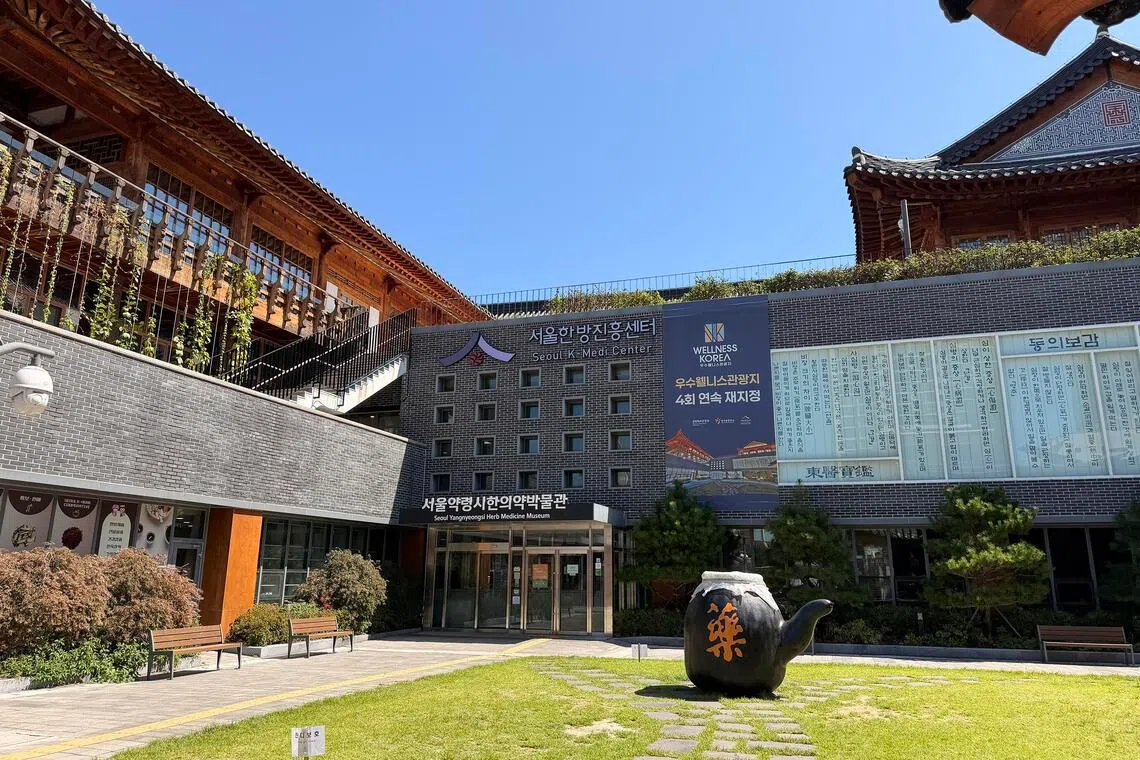
SEOUL – As a child, Morgan Awyong dreaded the taste of Chinese medicinal remedies. Thin and sickly, the Singaporean was made to down bitter concoctions every other day by his parents, leaving him with an aversion to medicinal herbs, such as ginseng. Now 49, the freelance writer has not only made peace with his childhood aversion but even embraces it.He has even developed a taste for the notoriously bitter ssanghwa-cha, a traditional Korean herbal infusion of roots and aromatic plants traditionally taken to combat fatigue and improve blood circulation.During his annual visits to Seoul, where he spends between three and six months at a time while working remotely, Awyong enjoys taking the immune-boosting ginseng supplement sticks that are ubiquitous in South Korea.On one trip to Seoul in December 2025, Awyong developed persistent neck and shoulder pain that did not improve despite his trying to massage it away himself. Having heard positive reviews about traditional Korean medical therapies of chuna (chiropractic adjustment therapy) and buhang (cupping) from his friends, Awyong, who has experienced their equivalents in traditional Chinese medicine (TCM) – tuina and baguan, respectively – decided to give them a try.He is among a growing number of visitors to South Korea seeking traditional Korean medicine, broadening the country’s medical tourism appeal beyond the cosmetic medical treatments for which it is best known.Medical tourism in South Korea surged to a record in 2025, with the number of foreign patients surpassing two million for the first time – an increase of nearly 72 per cent from 2024.Dermatology was by far the most sought-after medical service, accounting for 63 per cent of foreign patients, followed by plastic surgery at 11 per cent.But more significant is the rapid growth in demand for traditional Korean medicine.Embracing traditionsModern Korean traditional medicine is rooted in texts such as the Dongui Bogam, a comprehensive medical encyclopaedia compiled by royal physician Heo Jun during the Joseon dynasty and published in 1613.The number of foreign patients seeking traditional Korean medical services increased more than tenfold, from more than 2,500 in 2021 to over 37,000 in 2025, according to South Korea’s Ministry of Health and Welfare.Singaporeans were among the top six nationalities seeking such treatments, after patients from Japan, China, the United States, Russia, and Mongolia.Most of the foreign patients seeking traditional Korean medicine are in their 20s and 30s, with women accounting for an overwhelming 90 per cent.In response to queries from The Straits Times, the health ministry attributed the growth in part to the rising global popularity of K-culture, particularly following the runaway success of the animated film KPop Demon Hunters, released in June 2025.Separate data from the Korea Tourism Organisation also showed that spending by foreign patients at traditional Korean medicine clinics rose by 19 per cent in 2025 from the previous year, reaching 26.1 billion won (S$24 million), out of total medical treatment expenditure of 3.3 trillion won.The health ministry added that it is working to raise awareness of Korean traditional medicine among foreign visitors through promotional content on digital platforms, and training medical interpretation coordinators in languages such as English, Chinese and Japanese to help bridge the language gap. An exhibit on Korean traditional medicine at South Korea’s National Folk Museum. ST PHOTO: WENDY TEOAt Tong-in Traditional Korean Medicine Clinic in central Seoul, not far from the main tourist sights of Gyeongbukgung Palace and Jogyesa Temple, Singaporeans are among the top five foreign nationalities visiting the clinic. The clinic, which opened in 2010, started seeing a spike in foreign visitors after being featured in a particular episode about Korean traditional medicine on the YouTube channel Korean Englishman in 2019, said the clinic’s chief director, Lee Seung-hwan.These days, foreign patients from the US, France, Canada, Saudi Arabia, Australia and Singapore make up about 10 per cent of its clientele. Lee told ST that doctors at his clinic can converse in English with foreign patients, who usually seek treatments for musculoskeletal conditions using acupuncture, cupping, pharmacopuncture (a treatment that combines acupuncture with the injection of purified herbal extracts into specific body points) and chuna therapy. Herbal medicine is also prescribed based on the patient’s ailment. “Many of them find our treatment approach appealing because it identifies and treats the root causes of their symptoms, and we also follow up on their progress using WhatsApp or e-mail,” said Lee.Awyong was treated by Lee, whose clinic he had found while doing research online. After a consultation with Lee, Awyong underwent a body posture scan, and received a four-step treatment of chuna, cupping, moxibustion and acupuncture. He was also given a week’s prescription of herbal medicine.The scan result did not show any major issues, and his aches were attributed to long hours hunched over the laptop, which affects posture.The whole process, which cost $150 and took only 45 minutes, left Awyong suitably impressed with the price and the efficiency of the process. He added that his neck and shoulders felt considerably lighter the following day.The key difference between TCM and its Korean counterpart, he said, is that “while more strength is applied during Chinese tuina, Korean chuna feels more precise and intentional”.Morgan Awyong received a four-step treatment of chuna, cupping, moxibustion and acupuncture. He was also given a week’s prescription of herbal medicine. PHOTOS: MORGAN AWYONGWellness experiencesAt Seoul’s Dongdaemun district, in the heart of the city’s traditional medicine market, Seoul K-Medi Centre had virtually no foreign visitors when it opened in 2017. But that has changed in recent years after the centre began hosting familiarisation tours for people in the medical tourism industry.Besides operating a Korean medicine clinic, the centre houses an exhibition on traditional Korean medicine and offers a range of wellness experiences, including foot baths infused with seasonal medicinal herbs, as well as herbal hand and foot treatments and acu-massage beds.Foreign visitors accounted for 10 per cent of the centre’s 170,000 visitors in 2025, with Japanese and Taiwanese visitors making up the majority.Wi Won-beom, who handles marketing for the centre, said that while Japan and Taiwan have traditional medical practices with roots in Chinese medicine, there are subtle differences that pique the interest of foreign visitors.Besides operating a Korean medicine clinic, the Seoul K-Medi Centre houses an exhibition on traditional Korean medicine and offers a range of wellness experiences. PHOTO: SEOUL K-MEDI CENTRESeeking to capitalise on the growing interest in Korean traditional medicine, the Seoul Metropolitan Government and the Seoul Tourism Organisation hosted the inaugural World Chuna Festival on Sept 7, alongside the annual Seoul International Travel Mart for Medical Tourism, which connects local medical providers with overseas medical tourism agencies and buyers.But despite the growing interest, some visitors still need more convincing that Korean traditional medicine offers something distinct from its better-known Chinese counterpart.Stephanie Khoo, one of the invited buyers at the event, told ST that her Singapore-based events company 25Asia was looking for wellness experiences to offer participants attending conferences in South Korea.“Korean traditional medicine is influenced by TCM, which our clients find too similar, so they prefer more unique experiences instead,” she said.
Beyond Botox: S. Korea’s traditional medicine gains ground among tourists, including S’poreans
Full Article
Original Source
Read the full article at Straitstimes →KhanList aggregates and links to publicly available news content. We do not host full articles from third-party sources. Always verify important information with original sources.