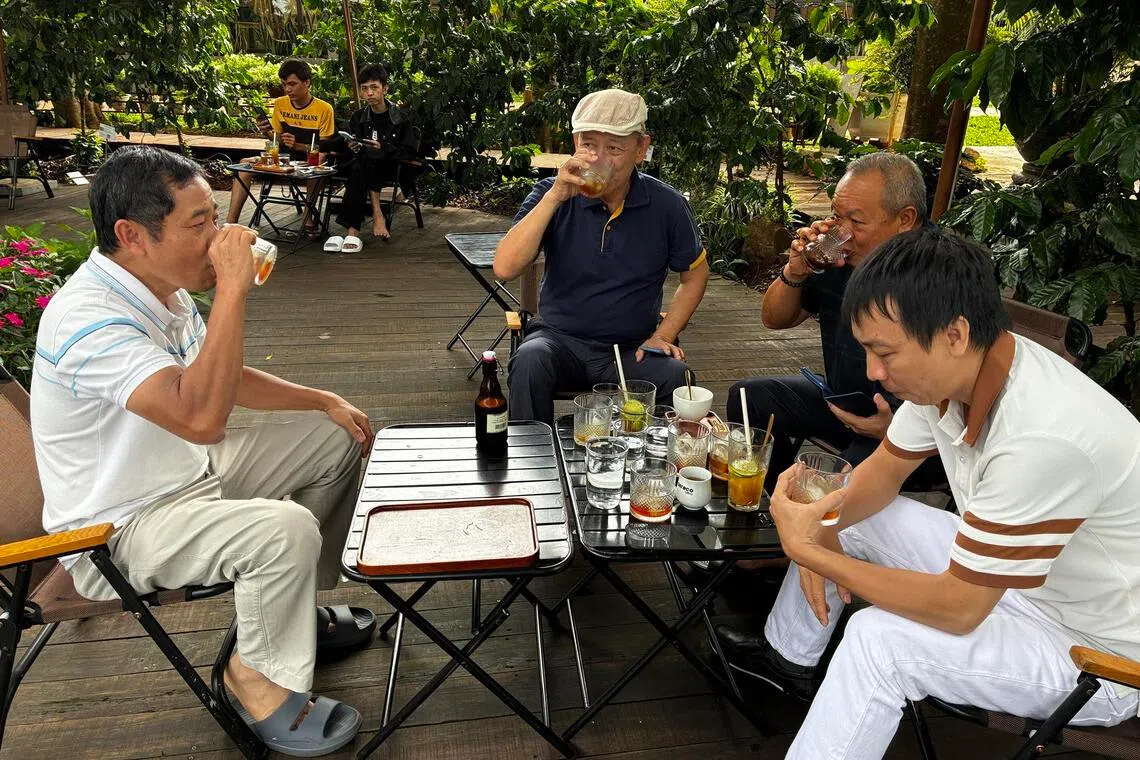
– “Have a sip and tell me what you can taste,” says Aeroco Specialty Coffee Farm owner Le Dinh Tu, as a server passes around tumblers of iced black coffee.The freshly brewed coffee has a subtle aroma of pineapple with a hint of durian, the prized tropical fruit just coming into season in Dak Lak, a mountainous province in Vietnam’s Central Highlands about 350km by road north of Ho Chi Minh City.The flavour is multifaceted, beginning with bitterness, followed by a slight acidity before finishing on a sweet, surprisingly umami note – a highly prized aftertaste in Asian cuisine.A sip transports you to Buon Ma Thuot, Vietnam’s coffee capital in Dak Lak – a land of red basalt, lush coffee plantations, fruit-laden orchards and glistening freshwater lakes.The city and its surrounding province produce about a third of Vietnam’s coffee, making the Central Highlands the country’s coffee heartland.“Unexpected?” Tu asks with a grin. “That’s what I aim for – a coffee that defies all perceptions of Vietnam’s robusta.”Vietnam’s dominant coffee variety has long suffered from a reputation problem.Robusta is often dismissed as bitter, harsh and fit mainly for instant coffee, with its quality widely seen as inconsistent. That perception is reflected in global prices: Robusta typically fetches US$3,700 (S$4,800) to US$3,900 a tonne, up to nearly 50 per cent less than arabica, which commands US$6,200 to US$7,100.Vietnam’s coffee industry is trying to rewrite that reputation. From small speciality farms to major coffee brands, growers and exporters are betting that better cultivation, processing and branding can transform robusta from a low-value commodity into a premium product – allowing the world’s second-largest coffee exporter to capture more value instead of simply selling more beans.Aeroco Specialty Coffee Farm covers 9ha of land near Ea Kao Lake in Buon Ma Thuot, Dak Lak province in the Central Highlands. PHOTO: AEROCOA bioengineer by training, Tu set up Aeroco eight years ago with a single purpose: to produce the best coffee possible, “so good that I can dictate the price”.To achieve this, he invested 50 billion Vietnamese dong (S$2.45 million) to transform 9ha of land near Ea Kao Lake into an organic farm where coffee grows among pepper vines and bountiful trees, improving both bean quality and biodiversity.Coffee, introduced by French missionaries in the mid-19th century, has become one of Vietnam’s defining crops. Robusta accounts for 95 per cent of the country’s 730,000ha of coffee plantations. Yet despite higher export volumes in 2026, revenues have fallen as global prices weakened while costs and sustainability requirements continued to rise.Nguyen Ngoc Xuan Quynh, co-author of a study on Vietnam’s coffee industry with Ho Chi Minh City University of Technology, says part of the revenue decline reflects weaker global coffee prices. Producers are also grappling with stricter sustainability requirements under the European Union’s Deforestation Regulation, rising input costs, and growing demands for traceability, she says.“In the long term, Vietnam’s coffee producers should not just try to increase export volumes, but also shift from selling raw materials to a value-added model,” she adds.Pride of the HighlandsThat shift is already under way.“Vietnam is the world’s largest producer of robusta coffee. However, the commercial value we capture has not matched our output,” says Le Hoang Diep Thao, founder and CEO of King Coffee, one of Vietnam’s leading coffee brands.Le Hoang Diep Thao is the founder and CEO of King Coffee, one of Vietnam’s leading coffee brands. PHOTO: KING COFFEE“The bottleneck is not the quality of our coffee beans but brand perception, as the world has long viewed Vietnam merely as a raw material supplier,” she notes. “It is time to change the narrative around robusta, and Vietnam is perfectly positioned to lead this shift.”In Thao’s opinion, with climate change disrupting global coffee supplies, robusta should no longer be just a blending bean.“It is a climate-resilient crop with immense potential in the premium and speciality segments,” she adds.Another company betting on premium robusta is Bazan Heritage Coffee, which is investing 300 billion dong in a large-scale facility in Dak Lak that includes an Italian-made coffee-processing line worth €3.5 million (S$5.2 million).“We want to build a closed value chain, from raw material sourcing and deep processing to brand development and the expansion of export markets,” says company chairman Dao Duc Dien. “All to the highest international standards to honour Vietnam’s fine robusta.”Bazan Heritage Coffee chairman Dao Duc Dien (left) inspecting a coffee-processing line, on July 1. ST PHOTO: NGA PHAMBorn and bred in Buon Ma Thuot, Dien, 44, has been involved in coffee farming from a young age.“Our robusta coffee is very different from that of other countries, thanks to the altitude of our farms, which are located 500m to 800m above sea level,” he explains. “The fertile, red basalt soil is another God-given advantage that gives the coffee its rich aroma and high caffeine content.”The Vietnamese Coffee and Cocoa Association is developing a long-awaited standards system for robusta, covering authenticity, traceability and sustainable sourcing. Industry leaders hope this will help move Vietnamese coffee beyond raw exports towards internationally recognised premium products.Yet King Coffee’s CEO points out that transitioning from raw exports to premium products and services is a long process.“This requires a unified strategy among farmers, enterprises, researchers, and policymakers to elevate Vietnamese coffee in the global value chain,” she stresses.Currently, King Coffee products are sold in more than 60 countries including Singapore, and Thao is promoting a Global Coffee Alliance to deepen collaboration across the industry. She also hopes to launch an AI Coffee Academy, using artificial intelligence to help farmers predict yields, optimise resources and improve traceability.Thao sees Singapore as a strategic hub for expanding both initiatives across the region and beyond.Vietnamese soulDespite those international ambitions, Thao insists the company’s broader goal is to export not just coffee but the “heritage, culture and intellectual value of Vietnamese coffee”.Exporting Vietnamese coffee, she believes, also means sharing its culture with the world.Coffee has long been woven into Vietnam’s urban culture. Today, the country has around half a million coffee shops, according to market research firm Mibrand.Employees selecting beans by hand at Aeroco Specialty Coffee Farm near Ea Kao Lake in Buon Ma Thuot, Dak Lak province, on June 29. ST PHOTO: NGA PHAMThe coffee scene has evolved significantly, according to Vietnamese-American David Thai, founder and CEO of Highlands Coffee, one of Vietnam’s largest coffee house chains.“In Vietnam, coffee is not just a drink but part of our culture, and in many ways, it reflects how Vietnam has changed,” he muses.“Vietnam was known for ca phe coc (small, casual coffee shops on sidewalks or street corners) where people gather without ceremony. Today, coffee (shops) have become a ‘second place’ for many people’s lives, where they study, work, meet friends, sit longer, or feel that they belong.”That shift has broadened coffee’s appeal, from a traditionally older, predominantly male clientele to a much younger and more diverse audience.Thai began his coffee business in what he described as “a very innocent way”, experimenting with coffee roasting in his own kitchen in Hanoi in the 1990s. Fast forward more than 30 years, and Highlands Coffee has opened its 1,000th store in June 2026. It has more than 12,000 employees and serves over 100 million cups of coffee a year.While Highlands Coffee hopes eventually to expand further overseas – including to Singapore – Thai says Vietnam remains its home and “most important responsibility”.“From the beginning, that is what we have tried to protect at Highlands Coffee – not only the flavour of Vietnamese coffee, but also its soul.”
Beyond bitter: Vietnam brews a new image for robusta, one sip at a time
Full Article
Original Source
Read the full article at Straitstimes →KhanList aggregates and links to publicly available news content. We do not host full articles from third-party sources. Always verify important information with original sources.