
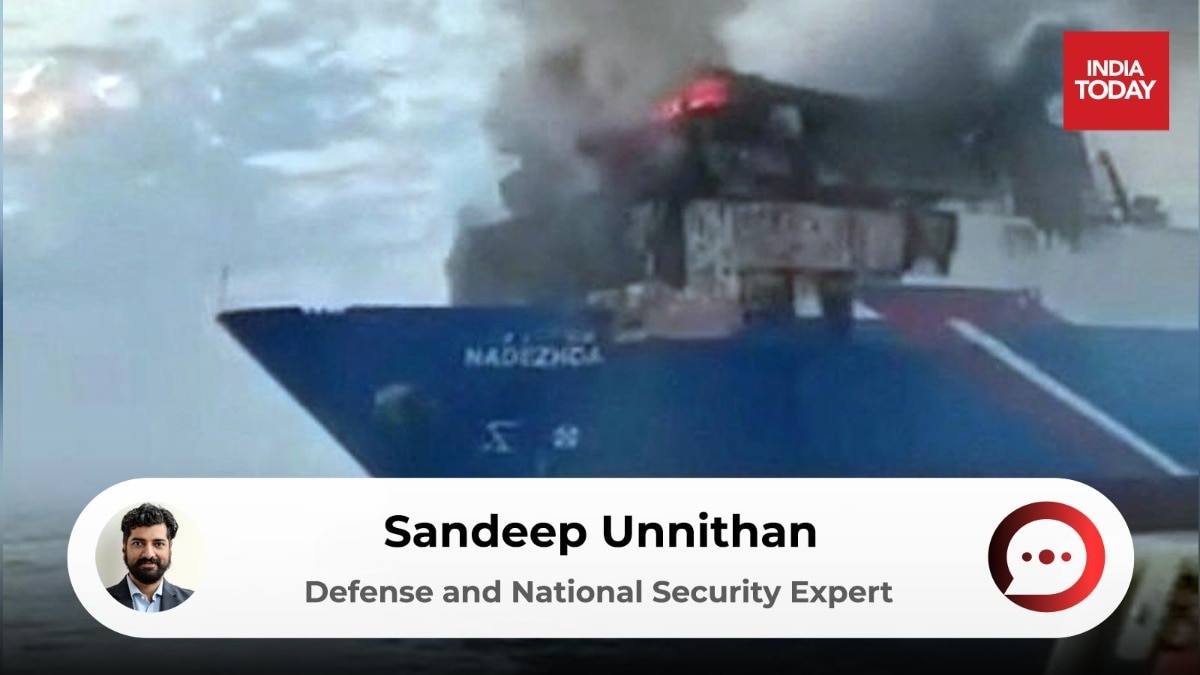
On July 25 Russian drones slammed into the merchant vessel MV AGN Ragnar on the Black Sea. Four Indian crew members jumped into the sea. Two were rescued by the Ukrainian Navy while two crew remain unaccounted for as of now. At least 18 Indian seafarers have died in recent conflicts — 13 in West Asia, five in the Black Sea. Three Indian crew are missing after strikes near the Strait of Oman and Gulf of Oman.These incidents are part of a broader rise in kinetic attacks on global shipping, the worst in the 21st century. Attacks on global shipping are concerning because the government’s maritime vision sees shipping as key to India’s economic growth.The world economy runs on the churn of thousands of aluminum-bronze alloy propellers pushing over 11 billion tons of cargo across the oceans, economically and efficiently. A single large container ship can carry between 15,000-24,000 twenty-foot containers—equivalent to thousands of truckloads or dozens of freight trains—in a single voyage.Indians make up 12.16 per cent of the global maritime workforce with over 300,000 seafarers on over 50,000 merchant ships. The reasons are not far to see.Merchant ships need a huge workforce of trained seafarers aged between 18 and 65. Seafarers from developed countries aren’t taking to sea as they once did. India’s youth bulge has filled the gap, snapping up jobs – ranging from $2,000 a month for a rating, to over $12,000 a month for the captain of a large vessel. India now supplies 140,718 officers — 13.41 per cent of the world’s officer workforce and 171,218 ratings, 11.29 per cent of the global ratings on merchant ships. This jump occurred in the last decade. Indian seafarers are now second only to the Philippines and ahead of China, Russia and Indonesia.The downside of this boom is that current global conflicts like Russia-Ukraine, Iran-US tensions are spilling into the sea, with antagonists striking at maritime jugulars through ‘commerce destruction’ and ‘chokepoint warfare’ -- attacking merchant ships using drones, cruise and ballistic missiles.This means any conflict zone disruption statistically hits Indians harder than most nationalities. The MEA believes 166 Indians are among nearly 6,000 seafarers trapped on board more than 400 ships in the Straits of Hormuz.A majority of India’s seafarers work on foreign vessels registered in Liberia, Panama, the Marshall Islands and Malta. Indian flagged vessels account for a miniscule 0.77 per cent of global shipping.On July 28, Union Minister of Ports Shipping and Waterways Sarbananda Sonowal announced India’s ‘Mission 20 %’ that aims to make one in every five global seafarers, an Indian. This means the number of Indian seafarers will double over the next few years. It also means they are at increased risk to global conflicts.The advent of cheap weaponry like low-cost drones, unmanned surface vessels and anti-ship ballistic missiles make it easier for countries to target slow-moving merchant vessels. The system to track and warn India’s seafarers has not kept pace with such military technological breakthroughs.The Mumbai-based Directorate General of Shipping is India’s apex maritime regulator. The DG Shipping enforces safety of life at sea on Indian-flagged and foreign ships, but only in Indian waters. Indian seafarers operating in foreign waters have to look to the MEA and overseas Indian missions for their well-being.The MEA has thus far issued strong protests with the US, Iran, Ukraine and Russia over the ship attacks, warned Indian seafarers to reconsider employment on commercial vessels operating in or passing through conflict-affected regions and assess the prevailing security situation before accepting such assignments to conflict zones. There is little else they can do.This is because Indian seafarers embark foreign ships by contacting global shipping companies directly, or through their India-based agents, the nearly 576 Recruitment Placement Services (RPS) agencies located in India.Seafarers have the right to refuse to enter conflict zones or piracy-infested waters. When they refuse, it is the duty of the shipping companies to disembark them at the nearest port. “These provisions are rarely opted for because, quite literally, no one wants to rock the boat—seafarers fear they might lose future employment opportunities with these companies,” says Captain Naveen Singhal, a Singapore-based marine consultant and author.What the DG Shipping could do, Captain Singhal says, is crack the whip on RPS agencies to ensure that Indian seafarers are not placed on ships sailing through war zones.The DG Shipping issues the two most important documents carried by every Indian seafarer — a Continuous Discharge Certificate (CDC), an international mandatory document required for seafarers to sail onboard merchant navy ships, and an ‘E clearance document’ without which an Indian seafarer cannot leave the country.When a seafarer exits the country, the RPS has to update joining data on the DG’s website to get an e-migrate document. When the seafarer returns to India the RPS has to update the website about the crewmember having signed off.There is, however, no proactive system that allows the DG Shipping Directorate to know, in real time, how many Indian seafarers are transiting a high-risk zone, which vessels they are on, and how to reach them and their employers immediately when a threat emerges.This is where technology could come to India’s aid.In the superhero film X-Men, Professor Charles Xavier dons ‘Cerebro’, a wearable supercomputer which can track superheroes across the world in real-time. In 2026, computers and AI have transformed the science-fiction of 2003 into science fact. An AI-enabled real time global tracking system for Indian seafarers will build a real-time situational awareness system that tracks the approximate location of Indian seafarers globally by aggregating vessel position data with crew manifest data.This system could combine data from Automatic Identification Systems (AIS), the Indian National Database of Seafarers, RPS records, IMO vessel registries, and conflict zone intelligence.An LLM could rapidly summarise open-source intelligence and cross-reference against live vessel and crew databases to identify potentially affected Indian nationals in minutes rather than hours. Such a system will enable India to take faster diplomatic and consular action when an incident occurs. It will cover all Indian nationals holding a valid CDC regardless of the flag state of the vessel they serve on.Users of such a system could be the DG Shipping and the DGMA control room in Mumbai, the MEA’s crisis management division in New Delhi, the Indian Navy and the Indian Coast Guard for coordination on escort or rescue operations. India needs every innovative solution it can get to safeguard its nationals on the high seas.- EndsPublished By: Aprameya RaoPublished On: Aug 5, 2026 09:00 IST
Beyond advisories: What India owes its seafarers in an age of maritime conflict
Full Article
Original Source
Read the full article at Indiatoday →KhanList aggregates and links to publicly available news content. We do not host full articles from third-party sources. Always verify important information with original sources.